Introduction
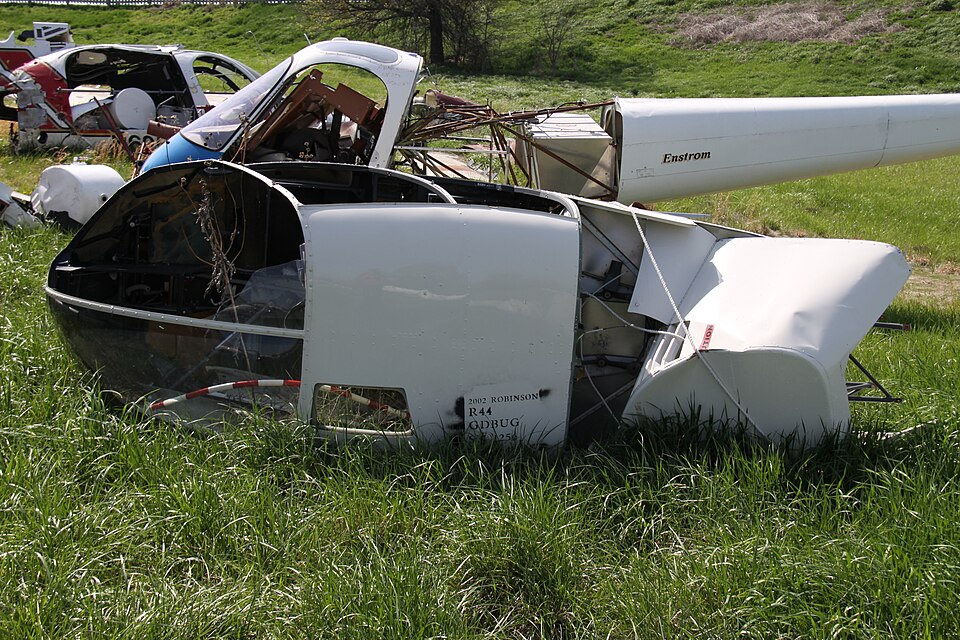
On 9 July 2009 at 1045 UTC, a Robinson R44 Clipper, registration G-DBUG, was involved in an accident at Welshpool Airport, Powys. The aircraft, manufactured in 2002 and powered by a single Lycoming O-540-F1B5 piston engine, sustained damage beyond economic repair. The private flight had one pilot and one passenger on board; neither was injured.
History of the Flight
The pilot, aged 61 and holding a Private Pilot’s Licence (Helicopter), had recently completed a conversion from the two-seat Robinson R22 to the larger R44. His total flying experience was 135 hours, with only 6 hours on type.
After completing ground and start-up checks—which included momentarily switching the hydraulics off to confirm that the cyclic control became heavy—the pilot lifted the helicopter into a hover. He intended to reposition the aircraft from the north apron to the fuel bay. Turning left to hover-taxi past an air ambulance, the pilot noticed the cyclic control becoming heavy. Almost immediately, the helicopter became laterally unstable and began drifting toward the air ambulance. The pilot raised the collective and applied forward cyclic to avoid a collision, then decided to perform a run-on landing. He lowered the collective but could not raise the nose sufficiently. The helicopter struck the ground in a nose-down attitude and rolled onto its right side. Both occupants exited through the passenger door uninjured.
Aircraft Inspection
The first person to arrive at the scene, an instructor, observed that the hydraulic switch was in the off position. An engineer subsequently inspected and tested the helicopter’s hydraulic system, including a visual inspection, an operational check using a slave hydraulic pump, and an operational check of the hydraulic pump. The engineer concluded that the hydraulic system had functioned normally. No defects were identified.
Discussion
The Robinson R44 features a Press-To-Talk (PTT) switch on the cyclic control’s pistol grip, activated by the index finger. The hydraulic switch is located on the front of the cyclic stick. In contrast, the R22 does not have a hydraulic system, and its PTT switch is in a position similar to the R44’s hydraulic switch.
Post-accident inspection revealed no defects in the hydraulic system. The hydraulic switch being found in the off position, combined with the pilot’s account of the handling difficulties, is consistent with the pilot having inadvertently switched off the hydraulics during the flight. The similar positions of the R44’s hydraulic switch and the R22’s PTT switch may have been a factor, although the pilot did not recall any intention to use the radio at the time the controls became heavy.