Accident Overview
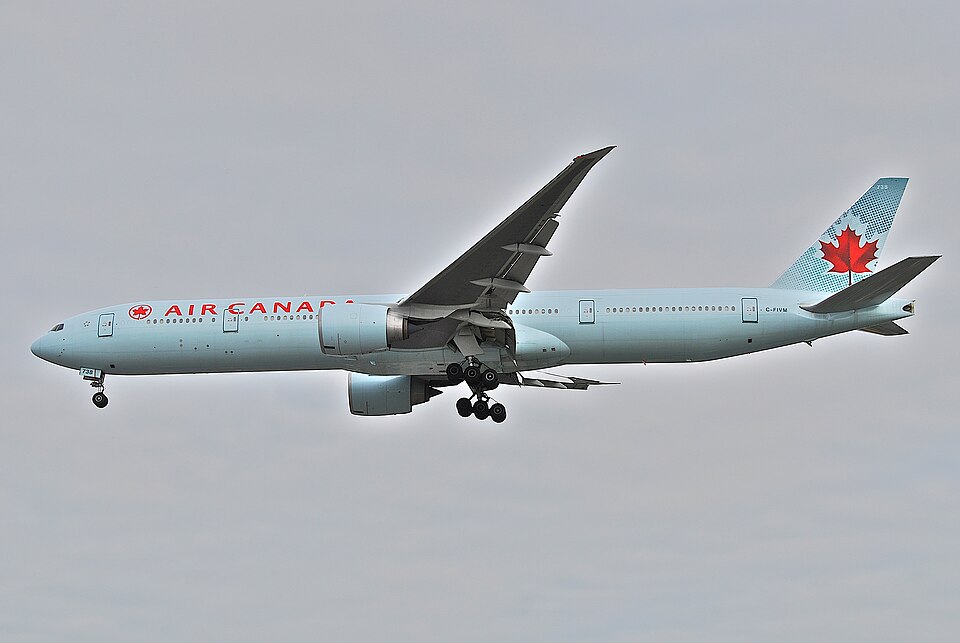
On April 10, 2011, at 09:44 UTC, a Boeing 777-333ER registered as C-FIVM, operated by Air Canada on flight ACA881 from Paris Charles de Gaulle to Toronto, was involved in an accident during pushback from stand A4. The aircraft collided with the pushback tug after the towbar failed, causing damage to the nose landing gear, the tug, and the towbar.
Sequence of Events
The flight crew requested pushback at 09:39. The apron controller initially instructed the aircraft to hold its position due to two other pushbacks in progress. After one aircraft departed, the controller cleared OMA134 for a long pushback from stand A8 to face west, then authorized ACA881 for a short pushback contingent on OMA134's position. The crew relayed this to the ground crew via intercom. Engine 2 was started per procedure.
After pushback, the Boeing 777 was not fully aligned on taxiway Papa. At 09:44:20, the tug driver began pulling the aircraft backward to realign it, first turning to the right, then to the left. The aircraft's speed increased over about 15 seconds to 4 knots. During this maneuver, the aircraft closed on the tug. The driver applied brakes. The angle between the towbar and the aircraft axis increased; the nose gear began turning left, then the shear pins on the towbar head failed. The aircraft continued forward, the towbar pivoted, lodged under the left nose tire, and contacted the tug. The towbar fractured, separating the aircraft from the tug. The aircraft continued forward onto the tug. At 09:44:45, the part of the towbar still attached to the nose gear contacted the tug, causing additional rotation of the nose gear. The right tire split on the left side of the tug. The aircraft stopped against the tug. The crew set the parking brake as requested by intercom.
Aircraft and Ground Personnel
The Boeing 777-333ER was equipped with two General Electric GE90-115B engines, each producing about 2 tonnes of thrust at ground idle. The aircraft's mass at departure was approximately 295 tonnes.
The ground crew included a 44-year-old Air France marshal (licensed mechanic) who communicated with the flight crew, a 35-year-old driver from AGS (authorized for pushback with towbar on September 13, 2010), and a 47-year-old Air Canada ramp coordinator with valid safety certificates.
Damage and Wreckage Examination
The nose gear was rotated 90° left of the aircraft axis; the right tire was vertically split. The left steering actuator rod was fractured in bending. Both steering actuators, both wheels, and the servo valve cover were replaced. The towbar (USIMAT SERMEES / B777) was fractured in bending.
Ground scars showed two friction marks from the tug's front tires near marking A2 along taxiway P, indicating the tug skidded. Friction marks from the aircraft's nose gear tires also indicated skidding.
Operational Context
Air Canada's documentation states that an aircraft must never be pulled forward with an engine running due to risk of overriding the tug and towbar shear. It also specifies that engine start (engine 2) is initiated by the captain after the marshal announces start availability.
Air Canada had agreements with Air France (since 1998) and Groupe Europe Handling (GEH) for ground handling; AGS, a GEH subsidiary, provided drivers, tugs, and towbars. Airport operator ADP did not specify procedures for engine start during pushback.
Air France's procedures define pushback, responsibilities, speed limits (10 km/h), and actions in case of towbar shear pin failure.
Training documentation from IFMA (training center for GEH/AGS) describes standard pushback and "push-pull" maneuvers, which involve pushing back partly, then pulling forward to align.
Testimony
The tug driver reported that he was asked to perform a short pushback but could not align the B777 on taxiway P. It was his first time pushing back a B777 from stand A4. He obtained permission from the marshal to pull backward, raised his cab for visibility, and noticed the aircraft accelerating relative to the tug. He focused on the trajectory and did not look at the marshal; he braked and lowered his cab when he saw the aircraft approaching. He performs only 2-3 pull maneuvers per year.
The marshal did not recall explicitly instructing a pull maneuver before pushback but considered it likely due to conditions. He authorized engine start after coordinating with the driver but stated the pull maneuver was not coordinated with the flight crew. When the aircraft accelerated, he signaled the driver to brake.
The cockpit voice recorder (CVR) did not contain the event data because it continued recording after the accident and overwrote the relevant segment. The flight data recorder (FDR) showed only engine 2 was started, N1 never exceeded 21%, and the thrust lever remained at ground idle.
Probable Cause
The report does not state a probable cause.