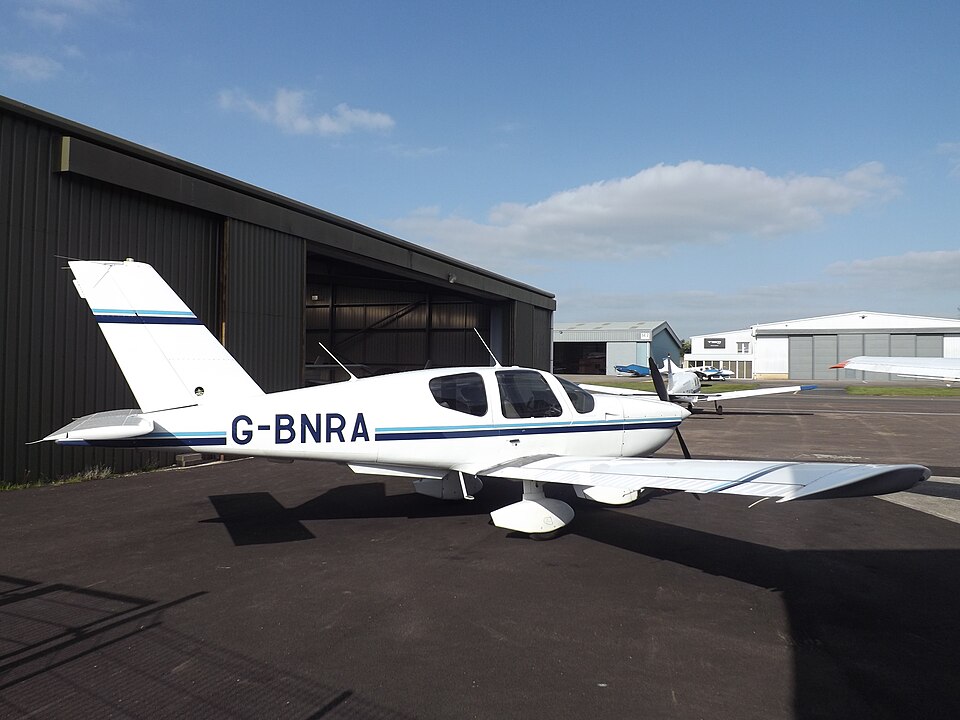
History of the Flight
During a touch and go landing at Nottingham Airport, the pilot applied full power smoothly for takeoff. A loud bang was heard, the propeller detached, and the engine shook from its mountings. The pilot maintained the aircraft level despite asymmetric effects and brought it to a halt.
Engineering Investigation
Photographs confirmed the engine had partly separated from the aircraft structure and was re-oriented at angles between 30 and 40 degrees from its normal position. The two-bladed constant-speed propeller was missing; it was found with one blade absent alongside the runway near where the aircraft stopped. The missing blade was on the opposite side of the runway. Two depressions in the paved surface indicated where propeller debris impacted.
The propeller is of the variable pitch type with blades located by thrust bearings within a two-piece hub. The hub consists of an aft casing bolted to the drive flange and a forward casing. The crankshaft fractured near its forward end, and part of the crankcase casting also fractured. The separated blade was released due to fracture of the hub portion carrying a pitch change bearing.
Examination of the crankshaft fracture face showed it was consistent with bending load and exhibited no fatigue or corrosion. The crankcase fracture appeared from overload. The hub was dismantled: the pitch change bearing of the attached blade was fully greased, while the bearing components from the separated blade lacked lubrication. Metallurgical examination of the hub fracture faces indicated the aft casing failed in simple overload, but the forward section showed a more complex failure including fatigue.
Service Bulletin Information
The propeller manufacturer's Service Bulletin HC-SB-61-269 addresses hub fillet cracks and incidents of in-flight blade separation in Hartzell two-blade "compact" series aluminum hub propellers, which includes the type fitted to G-BNRA. The bulletin requires visual and eddy current inspection of fillet radii within 50 flying hours of receipt and repeated at 100-hour intervals. It was issued in April 2005; the aircraft had operated about 105 hours between then and the accident. The bulletin had not been implemented on this propeller. The aircraft was maintained by an M3 maintenance organization, which confirmed the bulletin was not applied. M3 organizations normally only perform general examination and applicable Airworthiness Directives; eddy current inspection equipment and expertise are not required for such organizations. The bulletin states that regulatory action is expected, but no mandatory action had been taken at the time of the accident.
Safety Recommendations
Three safety recommendations were made: the CAA should alert UK M3 organizations and relevant maintainers to the existence and importance of Hartzell Service Bulletin HC-SB-61-269; the FAA should issue an Airworthiness Directive making its inspection requirements mandatory; and EASA should also issue an Airworthiness Directive to mandate those inspections.