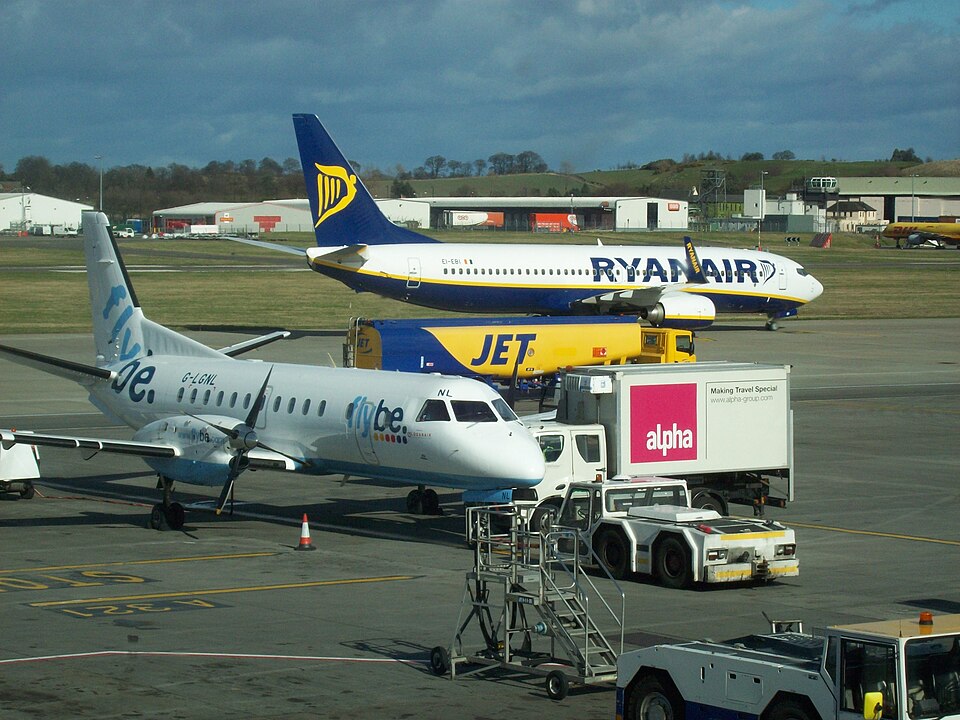
Incident Overview
On the day of the event, a commercial air transport aircraft registered as G-LGNL was prepared for a flight from Stornoway Airport to Glasgow Airport. The aircraft carried 26 passengers and three crew members. The commander served as Pilot Flying (PF) and the co-pilot as Pilot Monitoring (PM).
Sequence of Events
At 0825 hours, the aircraft taxied toward Holding Point A1 for departure from Runway 18. At 0832 hours, air traffic control cleared the aircraft to enter the runway and take off, reporting surface wind from 270° at 27 knots. The commander noted to the co-pilot that the wind was across the runway with no tailwind component.
As the aircraft entered the runway, the co-pilot applied nearly full right aileron input, consistent with a crosswind from the right. The commander said, "charlie1, one hundred, strong wind from the right." The commander advanced the power levers, and the co-pilot announced "autocoarsen high," with engine torques increasing symmetrically. The commander instructed the co-pilot to "set takeoff power," to which the co-pilot replied "apr armed." Approximately one second later, engine torques began increasing symmetrically, reaching 100% as the aircraft accelerated through 70 knots.
During the early takeoff roll, left rudder was applied, and the aircraft maintained an approximately constant heading. As acceleration continued, the rudder was centralised. Subsequently, the aircraft experienced a small heading change to the left, then to the right, followed by a rapid heading change to the left, causing the aircraft to deviate to the left of the runway centreline. The pilot applied right rudder; although the aircraft's heading changed to the right in response, its track did not alter significantly. The aircraft skidded to the left and departed the runway surface onto grass at an indicated airspeed of 80 knots.
The power levers remained at full power as the aircraft crossed a disused runway and continued onto grass. During this phase, the nose landing gear collapsed before the aircraft came to a halt approximately 38 metres left of the runway edge and 250 metres from the point where it first left the paved surface.
Aftermath
After the aircraft stopped, the captain observed that the propellers were still turning and called into the cabin for passengers to remain seated. One passenger shouted for someone to open an emergency exit, but a cabin crew member instructed passengers not to do so because the propellers were still turning. The co-pilot noted that the right propeller was still turning and operated the engine fire extinguishers to shut down both engines.
When the passenger seated in the right-side emergency exit row saw that the right propeller had stopped, he opened the exit. He climbed out onto the wing and assisted other passengers in leaving the aircraft through the same exit, instructing them to slide off the rear of the wing onto the ground. The left propeller was still turning when the right over-wing exit was opened; the passenger in the left-side emergency exit row decided not to open that exit.
Air traffic control activated the crash alarm at 0833 hours. An aircraft accident was declared, and the aerodrome emergency plan was implemented. When the Rescue and Fire Fighting Services (RFFS) arrived, passengers were still exiting the aircraft, and the left propeller continued turning. After leaving the aircraft, the cabin crew member confirmed to RFFS that all passengers had exited and were accounted for outside. Passengers were taken to the fire station and then to the passenger terminal. There were no injuries.
Investigation Findings
The official probable cause statement noted: During the attempted takeoff, the rudder was central from 40 kt and remained so until approximately 65 kt. Between approximately 52 and 65 kt, the aircraft turned right slightly before it turned left sharply at approximately 65 kt. Given that the rudder was central, this change of direction might have been caused by one, or a combination of the following factors: a. Differential braking b. Asymmetric thrust c. A change in wind speed and direction d. A nose wheel steering input. Data from the FDR showed that thrust was applied symmetrically throughout the takeoff run, and the manufacturer did not consider that the data for longitudinal acceleration and indicated airspeed supported the use of differential braking.