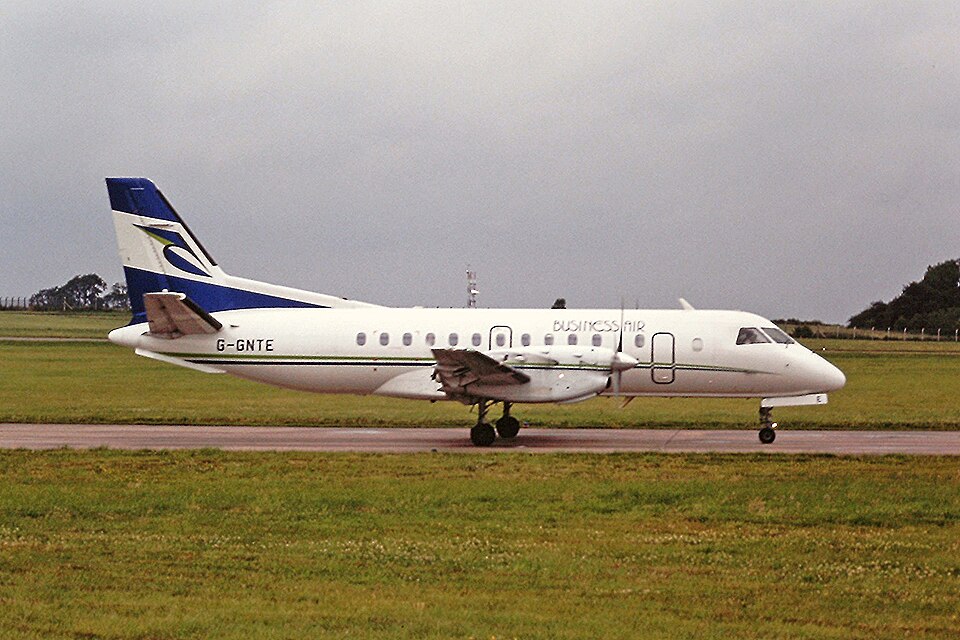
History of the Flight
Approximately two minutes after takeoff from Aberdeen Airport, the crew of a Saab-Scania SF340A, registration G-GNTE, felt a 'thump' from the right side. They considered it a bird strike. The No 2 engine turbine over temperature light illuminated, but engine instruments showed no abnormal indications. The first officer visually checked the No 2 engine for damage but saw none. The commander reduced power on that engine to 20%; 10 to 20 seconds later, the engine lost power and failed. A Mayday was declared, and the aircraft returned visually to Aberdeen Airport, landing without further incident. There was no fire, and no injuries to crew or passengers.
Initial Examination
Examination of the No 2 engine revealed an uncontained failure in the Gas Generator Turbine (GGT), resulting in a hole approximately 25 mm by 12 mm in the engine casing at the 9 o'clock position (viewed from rear). Uncontained parts passed through the steel engine IPS duct and an aircraft de-icing pipe within the nacelle. One fragment passed through the nacelle cowling and damaged the de-icing boot on the leading edge of the right tailplane. None of the ejected uncontained material was found.
Strip Inspection
The engine was sent to an overhaul organization for strip examination under AAIB supervision, with representatives from the manufacturer, operator, and Civil Aviation Authority. The examination found a radial fracture in the Aft Cooling Plate (ACP) of the second stage turbine (S2). This fracture extended through one of three air cooling holes, and approximately 15 cm of the ACP rim was missing. The S2 ACP had achieved 11,454 cycles since new; its retirement life was 12,000 cycles. Manufacturing and service records showed nothing unusual.
Severe heat and foreign object damage (FOD) were present on the first and second stage turbine blades, nozzles, and other GGT cooling plates. The stage three and four Power Turbine blades and guide vanes also showed severe heat and FOD damage. The GGT stage 1 nozzle assembly was loose, with retaining bolts at about half specified torque; one bolt head had broken off. The B-sump inner heat shield had multiple fractures, with some pieces missing.
Metallurgical Examination
A joint examination with the manufacturer's metallurgical specialists in the USA revealed that the radial fracture through the S2 ACP was caused by a fatigue mechanism propagating radially inboard and outboard from one of the three air holes. At least two adjacent fatigue origins inside that air hole were initiation sites for the radial inboard fracture, and two fatigue origins near the aft and forward corners of the hole initiated the radial outboard fracture. Parallel axial grooves, up to 0.5 mm deep, were found around the bores of all air holes over their full length. Many small crack-like indications were observed at the base of these grooves. A remnant 'recast layer' appeared present near the two adjacent inboard fatigue origins. The material microstructure and hardness were satisfactory.
Investigation of Defective Air Holes
The S2 ACP was machined at the manufacturer's main facility; air holes were produced by electrical discharge machining (EDM) followed by an abrasive flow process. The manufacturer investigated the EDM and abrasive flow processes to determine how axial grooves formed. They could not positively identify the mechanism but concluded that fatigue cracking initiated from an anomaly in the EDM process that remained after abrasive flow, reducing material fatigue capability. The AAIB concurred.
Assessment of Effects
The manufacturer conducted life and fracture mechanics analyses of the S2 ACP. Baseline analysis indicated that boltholes used to attach the ACP to the turbine disc, not the air holes, were the life-limiting feature by a substantial margin. Efforts to model the grooved air hole conditions to evaluate effects on disc life were unsuccessful. Fracture mechanics analysis correlated with actual ACP life, indicating that the crack initiated during manufacturing and propagated during service.
Safety Action
Following the incident, the engine manufacturer introduced 100% inspection of air holes during production of all new ACPs, along with continuous monitoring of the EDM process. They conducted a quality review for potential improvements to the machining process. Alternative air hole designs and production methods not requiring EDM were being evaluated, with a target introduction date of June 2000. S2 ACPs produced since January 1993 (with EDM-machined air holes) were required to be replaced at 4,000 cycles instead of the previous 12,000-cycle retirement life.