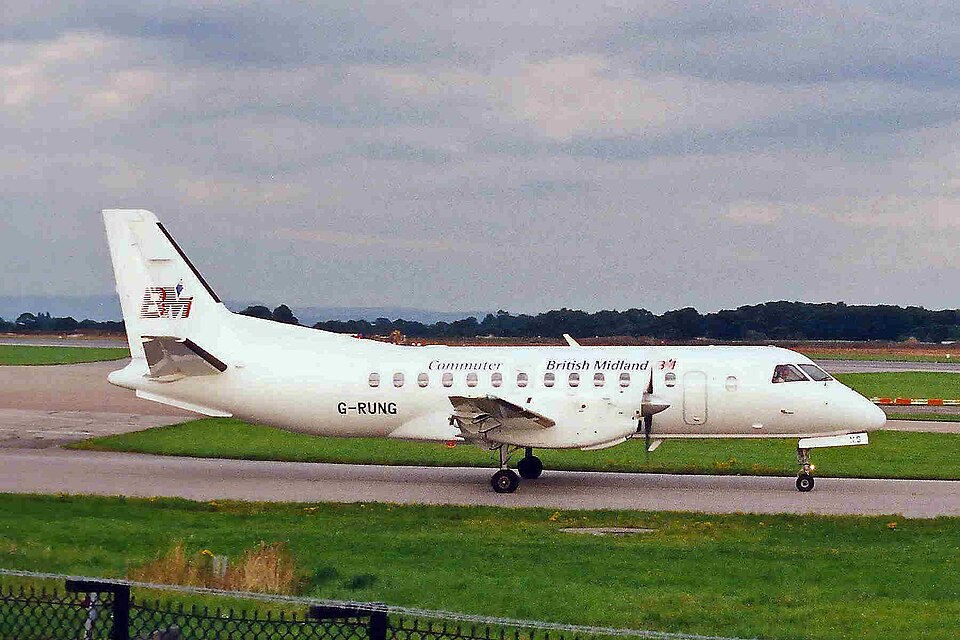
Incident Overview
On 28 December 2004 at 1618 UTC, a Saab-Scania SF340A aircraft, registration G-RUNG, operating a public transport passenger flight from Jersey, landed on Runway 27 at Guernsey Airport, Channel Islands. The aircraft was manufactured in 1987 and was powered by two General Electric CT7-5A2 turboprop engines. On board were three crew members and seven passengers.
Incident Description
After landing, the commander attempted to turn off the runway onto taxiway 'Charlie', a 90-degree left turn. During the turn, the commander found that he did not have sufficient steering authority to complete the manoeuvre. The right main landing gear departed the paved surface and moved onto the grass alongside the taxiway, where it sank into the ground as the aircraft came to a halt. The aircraft sustained no damage, and passengers disembarked onto the taxiway.
Weather and Runway Conditions
At the time of the incident, the weather was clear with a surface wind from 320° at 15 kt. The runway surface was wet. The landing distance available on Runway 27 was 1,453 metres (4,767 feet), with the entrance to taxiway 'Charlie' located 1,070 metres (3,510 feet) from the threshold on the left-hand side.
Post-Inspection
Following the incident, the contracted maintenance organisation inspected the aircraft. No fault was found with any of the aircraft systems.
Commander's Observations
The commander attributed the loss of steering authority to his continuous use of brakes during the landing roll. He believed that this had produced a reduced pressure in the hydraulic system, leading to a temporary loss of pressure to the nosewheel steering when he attempted to use it. As the hydraulic pressure recovered, the nosewheel steering became effective again, but by that time it was too late for him to maintain the taxiway.
Nosewheel Steering System
The nosewheel steering is operated by a single hydraulic actuator and is controlled by a wheel mounted on the left seat pilot’s side panel. The wheel is spring-loaded in the up (disengaged) position. To steer, the wheel must be pushed down to engage mechanically with the steering system and to complete the electrical circuit that opens the steering shutoff valve. If the steering wheel is released, it extends into the disengaged position. Additionally, when the nosewheel is deflected more than approximately 15° without the steering wheel being pushed down, it locks in its present position and limits further deflection.