History of the Flight
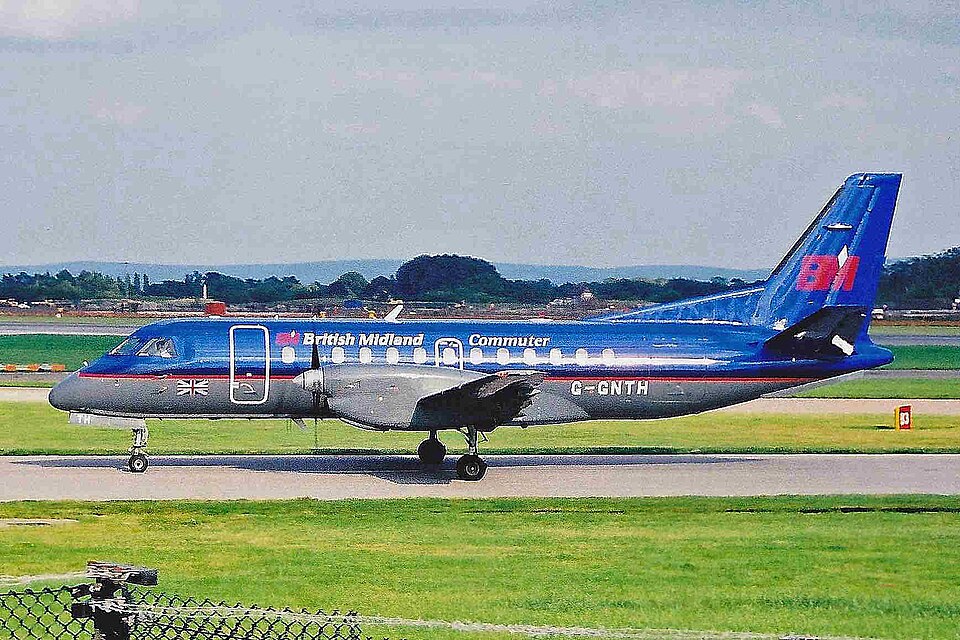
The crew of Saab-Scania SF340B, registration G-GNTH, were operating the first sector of the day to Glasgow. It was a line training flight for the first officer. The commander, in the left seat, was the handling pilot. After obtaining weather information indicating surface winds of 250°/24 kt gusting to 35 kt, with forecast gusts up to 50 kt, the crew performed normal pre-departure checks and engine start. Runway 32 was in use. During taxi, the Automatic Terminal Information Service (ATIS) broadcast wind of 240°/25 kt gusting to 40 kt. The aircraft held at holding point 'Delta 1' while a preceding aircraft departed. The commander then taxied onto the runway and backtracked to the turning area. After lining up, the crew completed control checks and received takeoff clearance with surface wind reported as 250°/29 kt. Flap 15 was set.
The commander initiated the takeoff roll. He used nosewheel steering and rudder to maintain centerline. At 60 kt, the commander released nosewheel steering and took the control wheel. The aircraft immediately began drifting right. The commander applied left rudder but the drift continued. He then used nosewheel steering again with no effect. At low airspeed and unable to rotate, he closed the power levers, centralised rudder, and applied brakes. The aircraft left the runway at intersection 'Delta'. The commander pulled back on the control wheel to protect the landing gear, then used limited thrust reverse until the aircraft stopped after turning nearly 180°. The crew secured the engines and activated fire extinguishers. No major damage or fire was evident, so the commander did not order an evacuation. Passengers deplaned normally.
The air traffic controller observed the aircraft veer off and activated the crash alarm. The Airport Fire Service, already on weather standby, responded quickly.
Company Procedures and Instructions
The company Operations Manual specified a crosswind limit of 35 kt for dry and wet runways. For crosswind takeoffs, it advised applying aileron into the wind and keeping wings level. Prior to engine start, the first officer set yaw trim to 1.5 units right per company procedures.
Wind Information
Wind data was derived from two anemometers at each end of Runway 32/14. The wind passed to the crew (250°/29 kt) was likely a 2-minute mean from the Runway 32 anemometer. Review of the 10-minute period up to 0720 hrs showed a maximum gust of 46 kt and direction extremes between 216° and 272° on Runway 32, while Runway 14 showed a maximum of 36 kt. Examination of recordings indicated a strong gust near the time of takeoff. The UK AIP warned pilots to expect windshear and turbulence when surface wind is between 190° and 240° above 20 kt, though this was published after the incident.
Aircraft Information
G-GNTH (serial 169, built 1989) was equipped with a nosewheel steering system with a free castoring limit of ±20°, except when the tiller is depressed for up to 50° deflection. The aircraft had a spring-tab rudder; maximum rudder deflection at low speeds was about 16.9°, decreasing at higher speeds due to a rudder limiter system. The rudder limiter stops were found damaged, likely from the aircraft being tail-to-wind in strong winds after the event.
Initial Engineering Investigation
Examination of the aircraft on the taxiway revealed no external damage, but the landing gear were mud-contaminated. Tyre marks on the runway showed the aircraft initially deviated left of the centerline near the piano keys, then crossed to the right and continued drifting until departing the runway. The crew reported no audio or visual warnings, and both engines operated normally. The aircraft was within weight and center of gravity limits.
The investigation found no evidence of mechanical failure; the rudder damage occurred after the incident.