History of the Flight
The crew reported for duty at 0620 hrs for a 0720 hrs departure from Glasgow to Benbecula. After completing flight planning and requesting fuel, they arrived at the aircraft about 45 minutes before departure. Seat rows 8 to 11 inclusive on the right side were unavailable for passengers as seat converters for carrying newspapers had been fitted. Passengers, bags, and freight were boarded, and the cabin attendant informed the commander of the actual seating by zone. The commander checked this against the seating plan on the load sheet and found it correct.
Push-back occurred at 0718 hrs, and the aircraft departed at 0727 hrs with the co-pilot as pilot flying. The rotation appeared normal, and shortly after takeoff the autopilot was engaged. The aircraft climbed to FL145. After briefing for a VOR/DME approach to Runway 24, the aircraft descended to 1,500 ft. The weather at Benbecula was surface wind 260°/15 kt, visibility 20 km with scattered cloud at 1,500 ft. The crew saw the airport at about 12 nm on base leg and continued with a visual approach. At about 5 nm, the autopilot was disconnected, and with flaps set to 20°, the aircraft touched down normally on the runway.
The co-pilot attempted to lower the nose, but even with the control column moved forward, the nose remained high, and the rear fuselage contacted the runway. The commander attempted to lower the nose using propeller reverse thrust and wheel brakes, using differential braking to maintain directional control as nosewheel steering was unavailable. At about 40 kt, the nosewheel lowered onto the runway, and the aircraft was brought to a stop. It was then taxied to the parking area and shut down.
Weight and Balance
The aircraft had a maximum permitted takeoff mass of 13,155 kg. The landing mass was 11,947 kg, and the CG index with passengers, baggage, and freight as loaded was calculated as 67.5. Had the aircraft been loaded per the final load plan, the index would have been 47. With the actual loading, the CG position was significantly outside the aft limit for takeoff, landing, and flight.
Loading procedures involved two computer systems: SHARES for passenger check-in and D-PLAN for mass and CG calculations. The operator reduced the number of cabin zones from six to two to simplify crew checks. On the incident flight, the flight closure message containing seating changes was not received by the dispatcher, leading to incorrect loading.
Damage
The attachment bracket on the underside of the rear fuselage (used to secure a 'pogo stick' when parked) was worn away. The 'pogo stick' was not attached; it hangs down to prevent tipping onto the tail during loading. Damage included abrasion of the aluminium skin and mounting bracket.
Occupants and Injuries
There were three crew and ten passengers on board. None reported injuries.
Aircraft Information
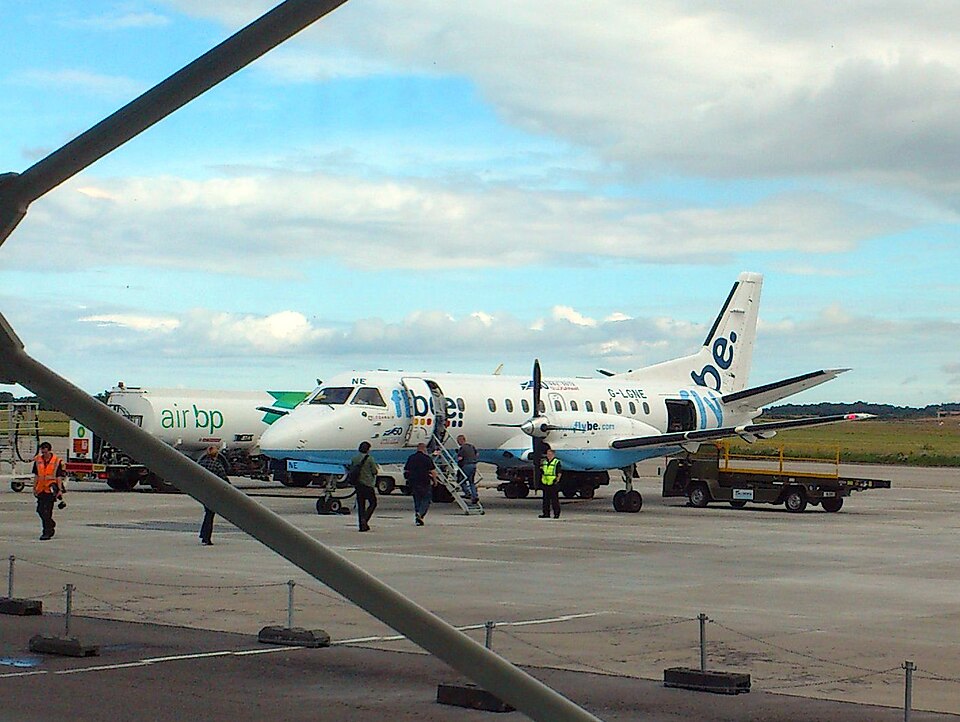
The aircraft was a Saab-Scania SF340B, registration G-LGNE, powered by two General Electric CT7-9B turboprop engines. Year of manufacture was 1989. The commander held an Airline Transport Pilot's Licence, was 37 years old, and had 5,924 total flying hours (1,155 on type).