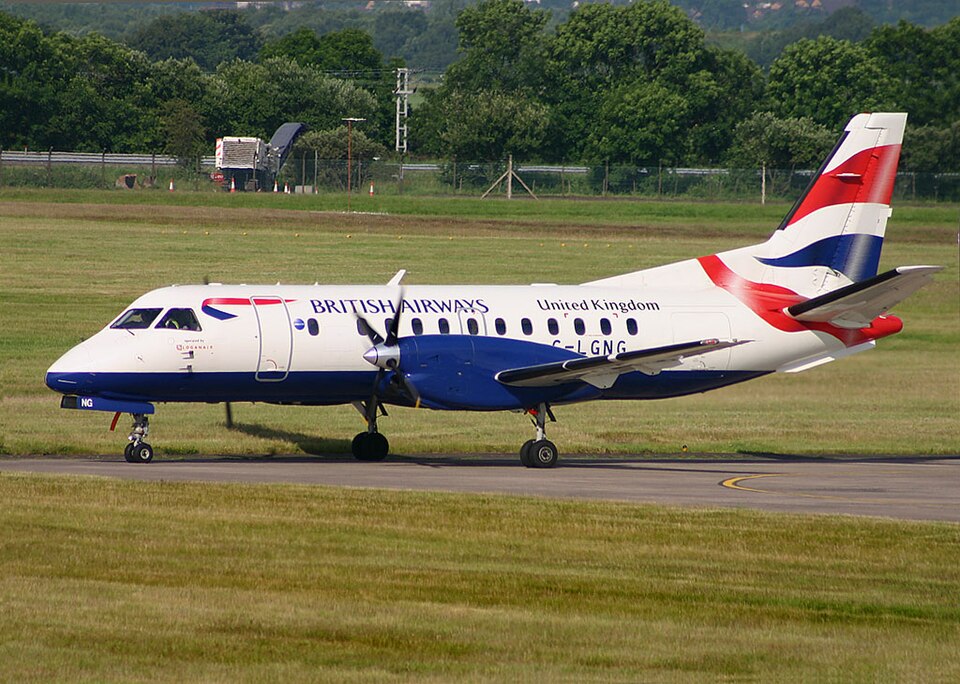
Incident Summary
On 12 September 2003, a Saab-Scania SF340B, registration G-LGNG, operated a public transport passenger flight from Aberdeen to Kirkwall, Orkney. Upon landing at Kirkwall, the aircraft's nose attitude briefly decreased after touchdown then began to rise, causing the ventral strakes on the aft fuselage to contact the runway. No injuries to the three crew or 36 passengers were reported. The aircraft sustained scrapes to the aft fuselage ventral strakes.
Flight History
The flight crew consisted of two pilots. The first officer was the handling pilot. During the initial climb, the first officer felt the aircraft was out of trim and re-trimmed before raising the flaps; the aircraft functioned normally for the remainder of the climb, cruise, and initial descent. Approaching Kirkwall, the first officer disengaged the autopilot and positioned the aircraft on a downwind leg for Runway 27. At 1,800 feet above ground level (agl), landing gear was selected down, and flaps were set to 15° at 1,500 ft agl, then to 20°. After selecting flaps 35°, the first officer reported running out of nose-down trim. The crew discussed the controllability and decided to continue the approach.
The aircraft crossed the threshold at 113 kt (Vref). During the flare, the first officer remarked that the feel was not normal. Touchdown was uneventful, and the power levers were retarded from FLIGHT IDLE toward GROUND IDLE just after touchdown. Shortly after, when both power levers were brought below the FLIGHT IDLE stop, the nose began to rise rapidly. The stall warning activated. Despite both pilots applying full nose-down elevator, the nose continued to rise until the crew lost sight of the horizon. An eyewitness in the control tower considered the landing attitude and touchdown normal but noted the nose wheel remained clear of the ground and began to rise. The crew considered a go-around but decided against it due to the stall warning and controllability concerns. After a few seconds at the maximum attitude, the power levers were advanced to the FLIGHT IDLE stop, and the nose pitched downward. Following de-rotation and reverse selection, the aircraft stopped about 350 metres from the end of the runway. The crew and eyewitness were unaware that the strakes had scraped the runway. The aircraft came to a halt in an unusually high nose attitude, and the crew confirmed with ATC that the nose wheel was contacting the ground. The commander disembarked some rear-seated passengers and hold baggage before taxiing to the ramp.
Baggage Loading Discrepancies
After landing, passenger baggage was weighed and found to be 215 kg more than shown on the loadsheet. A revised weight and balance calculation revealed that the aircraft was 85 kg over maximum take-off weight, the maximum load for baggage compartment C2 had been exceeded by 45 kg, and the aircraft had operated with the center of gravity (CG) beyond the aft limit.
Aircraft Configuration
G-LGNG was a Saab 340B with seating for 36 passengers and two aft cargo compartments (C1 and C2). Passenger baggage was loaded loose into these compartments. The maximum load for C1 was 510 kg, for C2 was 385 kg, and the combined maximum was 860 kg. G-LGNG had a unique 'L'-shaped C1 compartment, allowing a row of passenger seats aft of fuselage station 623, which shifted the CG further aft compared to other aircraft in the operator's fleet.
Flight Recorder Analysis
Data from the Flight Data Recorder (FDR) showed that during the approach, nose-down trim was progressively applied. At 69 ft agl, power was reduced and the flare initiated. Nose-up trim was applied at an average rate of 0.32°/sec during the touchdown sequence. At first runway contact, the airspeed was 93 kt, pitch attitude was 8.4° nose-up, and pitch trim was increasing through -2.4°. The power levers were retarded to within 4° of the ground idle detent. Pitch attitude momentarily reduced then increased, causing the oleos to extend (possibly momentarily airborne). Elevator moved to full nose-down, and pitch trim stabilised at -1.6°. At the second touchdown, pitch attitude increased to 13.4° nose-up, reaching a maximum of 14.06° nose-up one second later, at which point the rear of the aircraft contacted the ground at an airspeed of 71 kt. Power levers were then advanced to FLIGHT IDLE, the nose pitched forward, and nose gear contacted the ground three seconds later.
Investigation Findings
The investigation concluded that the lower-than-normal de-rotation after touchdown was caused by a combination of the high landing pitch attitude, the elevator position, and the aft CG position. The major contributors to the nose-up pitch change were the negative thrust generated at GROUND IDLE power in combination with the aft CG. The inability of the crew to lower the nose using full nose-down elevator was due to a reduction in elevator effectiveness caused by low speed and a change in airflow over the elevators resulting from negative thrust.