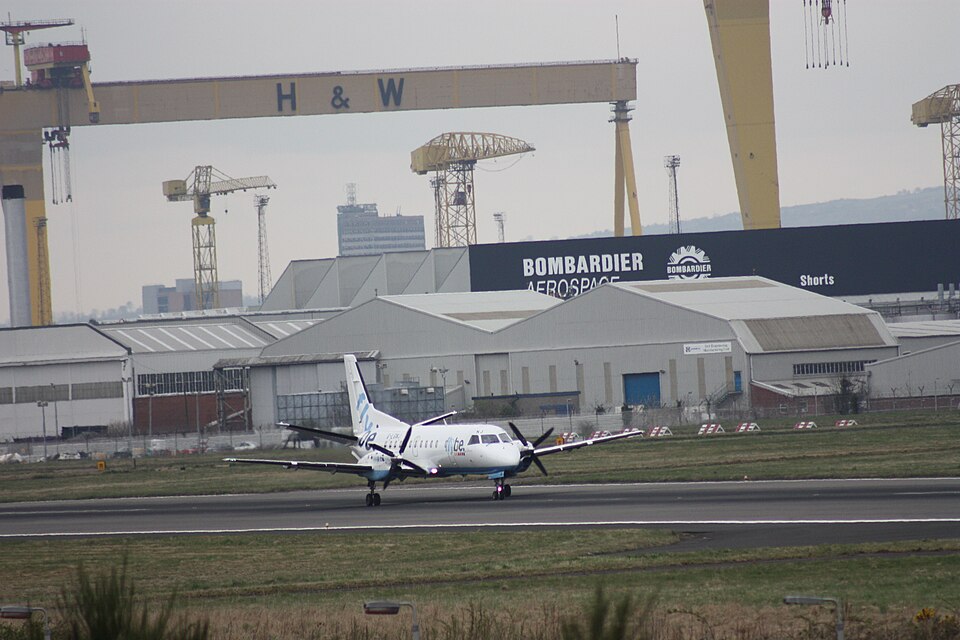
History of the Flight
The aircraft, a SAAB-Scania SF340B registered as G-LGNJ, operated a scheduled passenger flight from Stornoway to Glasgow on 9 January 2006. During the climb to FL135, the crew selected engine anti-ice upon entering icing conditions. When a small accumulation of ice appeared on the wing leading edges and windshield, they activated the continuous mode of the airframe de-icing boots. Monitoring continued throughout the flight.
As the aircraft descended, with an indicated outside air temperature of -12°C, the pilots noticed increased ice buildup on the propeller spinners, windshield, and wipers, and selected normal propeller de-icing. The commander requested and received clearance to descend to FL080. The co-pilot initiated a descent at 1,500 feet per minute using the autopilot's vertical speed mode. Shortly thereafter, a large piece of ice shed from one propeller and struck the fuselage, causing vibration. The co-pilot increased propeller rpm to maximum, but the vibration intensified.
Autopilot Disengagement and Control Restriction
Without any command, the autopilot and yaw damper disconnected. The pilots perceived an abrupt nose-down pitch of about 5°. The co-pilot took manual control but found the control column immovable in pitch. The commander confirmed his control column also appeared stuck. The aircraft continued in a stable trimmed descent. The co-pilot was able to re-engage the autopilot and yaw damper, and the autopilot functioned normally in pitch and roll. No further manual flying was attempted until shortly before landing.
The commander declared a PAN due to ice, and air traffic control provided radar vectors for an instrument landing system approach to Runway 23 at Glasgow. During the landing roll, the power levers could not be retarded below flight idle; the co-pilot used the flight idle override to reduce power for deceleration. All occupants disembarked normally without injuries, and the aircraft sustained no damage.
Recorded Data
The flight data recorder indicated that the autopilot disengaged for seven seconds at the time of the incident. An upward trend in elevator position was observed before disengagement, suggesting the autopilot was maintaining the selected vertical speed. No other abnormal data were recorded.
Engineering Inspection
A detailed post-flight inspection revealed all control surfaces and mechanisms functioned normally without restriction. No evidence of de-icing fluid residues or mechanical binding was found. The flight-idle stop system operated correctly. A subsequent non-revenue test flight was completed without any issues.
Meteorological Information
A synoptic chart indicated a freezing level at 5,000 feet and the possibility of moderate icing in cloud in the area. The commander assessed that moderate icing conditions were present during the incident.
Autopilot System
The SAAB 340 is equipped with an APS-85 three-axis digital flight director and autopilot system. Autopilot disengagement can occur manually or automatically due to various fault conditions, including stall warning activation, servo-loop faults, loss of valid altitude, and bus transmission errors. A diagnostic mode stores fault codes in volatile memory. However, no fault codes were retrieved in this instance.
Analysis
The manufacturer explored possible causes for the elevator control restriction, including binding between the autopilot servo gear-train and its mounting, or an undetermined mechanical problem. Alternatively, an electrical issue such as chafed wiring or moisture in connectors could have caused autopilot disengagement, but the operator reported no recurrence. The event was not typical of incidents involving re-hydrated de-icing fluid residues, as the restriction was brief and occurred above freezing. Recorded data showed increased elevator deflection before disconnection, consistent with the autopilot compensating for reduced tailplane effectiveness from ice accretion. When the autopilot disconnected, elevator deflection decreased, possibly explaining the perceived nose-down pitch.
Conclusion
The crew managed the situation by re-engaging the autopilot and completing the flight safely. The specific cause of the autopilot disengagement and control restriction could not be determined.