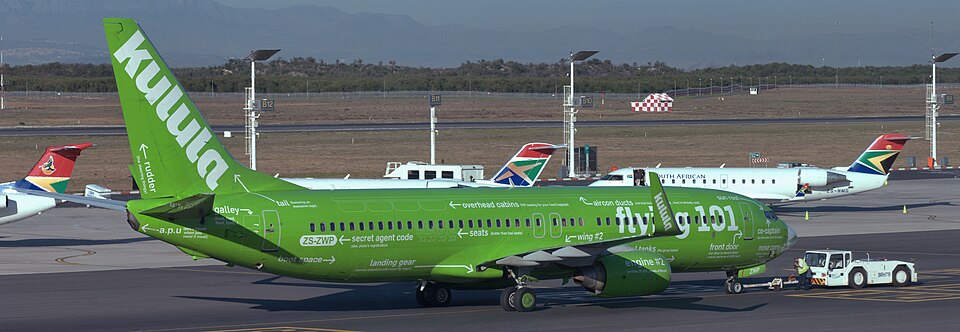
On February 27, 2013, a Boeing 737-800 (registration ZS-ZWP) was involved in an aviation accident near On Runway 01 at Cape Town International Airport, ZA. Investigators recorded the probable cause as: Aborted take-off as a result of the No. 2 engine failure due to the failure of the HPT blade. This summary draws on records from the South African Civil Aviation Authority (SACAA) Accident and Incident Investigations Division; 2 related events involving the same aircraft type or operator are linked below.
Aircraft registered ZS-ZWP. Photo: NOTE: This image is a panorama of Cape Town Intl. Airport consisting of 2 frames that were merged or stitched in Panorama Studio. As a result, this image necessarily underwent some form of digital manipulation. These manipulations may include blending, blurring, cloning, and colour and perspective adjustments. As a result of these adjustments, the image content may be slightly different from reality at the points where multiple images were combined. This manipulation is often required due to lens, perspective, and parallax distortions. / CC BY-SA 3.0, via Wikimedia Commons
On 27 February 2013, a Boeing 737-800 (ZS-ZWP) operated by Kulula rejected take-off at Cape Town International Airport after a No. 2 engine failure. No injuries were reported.
Incident Overview On 27 February 2013, a Boeing 737-800 with registration ZS-ZWP, operating as flight CAW104 for Kulula, was scheduled to depart Cape Town International Airport (FACT) for OR Tambo International Airport (FAOR). The aircraft carried 181 passengers and 6 crew members. During the take-off roll on Runway 01, the crew experienced a loud bang and vibration at approximately 30 kt. The No. 2 engine's N1 and N2 gauges indicated a zero reading, prompting the crew to execute a rejected take-off (RTO). The aircraft came to a stop on the runway, and no injuries were reported. ## Investigation Findings The South African Civil Aviation Authority (SACAA) investigated the incident. Engine debris, identified as turbine blade parts, was found scattered over a substantial area of the runway surface, leading to a temporary runway closure for clean-up. The investigation determined that the probable cause was an aborted take-off resulting from a No. 2 engine failure due to the failure of a high-pressure turbine (HPT) blade. A contributory factor was the failure of the HPT blade coating, which led to corrosion and subsequent blade failure. The aircraft's damage was contained to the No. 2 engine, and the flight crew successfully completed the emergency procedures.
An X-AIR HAWK ultralight crashed in Chonburi, Thailand, killing the pilot and injuring a passenger. The accident was caused by deteriorated wing fabric and…
A Challenger II Special ultralight aircraft (U-B23) landed off-runway at Pai Airport, Mae Hong Son, on September 17, 2024, due to a gust of wind. No injuries…
The Polish aviation safety authority is investigating a serious incident involving an AT-3R100 aircraft that occurred on September 2, 2024. The investigation…
A SZD-48-3 glider suffered damage when its left wing struck a ground obstacle during a low final approach at EPWK on June 20, 2025. The pilot was uninjured.
A 39-year-old skydiver died after a hard landing near Leszno on May 1, 2026. The PKBWL preliminary report indicates the fatal impact resulted from a late,…
A student pilot crashed an SZD-50-3 Puchacz glider into the airfield fence during a solo training flight on June 6, 2026. The pilot was uninjured, but the…