Introduction
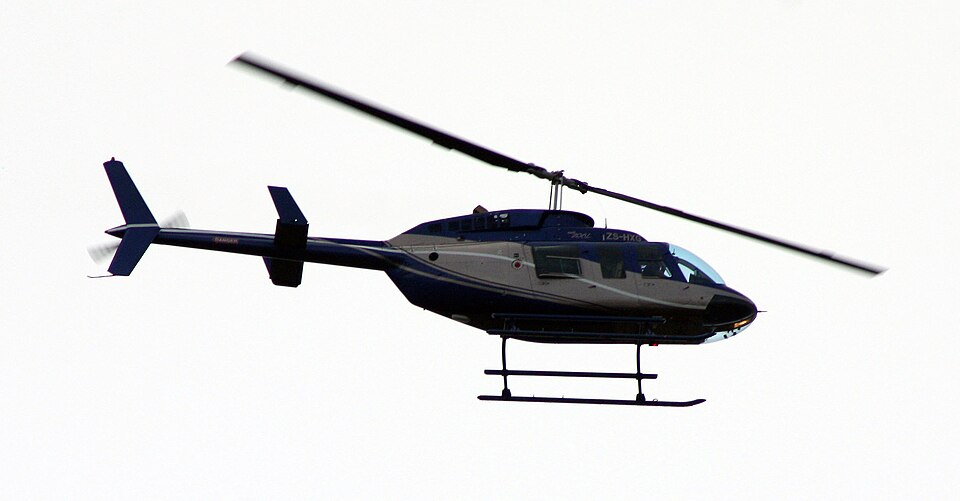
On 11 December 2021, at approximately 0420Z, a Bell 206L-3 helicopter (registration ZS-HXG) took off from Ultimate Heliport in Midrand, Gauteng Province, South Africa, with a pilot and one passenger on board. The intended route included a refuelling stop at New Tempe Aerodrome, Free State Province, with a final destination of Plettenberg Bay Aerodrome, Western Cape Province.
History of Flight
Shortly after departure, an eyewitness, also a pilot, observed smoke emanating from the right side of the engine compartment. The eyewitness used a nearby helicopter's radio to alert the pilot of ZS-HXG about the smoke. Upon receiving the message, the pilot executed a 180° turn back towards the helipad with the intention of performing a precautionary landing.
Closed-circuit television (CCTV) footage from the heliport building captured the helicopter entering an uncontrolled descent and crash-landing on the field just short of the heliport's embarkment. The helicopter sustained substantial damage during the accident sequence, and the pilot sustained minor injuries.
Investigation Findings
The investigation determined that the engine failure was caused by insufficient oil supply to the engine. This resulted from a damaged engine oil pressure supply hose, which had come into contact with the rotating rotor brake disc. The oil starvation led to thermal destruction of the Number 6 and 7 bearings, followed by decoupling of the spline (tie bolt) coupling from the compressor drive shaft. The clash of rotating components as the shaft separated caused the turbine wheel to burst.
Poor maintenance practices were identified: the engine oil hose was not correctly secured to the required P-clamps as specified in the maintenance manual. Additionally, there was non-compliance with safe standards and recommended practices from the manufacturer and the Civil Aviation Regulations (CAR) 2011, as amended.
Probable Cause
The helicopter experienced an engine failure and landed hard just short of the helipad's embankment. The engine failure was due to insufficient oil being supplied to the engine as a result of a damaged engine oil pressure supply hose, causing the Number 6 and 7 bearings to suffer thermal destruction which led to an internal clash of rotating components, followed by the destruction of the 1st stage gas producer turbine. Poor maintenance practice as the engine oil hose was not correctly secured to the required P-clamps as called for in the maintenance manual. Non-compliance with regards to the safe standard and recommended practises from the manufacturer as well as the Civil Aviation Regulations (CAR) 2011 as amended.