Background
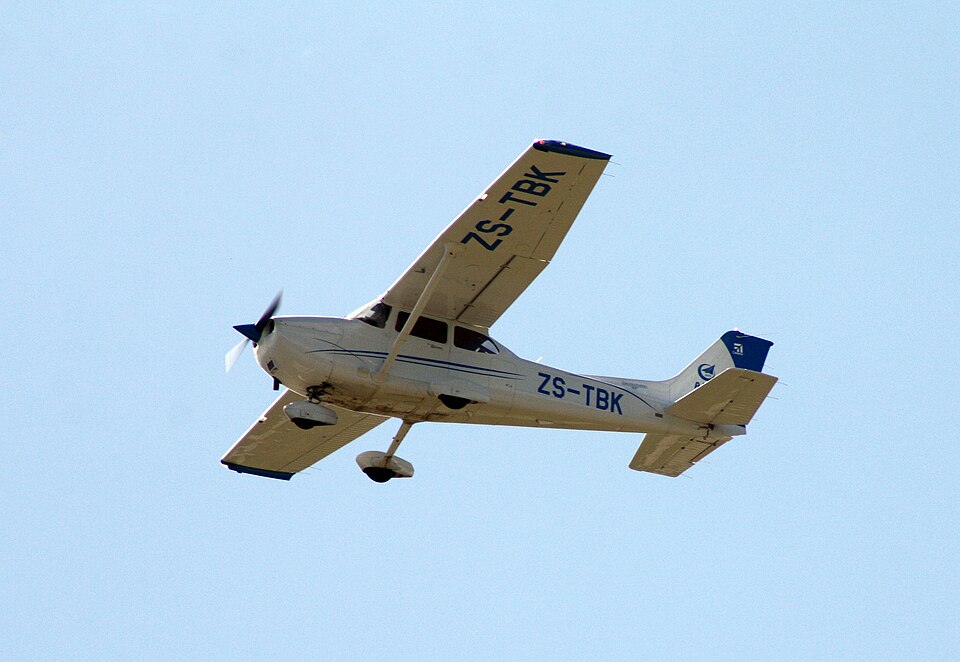
On 3 February 2023, a student pilot (SP) was conducting a solo navigation exercise in a Cessna 172 S Skyhawk, registration ZS-TBK, under Part 141 of the Civil Aviation Regulations. The flight was conducted in visual meteorological conditions (VMC) by day.
Flight
The SP completed a pre-flight check with no anomalies and filed a VFR flight plan. Departing Beaufort West Aerodrome (FABW) at 0730Z, the route included Willowmore Aerodrome (FAWO) and Aberdeen Aerodrome (FAAE) before returning to FABW. Upon return, the SP joined overhead the aerodrome at 5000 ft AGL and then joined the circuit on left downwind for Runway 08.
Accident
During the approach, the aircraft was unstable. On round out, it ballooned, followed by a hard landing and a bounce. The pilot lost directional control; the wings contacted the runway surface and the nose gear broke off. The aircraft skidded left of the runway before stopping.
Damage and Injuries
The aircraft sustained substantial damage to the nose gear, propeller blades, engine cowling, wings, and fuselage. The SP was injured and transported to hospital.
Findings
Pilot Information
- The pilot held a Student Pilot Licence (SPL) Integrated Course (IC) Aeroplane, issued 22 April 2022, valid until 21 April 2023, with C172 endorsement.
- A Class 2 aviation medical certificate was issued 29 March 2022, valid until 28 March 2027, with a stipulation to wear corrective lenses.
Aircraft Information
- Certificate of Airworthiness (C of A) reissued 14 May 2021, valid until 31 May 2023.
- Last mandatory periodic inspection (MPI) before the flight was on 1 February 2023 at 5488.6 airframe hours; the aircraft flew 4.6 hours since.
- Last maintenance was performed by an AMO with a valid certificate.
- Certificate of Release to Service (CRS) issued 2 February 2023.
- The aircraft landed with an effective crosswind of approximately 8 knots.
Weather at Time of Accident
- METAR: Wind 160° at 8 kt, visibility 10 km, temperature 34°C, QNH 1016 hPa.
Probable Cause and Contributing Factor(s)
Probable Cause: The aircraft ballooned during round out following an unstable approach; this led to a hard landing and loss of directional control.
Contributing Factor(s): Crosswind component.
Safety Action(s)
None.
Safety Message
ATOs must develop procedures to correctly evaluate the students’ ability to recover from emergency situations prior to signing them off for solo consolidation training.
This accident could have been prevented if the pilot had carried out a go-around. Thus, it is recommended that ATOs emphasise the importance of carrying out a go-around when the aircraft is not stable on approach.