History of Flight
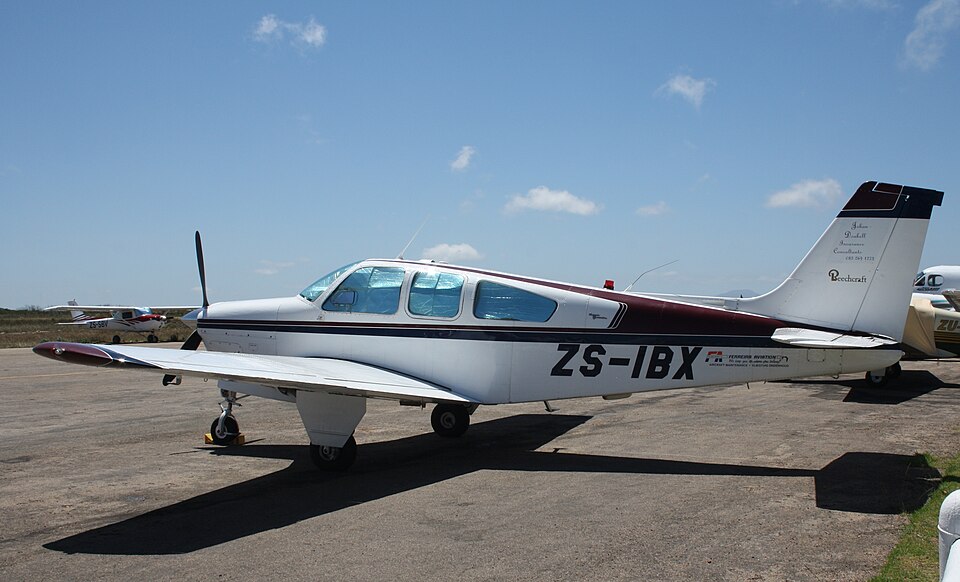
On Monday, 30 January 2023 at 1230Z, a pilot departed from a private farm in Steelpoort, Mpumalanga province, flying a Beechcraft E33 Bonanza registered ZS-IBX. The intended destination was Nelspruit Aerodrome (FANS), also in Mpumalanga. No flight plan was filed. The flight was conducted under day visual flight rules (VFR) in visual meteorological conditions (VMC).
After take-off, the pilot routed southeast toward FANS and requested entry into Kruger Mpumalanga airspace, stating his intention to route to FANS. Kruger Mpumalanga International Airport (FAKN) air traffic control granted entry, joining at 9500 feet above mean sea level (AMSL). Communication was lost before the aircraft reached its intended reporting point.
Another aircraft, ZS-EPO, operating near FANS, was asked to search for ZS-IBX. At 13:16:00Z, ZS-EPO reported that ZS-IBX had crashed 1.79 nautical miles northwest of FANS. The FAKN air traffic control officer notified the Aeronautical Rescue Coordination Centre (ARCC).
Wreckage and Impact
The aircraft was destroyed. The accident site was located on Portion 2 Hermannsburg 450 JJ, GPS coordinates 25°29'55.5" South 030°52'42.5" East, at an elevation of 3510 feet. The impact occurred in mountainous terrain.
Pilot Information
The pilot, aged 43, held a valid Private Pilot Licence (PPL). Total flying experience was 92.6 hours, with 30.1 hours on the Beechcraft E33 Bonanza type.
Meteorological Information
At the accident site, surface wind was 210° at 7 knots, temperature 19.2°C, dew point 0.8°C, and visibility was CAVOK (ceiling and visibility OK).
Medical and Pathological Information
The pilot was found fatally injured at the accident site.
Investigation and Probable Cause
The investigation determined that the aircraft flew from VMC into instrument meteorological conditions (IMC), and the pilot became disorientated due to loss of visual reference, leading to the crash in mountainous terrain. The probable cause was stated as: "The aircraft was flown from VMC to Instrument Meteorological Conditions (IMC) and the pilot became disorientated, which led to the crash in the mountainous terrain."
Contributing factors included proceeding with flight into IMC, the pilot not being instrument flight rated, and poor weather conditions (mist and low-lying clouds).