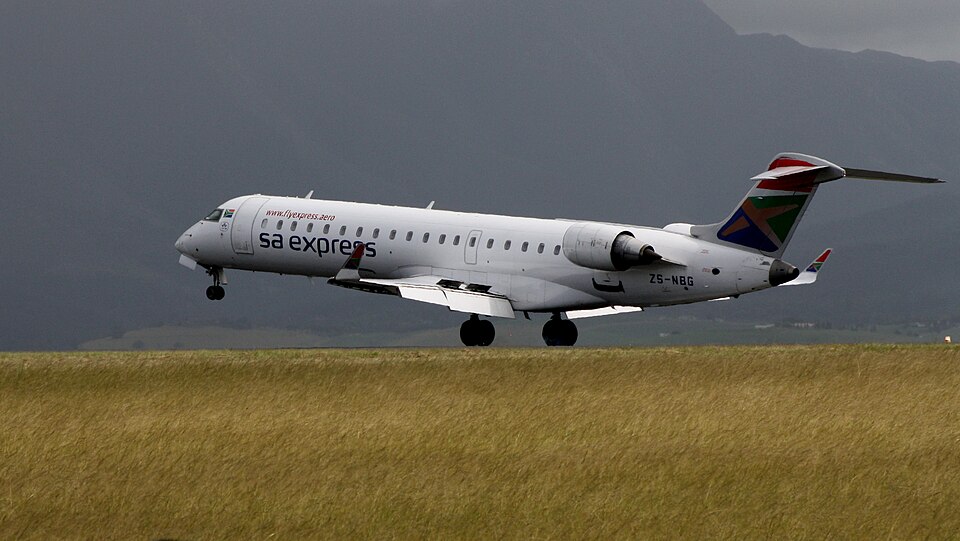
On May 11, 2018, a Bombardier CL-600-2C10 (registration ZS-NBG) was involved in an aviation accident near East London Airport (FAEL), ZA. Investigators recorded the probable cause as: Stage-two high-pressure turbine assembly blade separations due to fatigue. This summary draws on records from the South African Civil Aviation Authority (SACAA) Accident and Incident Investigations Division.
On 11 May 2018, a Bombardier CL-600-2C10 (ZS-NBG) experienced an engine failure during initial climb from East London Airport. The aircraft returned and landed safely with no injuries.
Incident Overview and Flight Details On 11 May 2018, a Bombardier CL-600-2C10 aircraft, registered as ZS-NBG, was operating a scheduled commercial flight (SA1412) from East London Airport (FAEL) in the Eastern Cape Province to O.R. Tambo International Airport (FAOR) in Gauteng Province. The flight was conducted under Part 121 of the Civil Aviation Regulations. At the time of the incident, the aircraft carried four crew members and 52 passengers. ## Sequence of Events The aircraft took off from Runway 29 at approximately 0616Z. During the initial climb, the crew engaged the autopilot at 600 feet above ground level (AGL). At approximately 800 feet AGL, the aircraft experienced high vibrations followed by a loud noise from the rear. The crew identified the number 1 engine as having failed and executed the relevant memory items and quick reference handbook (QRH) procedures. The captain declared a “PAN-PAN” emergency to air traffic control (ATC) and the aircraft continued its climb on a single engine, leveling off at approximately 3,000 feet AGL. The crew did not attempt to relight the engine. Following ATC instructions, the aircraft returned to East London Airport and landed safely on Runway 29 at approximately 0653Z. ## Investigation Findings and Outcome The investigation determined that the number 1 engine failed due to stage-two high-pressure turbine assembly blade separations caused by fatigue. Examination of the fractured surfaces indicated that the fatigue originated at the convex shank surface. No injuries were reported among the crew or passengers. The damage to the aircraft was limited to the number 1 engine. The incident was investigated by the Accident and Incident Investigations Division of the South African Civil Aviation Authority (SACAA).
Probable cause
Stage-two high-pressure turbine assembly blade separations due to fatigue.
A SkyWalk Join't 3 paraglider crashed into the ground near Las Vizcachas, Chile, on September 1, 2024. The pilot and passenger sustained serious spinal…
PARAPENTE (ULTRALIVIANO NO MOTORIZADO)·2024-09-01DGAC Chile
A Cessna 172N struck electrical cables while on final approach to land at Aucó Aerodrome in Chile. The pilot was uninjured, but the aircraft sustained damage…
A Bombardier DHC-8-402 suffered a tail strike during landing at Puerto Williams on September 9, 2024. All 76 occupants were unharmed, but the aircraft…
A MYD JS-MD 3 glider veered off the runway and struck a wall at Vitacura Aerodrome on January 6, 2025. The pilot was uninjured, but the aircraft sustained…
A recreational paraglider flight in Puchuncaví, Chile, ended with the pilot sustaining serious injuries after a rapid descent and impact with a hillside on…
PARAPENTE (ULTRALIVIANO NO MOTORIZADO)·2025-03-29DGAC Chile
A Tecnam P2006T landed on its belly at an aerodrome in Poland after the crew failed to confirm landing gear deployment. The incident resulted in no injuries…