History of Flight
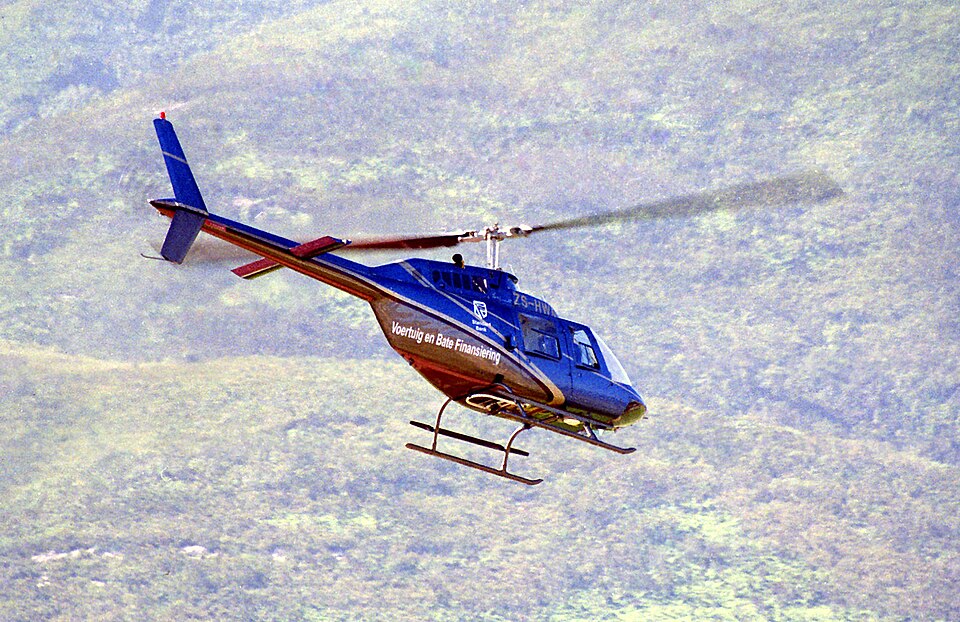
On 21 December 2008 at approximately 1430Z, the pilot, who was also the owner of the Bell 206B helicopter (registration ZS-HWM), departed from Bergsig Game Farm near Mossel Bay on a private flight to a farm at Riversdale, Western Cape. During the descent for landing, the “Engine Out” warning light illuminated twice and an audio warning sounded. The pilot immediately lowered the collective. As he approached the landing area in a south-easterly direction at an indicated airspeed of 60 knots, he encountered a downdraught caused by a southerly wind blowing over a hill just south of the landing area. He pulled the collective to arrest the sink rate while simultaneously flaring the helicopter.
During the subsequent autorotational landing, the main landing skids fractured as the helicopter made a hard landing on a slight upslope. The helicopter rolled over onto its left side. A witness who arrived at the scene assisted the pilot in exiting the wreckage. Some fuel was observed leaking from the main wreckage. The pilot did not recall hearing the engine running during or after the accident sequence and could not remember shutting down the engine.
Injuries to Persons
The pilot sustained no injuries.
Damage to Aircraft
The helicopter was extensively damaged. The landing skids separated from the main wreckage during the hard landing. The tail boom and tail rotor were severed from the main wreckage. The main rotor blades sustained minimal damage consistent with low-energy impact. The cockpit area remained virtually intact.
Meteorological Information
At the time of the accident, the wind was from the south at 10 knots, visibility was good, temperature was 28°C, and there was no cloud cover.
Engine Examination
The engine, an Allison 250-C20B, was removed and examined at an approved facility. The manufacturer’s inspection revealed damage to the No. 6, 7, and 8 bearings, which were dry and heat-damaged, consistent with operation with inadequate or no oil supply. Additionally, the Pc air supply line was found corroded, fretted, and fractured at a clamp point, with evidence of bending and tool marks. The fracture likely resulted in a loss of Pc signal to the N1 governor, reducing fuel flow and engine power.
Probable Cause
The probable cause of the accident was an unsuccessful autorotational landing. A contributing factor was an engine failure.