History of Flight
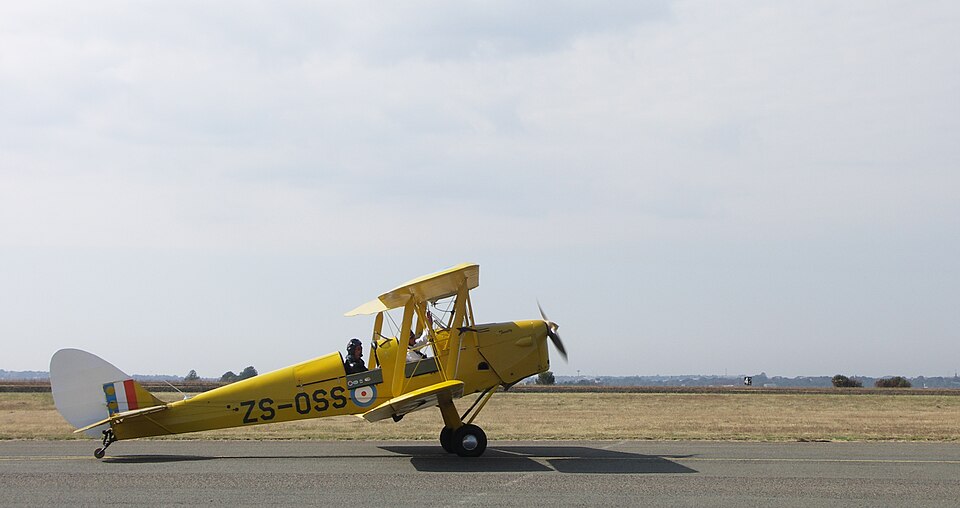
On 16 April 2013, a pilot and a passenger took off from Mahikeng Airport (FAMM) in a de Havilland DH-82 Tiger Moth, registration ZS-OSS, for a short scenic flight intended to return before sunset. The aircraft was cleared for take-off from runway 04 at 15:37Z and climbed uneventfully. At 15:40Z, the pilot advised air traffic control that they would be operating over Modimola Dam, approximately 3.4 nautical miles from the airport, and would report when complete. This was their last communication; ATC attempted to contact them three times starting at 15:58Z but received no reply.
A witness on the dam shore observed the aircraft flying above the water. The engine sounded as if it was losing power but did not stop. The aircraft then banked left and suddenly entered a nose-dive attitude, hitting the water with a large splash and disappearing. The witness, unable to swim, reported the accident to the airport fire department, which alerted ATC. Search and rescue efforts began, involving the South African Police Service (SAPS). At approximately 18:00Z, a yellow tail was spotted in the water, but recovery was delayed. The pilot's body was recovered the following morning at 08:00Z, and the passenger and wreckage were recovered at 12:58Z. Both occupants suffered fatal injuries.
Aircraft and Personnel Information
Z-OSS was a 1941 de Havilland DH-82A Tiger Moth, serial number 82982, with a total of 688 airframe hours. It was powered by a Gypsy Major engine (serial A164631) with 680.17 hours since new and 317.17 since overhaul. The propeller was a Dunbar DC-193-140-l-DH with approximately 535.77 hours since new. The aircraft was owned by Pearl Coral 1323 CC and operated under Part 91. The pilot held a valid Commercial Pilot Licence and a Grade III Instructor rating, with 870.6 total flying hours, including 252 hours on type. He had joined the academy in February 2013 as an aircraft responsible person. The passenger was a 23-year-old male holding a Commercial Pilot Licence and a Grade II instructor rating, with 1498.6 total flying hours (as of February 2013). He was not rated on the Tiger Moth. The flight was a birthday gift for the passenger.
Meteorological Conditions
At the time of the accident (16:00Z), weather at FAMM reported wind from 350° at 2 knots, visibility 10 km or more, temperature 28°C, dew point 4°C, few clouds at 4000 feet. No significant weather was reported.
Wreckage and Impact
The aircraft impacted the water late in the afternoon and remained submerged until recovery. The exact impact coordinates were not determined. Flight control cables were found intact and moved freely prior to the accident. The aircraft was completely destroyed: the wooden propeller blades shattered, both biplane wings broke backwards, and the left main undercarriage broke. Major components remained attached to the airframe during recovery. The passenger's body was trapped in the wreckage and required the use of the Jaws of Life to be freed.
Medical and Pathological Information
An autopsy of the pilot revealed multiple bruises and cuts predominantly to the front of the body; cause of death was drowning due to a neck fracture and brain damage. The passenger's autopsy showed signs of water aspiration in the lungs and a fractured left femur; cause of death was drowning due to brain damage and a fractured femur. The accident was not survivable.
Probable Cause
The report states the probable cause as "losing of control by flying low over water," which can be interpreted as a loss of control while operating at low altitude over the water's surface.