History of Flight
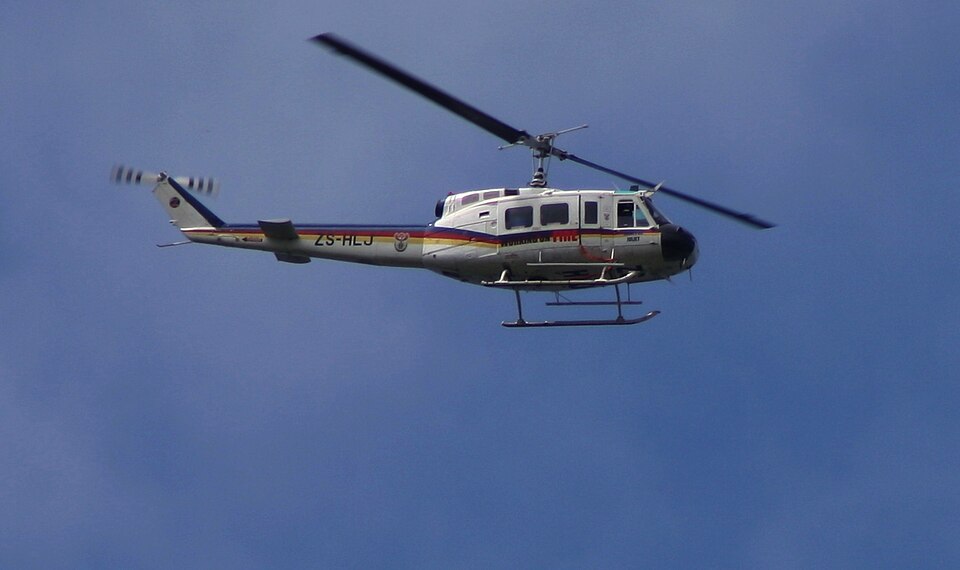
On Tuesday 23 July 2019, two Bell UH-1H helicopters, registered ZS-HLJ and ZU-LCY, along with a Cessna 182 spotter aircraft, were dispatched for a fire-fighting mission at Woodbush Forest Reserve near Tzaneen, Limpopo Province. The flight was conducted in visual meteorological conditions under Part 137 of the Civil Aviation Regulations.
An eyewitness video showed black smoke emanating from the helicopter's engine exhaust area during takeoff and initial climb. The pilot reported that after turning on course at approximately 200 feet, he noticed a lack of engine power as the helicopter struggled to climb to 280 feet. The temperature and pressure gauge indicators were in the green. A loud bang was then heard from the engine compartment. The pilot observed that both rotor and engine revolutions per minute (rpm) were decreasing significantly on the dual tachometer, and the master warning light illuminated. He broadcast a Mayday call on 123.55 MHz and lowered the collective partially. As rotor rpm continued to decrease, he scanned for a landing site, identified an open area to his right, fully lowered the collective, and steered toward it for an emergency landing.
During descent, the pilot attempted to flare to cushion the landing but insufficient rotor rpm resulted in a hard touchdown. Both skids broke on impact, and the main rotor blades severed the upper section of the tail boom. The pilot was not injured. After landing, he turned off the master switch and inverter, exited the helicopter, opened the front cowl door, and disconnected the battery. The engine was not running; the main rotor blades were windmilling.
The accident occurred during daylight at Bosveld Citrus Farm in Politsi, GPS coordinates S23°45'22.71" E030°6'32.97" at 2,643 feet above mean sea level.
Injuries to Persons
The pilot (the sole occupant) was not injured.
Damage to Aircraft
The helicopter sustained substantial damage. Both skids were broken, and the main rotor blades severed the upper tail boom.
Probable Cause
The manufacturer's technical report could not determine the cause of the engine failure. However, the investigation found it probable that the engine was periodically started at high temperature and not monitored during start, leading to the development of fatigue cracks and subsequent internal failures.