History
On 22 January 2019, the pilot, the sole occupant, operated a cross-country flight from Düsseldorf Airport (Germany) to Paris-Le Bourget Airport. At 17:53, the pilot received clearance from the Paris-Charles de Gaulle INI controller for an ILS approach to runway 27 followed by a visual manoeuvring with prescribed tracks (VPT) to runway 25. The pilot read back and queried the nature of the VPT 25 procedure. At 18:00, the ITM controller confirmed the clearance and inquired if the procedure suited the pilot, who replied affirmatively. At 18:08, the pilot was transferred to the Le Bourget tower controller.
At 18:12, during landing on runway 25, the main wheels touched the ground 800 m before the displaced threshold. The aircraft deviated left and veered off the runway approximately 500 m further, 300 m before the threshold. It came to rest on grass 50 m from the runway edge. The pilot informed the tower that he could taxi back and continue to parking; the controller authorized the move with ARFF escort. Post-flight inspection revealed a broken piece of the left main landing gear door. On the runway, one red side light, one green light, and one flashing light at the threshold were broken.
Aircraft and Pilot Information
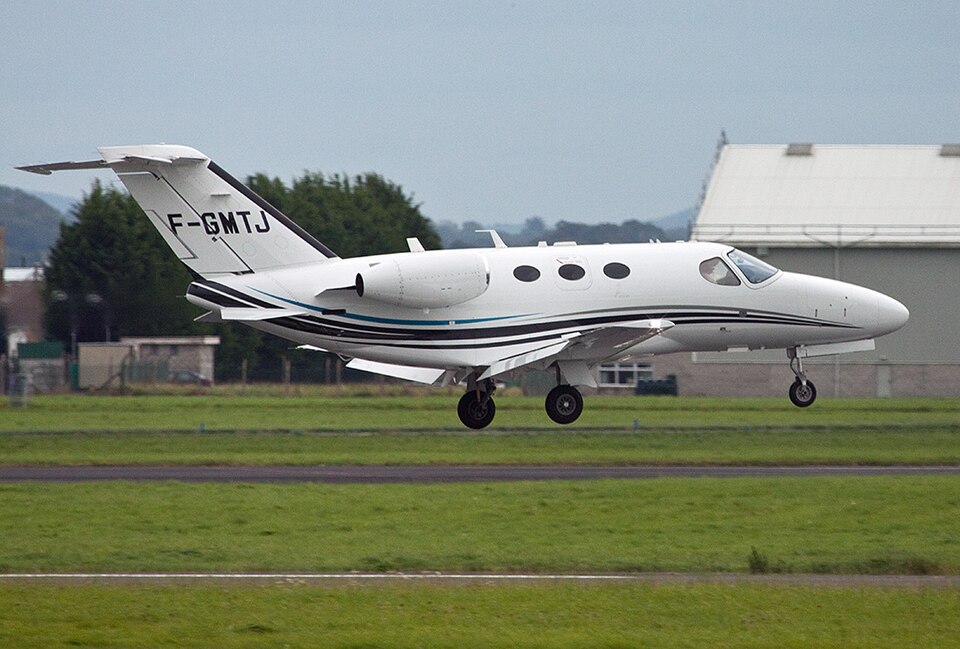
The Cessna 510 Citation Mustang (registration F-GMTJ) was delivered new in 2009 to a company chaired by the pilot. It was not equipped with flight recorders, as not required by regulations. It had an antiskid system. The pilot, aged 71, held a French private pilot license (since 1975) and a type rating for the Cessna 510, with a multi-engine instrument rating (since 2009). His medical certificate required corrective lenses. He had 2,313 total flight hours, including 936 on multi-engine aircraft and 728 on the Cessna 510, flying approximately 90 hours per year.
In November 2014, the same pilot experienced a serious incident when he landed on the disused runway between runways 25 and 27 at Le Bourget during a VOR 25 approach.
Weather and Airport Conditions
At 18:00, weather reports indicated calm wind, temperature 1°C, visibility 6,000 m, and a cloud ceiling at 700 ft. The incident occurred at night (sunset at 17:30). Runway 25, with a displaced threshold of 891 m, had a landing distance available of 2,100 m and a width of 45 m. It was not equipped with an ILS. The surface before the displaced threshold was a concrete overlay. The runway had been cleared of snow less than one hour before the incident. The ATIS at 17:00 UTC (18:00 local) reported runway 27 closed for snow clearing, approaches via ILS 27 then VPT 25, runway 25 wet, and cloud ceiling 700 ft. Successive ATIS messages advised pilots to check operating minima. At the time, the runway vicinity was covered with a thin layer of snow.
Pilot Statement
The pilot stated that after the 2014 incident, he contracted with FlightSafety for simulator training, completing a session in November 2018 (12 hours). Those sessions focused on instrument flight and emergencies, rarely covering visual approaches. He was accustomed to approaches at airports with specific procedures, such as La Mole, Cannes, Nice, and Blackbushe, and when dealing with displaced thresholds, he would visually identify the start of the runway and fly over the unusable section with slight throttle.
Before departing Düsseldorf, he consulted the ATIS indicating runway 27 active and prepared for an ILS 27 approach. He was surprised by the clearance for a VPT 25, which he had never performed. He had only once flown a VOR 25 approach to runway 25 prior to the 2014 incident, in daylight. He would have preferred the ILS 27 and would have postponed the flight had he known he would need to land on runway 25. He did not communicate his preference or discomfort to the controller, nor did he discuss the marginal weather or the possibility of not acquiring visual references at the MDA.
While aligned on the ILS 27 centerline, he overshot the right turn point for the VPT 25 and did not have the runway in sight. Upon emerging from cloud layer, he was surprised and dazzled by the brightness of ground lights and did not see the lead-in line lights or PAPI. Knowing the runway was slippery, he decided to land early without seeing the displaced threshold.