Incident Description
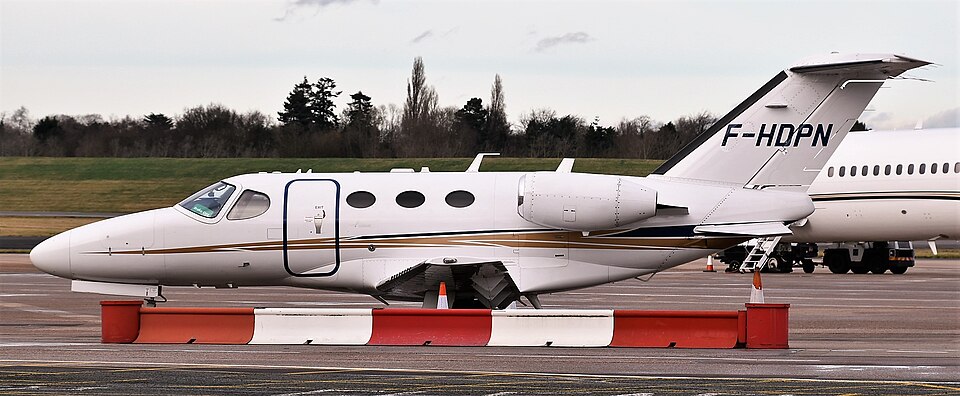
On 5 September 2013, at approximately 03:35 local time, a Cessna 510 Mustang, registered F-HDPN, operated by Oyonnair, was conducting a positioning flight for a medical evacuation from Lyon Saint-Exupéry to Saint-Étienne Bouthéon. The crew consisted of a commander (pilot flying) and a copilot (pilot monitoring).
At the time, runway 18L was in service. Runway 18R/36L was partially closed due to construction work between taxiways A6 and A9, as indicated by a NOTAM. The controller, aiming to shorten the taxi distance and noting light winds, proposed a takeoff on runway 36L (the opposite direction). He activated the runway lighting without requesting a physical inspection.
The aircraft lined up on runway 36L from taxiway A4, with 1,900 meters of runway remaining. During the takeoff roll, as the pilot flying approached rotation speed (102 knots), he saw an unlighted vehicle stopped in the middle of the runway. He executed a rapid rotation and steep climb, estimating that the aircraft passed about one meter above the obstacle.
The vehicle was a trailer carrying a three-meter-high St. Andrew's cross, attached to a truck from the airport's lighting service. It was positioned 70 meters south of taxiway A3. The vehicle's radar beacon had been deactivated to preserve battery power. Another six-meter St. Andrew's cross was placed at the threshold of runway 18R.
Background
The runway closure and work zone were defined by a directive from the Centre-Est Air Navigation Service (SNA-CE) issued on 28 August 2013. The directive specified that, during south-facing operations, only runway 18L should be used, with runway 36L limited to takeoffs from north of taxiway A6. The work zone was to be marked with permanent and temporary lighting. However, the placement or movement of mobile markers were not identified as potential threats to aircraft operating on a closed runway.
In practice, the red light line at taxiway A3 was replaced by the three-meter cross on a truck. This change was not documented but was made to facilitate and expedite runway mode changes.
Investigation Findings
The ground radar display used by the controller had a specific background for the construction zone, showing red crosses between A6 and A9. However, the locations of the St. Andrew's crosses at A1 and A3 were not depicted. The controller's display showed the truck at A3 as a primary radar plot with a numerical label (blue tag 00018), but without active identification because its beacon was off. The other cross at A1 lacked a radar identification system, making it difficult to distinguish on the radar, especially due to potential ghost echoes.
Regarding strip management, an orange strip reminding of the cross at A3 was placed on the controller's strip board, below the yellow strip for runway 18L/36R. This was part of the workspace arrangement per the standard operating procedures.
The directive did not specify the use of a specific radar background for the closed runway in south-facing configuration. According to the SNA-CE operations manual, a closed runway should be indicated by a red rectangle on the radar display, but the directive was silent on this.
The controller used the runway lighting control panel to activate the lights for runway 36L without requesting a physical inspection of the runway before takeoff.