History of the Flight
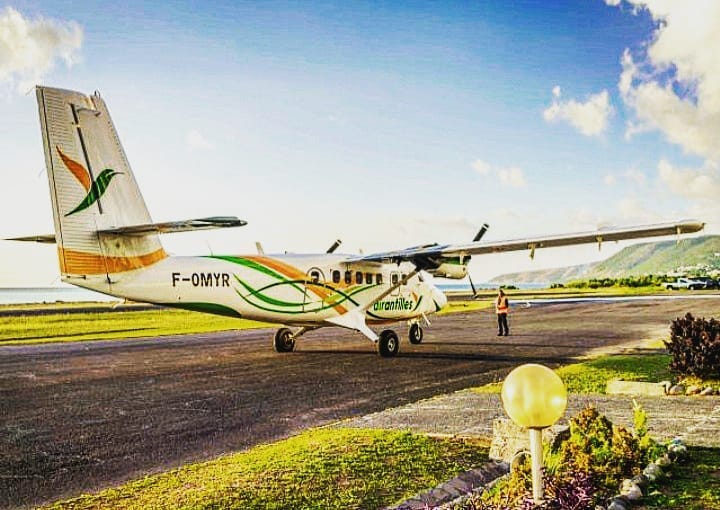
On 10 April 2022, the crew of the de Havilland DHC6-400 registered F-OMYR departed Pointe-à-Pitre - Le Raizet airport at 09:00 for an IFR proficiency check flight. Runway 12 was in use, and the crew was in contact with Raizet Approach on 121.3 MHz. They executed an RNP Z approach for runway 12, then requested clearance for an RNP approach for runway 30. From 09:10 to 09:32, the pilot of a Cessna 206 registered F-GERB coordinated with the same controller for parachute dropping at Saint-François aerodrome. The flight information, tower, and approach frequencies were combined at Pointe-à-Pitre. At 09:34, the controller was relieved. At 09:42, the pilot of F-GERB reported another group of parachutists to be dropped at FL 100; the controller asked for a report one minute before dropping. At 09:49, F-OMYR was cleared for an option on runway 12 and executed a go-around. After the go-around, F-OMYR was directed to waypoints DULBO and LOMPA for the RNP 30 approach. At 09:55, the controller informed the crew of F-OMYR about upcoming parachute dropping. At 09:59, F-OMYR was cleared to descend to 3,000 ft, and F-GERB reported readiness. The controller advised F-GERB that no traffic interfered below and that F-OMYR was conducting an RNP 30 approach. F-GERB was overhead Saint-François, while F-OMYR had not yet turned to LOMPA. Around 15 seconds later, the controller asked F-GERB to report dropping completed. At 10:00, the dropping began with a tandem and a solo jump. The controller then spent about 30 seconds communicating with another aircraft. At 10:00:29, the controller asked F-GERB if dropping had started, but received no reply. The dropping was already underway. F-OMYR was north of the drop zone. A second tandem jumped overhead Douche beach, opening parachute at about 5,900 ft, canopy fully deployed at 5,000 ft, heading west to land at Saint-François. The controller provided traffic information about F-GERB to F-OMYR; the crew confirmed clearance to continue. Shortly after, F-OMYR crossed the runway track of Saint-François at about 3,200 ft and 1 NM east, passing close to the second tandem under canopy. The tandem occupants could read the aircraft registration and company name. F-OMYR then joined the holding pattern at LOMPA and carried out the RNP 30 approach without further incident.
Crew Information
Crew of F-OMYR
The captain examiner held an ATPL(A), with ratings on ATR 42/72, DHC6, IR/ME(A), MAP(land), FI(A), IRI(A), CRI(A), and had 9,063 total flight hours (8,065 as captain). The co-pilot held a CPL(A) with DHC6, IR/ME(A), FI(A) ratings, and had 178 total flight hours (76 as captain). The crew stated that the controller informed them of F-GERB climbing through 8,500 ft towards FL 100 while en route to DULBO. They were cleared to hold at LOMPA and not go further north. On inbound track at 296°, they saw the dropping aircraft descending and deduced the dropping had occurred. They had not heard the radio exchanges regarding the drop clearance.
Pilot of F-GERB
The pilot held a CPL(A) with SEP, MEP, IR/ME(A) ratings, with about 1,300 flight hours (1,150 as pilot-in-command). He stated that easterly wind required offsetting the dropping point eastward. He did not know F-OMYR's position and displayed waypoint DULBO on his GPS to understand its path. Clouds and searching for a gap delayed the last tandem drop.
Meteorological Information
According to Météo-France, near Saint-François, a line of cumulus clouds with 4 to 5 octas coverage extended northwest, without precipitation or visibility reduction. The area was under a narrow convective cell with few gaps. Cloud bases were 3,000-4,000 ft, tops 6,000-8,000 ft. Wind from east-southeast at 10-15 kt up to 5,000 ft.
Air Traffic Control Service Information
The Pointe-à-Pitre control unit manages airspaces of Guadeloupe. Saint-François is an uncontrolled aerodrome in class G airspace. The approach frequency is 121.3 MHz. The DULBO-LOMPA segment of the RNP 30 procedure is east of Saint-François; minimum altitude at LOMPA is 3,000 ft. At the time, two controllers were on duty: one holding combined GND/TWR/APP positions, and the tower supervisor as assistant. The combined frequencies handled both IFR traffic and parachute activity. The Control Tower Operations Manual had a 'Parachuting' section, and a memorandum with the parachuting company specified that the dropping pilot must be on 121.3 MHz and request approval at least one minute before dropping. The controller was to inform of any interfering traffic. The IRMA radar display did not have the drop zone configured for APW alerts. The RNP 30 procedure was not displayed on the controller's screen, only waypoints DULBO and LOMPA were shown. The French phraseology manual indicates that for VFR parachute operations in controlled airspace, the controller should say 'Largage approuvé, rappelez fin de largage'; in uncontrolled airspace, 'Rappelez fin de largage'.