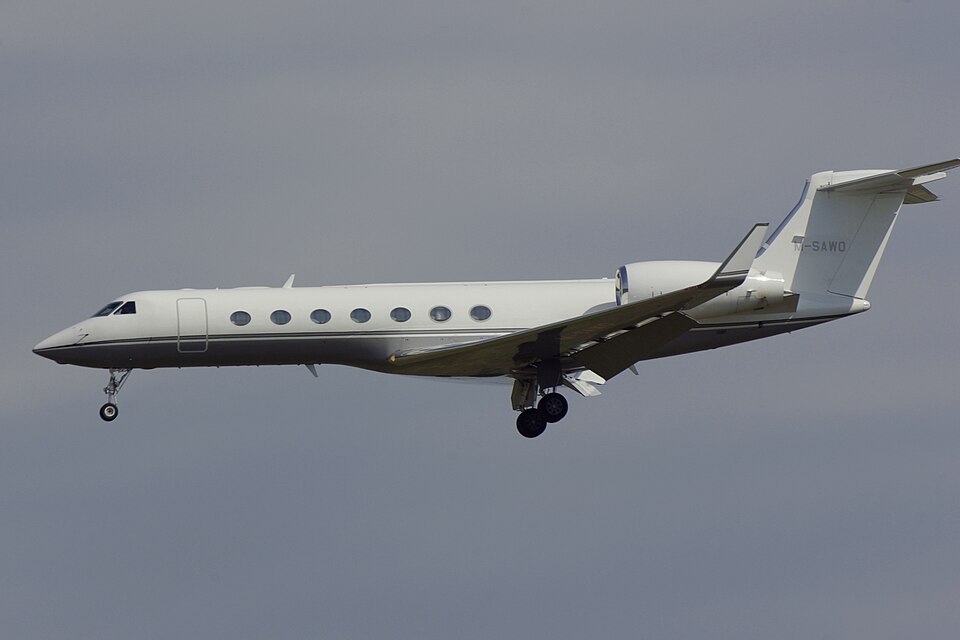
History of the Flight
A Gulfstream G550, registration M-SAWO, operated by Avcon Jet AG, was conducting an own-account transport flight from Vienna Airport (Austria) to Paris-Le Bourget Airport (France). The crew was cleared for a LOC A approach to runway 25. The approach path was on a heading of 275°, offset 26° from the runway centreline. During the approach, in good meteorological conditions, the pilot flying (PF) aligned the aircraft on a disused former runway located between runways 27 and 25. Realizing the error at a radio-altimeter height of 250 ft, the PF turned right to join runway 25. The aircraft overshot the runway centreline to the right at very low height. The angle-of-attack protection activated, and the stick shaker triggered. The PF initiated a go-around and followed the missed approach procedure. The crew conducted a second approach and landed normally on runway 25. Post-flight inspection revealed damage to the leading edge and lower surface of the left wing, and a broken runway light was found 300 m before the displaced threshold.
Chronology
At 17:03:29, while following the approach path on heading 272°, the pilot monitoring (PM) adjusted the altimeter setting from 1013 hPa to 1014 hPa. At 17:10:36, the PF made the same adjustment. The actual QNH was 1004 hPa, and the ATIS reported 1005 hPa; thus, displayed altitudes were about 280 ft higher than actual pressure altitude. At 17:13:17, the crew reported sighting the runway and disengaged the autopilot at a radio-altimeter height of 500 ft. The PF aligned on the disused former runway. At 250 ft, the PF commanded a right turn toward runway 25. At 17:14:07, the calibrated airspeed began decreasing from 148 kt. The PF made and maintained a nose-up input. At about 40 ft radio-altimeter height, the aircraft overshot the centreline of runway 25 in a left turn with 20° bank, engines at idle. The angle of attack increased from 9° to 29°, activating angle-of-attack protection. The stick shaker and Master Warning activated for six seconds. At 17:14:13, the PF aborted the approach, advancing the power levers; maximum thrust was reached seven seconds later. The aircraft was at about 20 ft height, offset 35 m right of the centreline, with 15° left bank. The left wing struck and damaged a light to the right of the runway. The aircraft climbed and the PF levelled the wings. The PM reported the missed approach. The controller requested a runway inspection, which confirmed glass debris before the displaced threshold. The crew of M-SAWO performed a second approach and landed at 17:43.
Meteorological Information
The ATIS message at 16:45 indicated wind 230° at 14 kt, visibility >10 km, few clouds at 3,200 ft, temperature 18°C, and QNH 1005 hPa. At the time of the incident, visibility conditions had not noticeably changed; the actual QNH was 1004 hPa.
Aircraft Information
The aircraft weight and balance were within manufacturer limits.
Crew Information
The 42-year-old captain held an ATPL(A), with 5,200 flight hours (nearly 1,000 on Gulfstream 450/550) and held instructor and examiner ratings. The 32-year-old co-pilot held an ATPL(A), with 3,200 flight hours (over 1,000 on Gulfstream 450/550). The incident flight was the first flight of the day for both.
Approach and Runway Description
Paris-Le Bourget has three intersecting runways: 03-21, 07-25, and 09-27. A disused former runway (P1, P2, P3) oriented approximately 260° lies between runways 27 and 25, measuring 1,550 m long and 60 m wide. It has runway closed markings (white crosses) and a white "AEROPORT DE PARIS LE BOURGET" marking. The first section of the disused runway has light-coloured concrete similar to the surface before the displaced threshold of runway 25. Runway 25 (LDA 2,100 m) has a displaced threshold of 891 m and is not equipped with an ILS. The LOC A 25 approach path is offset 26° from the runway centreline.
Crew Statements
The crew had thoroughly prepared the approach. They noted QNH 1014 hPa from the approach controller and input it, reading it back without correction. They identified the disused runway as runway 25 and reported having it in sight. They realized the error when instruments indicated about 700 ft (actual height ~200 ft due to QNH error). The PF attempted to correct, felt a possible gust, and at 50 ft the autothrottle reduced thrust. When the PF decided to go around, the aircraft descended before full thrust was available. Both pilots heard the stall warning and briefly dual-controlled. They did not feel the ground contact. The captain took over as PF during the missed approach.
Tower Controller Statement
The controller saw the aircraft appear to align on the disused runway, then turn left at low height, and had the impression the left wing tip contacted the ground. He immediately requested a runway inspection.
Damage
The aircraft sustained a dent in the leading edge and damage on the lower surface of the left wing near the wingtip. Runway lighting was broken.