History of the Flight
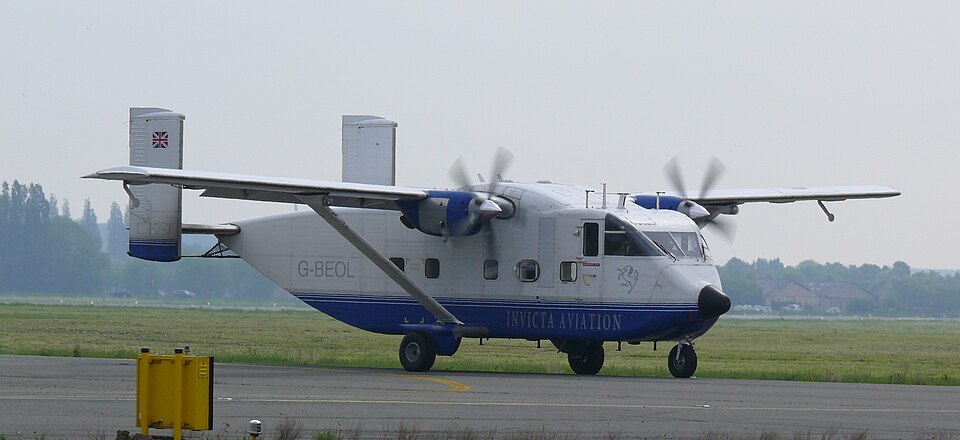
The aircraft, a Short SC7 Skyvan 3 registered G-BEOL, had returned to Weston-on-the-Green after refueling at RAF Brize Norton. The pilot made an uneventful approach to grass Runway 27. As the nosewheel contacted the ground on touchdown, the wheel and yoke assembly detached from the aircraft. The aircraft veered off the runway and came to a stop with a nose‑down attitude. There were no injuries to the crew or passengers. The pilot conducted engine and aircraft shutdown drills, and the occupants disembarked without further incident. The nosewheel and yoke assembly came to rest at the edge of the runway, having sheared from the oleo within the plated portion just above the yoke.
Aircraft Details
The Short SC7 Skyvan is an all-metal high-wing monoplane powered by two Garrett Airesearch TPE331-2-201A turboprop engines. It is fitted with fixed tricycle landing gear with a steerable nosewheel. Designed for operation from prepared and unprepared runways, it is often used for parachute drops.
Pilot's Comment
The pilot described the landing, up to the nose landing gear failure, as “quite normal with nothing untoward.” However, on reflection, he noted that during the landing at RAF Brize Norton he became aware of more nose gear shimmy than usual. The shimmy subsided as his speed decayed, and he thought nothing more of it. The shimmy did not reappear during taxi and takeoff for the return flight.
Engineering Investigation
The remains of the nose landing gear assembly were removed from the aircraft and, together with the nosewheel and yoke assembly, were transferred to the manufacturer for analysis at the request of the aircraft owner. The lower portion of the torque link had separated at the mid-pivot point and remained attached to the yoke; the upper portion of the torque link had detached completely from the nose landing gear forging. Two fracture faces were apparent on the main forging and on the yoke. The inner oleo liner had fractured just above an area where its diameter increases to accommodate the male portion of the thread onto which the outer piston of the oleo and yoke attaches. The second fracture face was around the circumference of the outer oleo piston where the female portion of the attachment thread finishes. Inspection of the aircraft structure revealed damage to the underside of the fuselage consistent with the nose landing gear collapse. The mechanism by which the fractures occurred is the subject of an ongoing forensic investigation by the manufacturer.