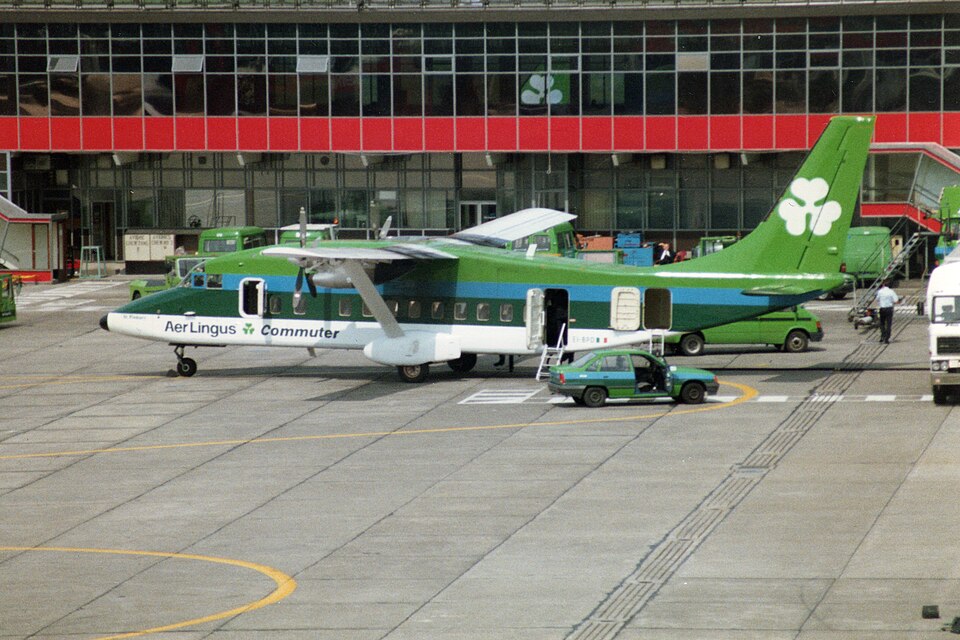
History of the Flight
On 4 February 2001, a Shorts 3-60 Variant 100, registration EI-BPD, operated a scheduled passenger flight from Dublin to Sheffield City Airport. The commander was the handling pilot, and both pilots had operated into Sheffield between five and ten times in the previous three months. The aircraft departed Dublin at 1814 hrs and was routed via the Wallasey VOR/DME at FL90. Prior to descent, the crew received ATIS 'Information Hotel' reporting surface wind variable at 3 kt, visibility 4,000 metres in rain and snow, scattered clouds, temperature +1°C, and QNH 989 hPa. Approach control was passed to Sheffield at 12 nm, where the crew received updated ATIS 'Information India' with no significant changes.
The aircraft was cleared for the ILS/DME approach to Runway 28. The crew requested QFE 980 hPa, and the decision height was 400 feet. During the manually flown approach, the commander's flight director warning flag appeared briefly but did not recur. The de-ice boots were selected off at 5 nm when the outside air temperature indicated +5°C (actual +2°C). At 1918:11 hrs the crew reported established on the localiser. Flaps were set to 15° on glidepath interception. The handling pilot noted a slightly higher rate of descent initially, which normalised near 4 nm. Propellers were set to maximum rpm at 1,200 feet agl. The crew was cleared to land with surface wind variable at 2 kt and warned of a wet runway.
Both pilots saw the runway at about 400 feet agl; flaps were selected to 30°. As the commander checked back on the control column, the rate of descent increased noticeably, and the aircraft landed firmly. Both pilots believed power levers were at flight idle and reported no unusual control inputs during the flare.
Two witnesses (one in the control tower, one in front of the terminal) saw the aircraft at about 400 feet, apparently faster than normal. They described the aircraft striking the ground very hard with the left wing low, a loud noise on initial contact, followed by a bounce, then a nose-wheel-first second impact, and a third bounce. Crew statements and flight data indicate the aircraft lifted no more than 8 feet before settling and remaining on the ground. The aircraft then travelled about half the runway before slewing left onto the grass, where it stopped with the left wing tip touching the grass.
At 1921:15 hrs the tower controller asked if assistance was required. The crew requested fire services on standby, but the controller activated a full emergency response. Fire services arrived at 1924 hrs, and all passengers were evacuated by 1925 hrs. South Yorkshire fire services arrived at 1933 hrs and assisted in ferrying passengers.
Aerodrome Details
The published ILS/DME approach for Runway 28 had a localiser track of 279°M, coincident with the runway QDM. The ILS glideslope was 3°. The runway had a published landing distance of 1,199 metres, width 30 metres, and an asphalt surface. Precision approach path indicators set to 3°, high-intensity approach lighting with three cross bars, threshold lighting, and runway edge lighting were all serviceable. A lighting check at 1822 hrs was satisfactory, and radio aids were serviceable.
Meteorological Conditions
The synoptic situation at 1900 hrs showed low pressure near Cardiff with an occluded front. A south-easterly airstream covered the area. An aftercast from the Meteorological Office reported surface wind variable 02 kt, temperature +2°C; at 1,000 feet wind 110°/22 kt, +1°C; at 2,000 feet wind 120°/25 kt, 0°C. ATIS 'Information India' (1850 hrs) reported surface wind variable 02 kt, visibility 4,000 metres in rain, few clouds at 500 feet, broken at 1,600 feet, temperature +2°C, dew point +1°C, QNH 988 hPa. 'Information Juliet' (1920 hrs) reported similar but with rain and snow instead of rain.
Wind information was derived from two anemometers: one near the ILS glide path aerial (mean 2-minute velocity) and one near the threshold of Runway 10 (mean 10-minute velocity). The wind passed to the pilots (variable 02 kt) came from the ILS anemometer. The recorded wind from the threshold anemometer had been less than 4 kt since 1750 hrs.
Flight Recorder Analysis
The aircraft was equipped with a 25-hour flight data recorder (FDR) and a 30-minute cockpit voice recorder (CVR). Both were serviceable. The recordings showed the flight was uneventful until the approach.
About 3 minutes from touchdown, the crew reported established on the localiser. 54 seconds before touchdown, the commander commented "... MUST HAVE A TAIL WIND" and requested power "... ALL THE WAY BACK". FDR data showed no windshear or turbulence. The crew saw the runway about 100 feet above decision height. Flap 30 was selected, and the commander stated "The decision is to land." At 18 seconds prior to touchdown, airspeed was 118 KIAS, and the first officer called "ABOUT 20 KNOTS." At 7 seconds prior, at 120 feet and 112 KIAS, the first officer called "THREE REDS."
Three seconds prior to touchdown, at 105 KIAS, the FDR recorded propeller blade angle changing from flight range to ground range. This had not occurred on any of the previous 25 hours of landings. The CVR recorded sounds consistent with propellers 'disking', and FDR indicated longitudinal deceleration and downward acceleration. Full nose-up elevator, right aileron, and right rudder were applied, but the aircraft rolled left, and sounds of a very heavy landing were recorded.
The impact caused FDR tape speed fluctuation, corrupting 0.5 seconds of data. After recovery, propeller blade angle had returned to flight range. Interpolation indicated a bank angle of 5° to 7° left wing low at touchdown. Corrected normal G yielded a sink rate of 12 to 15 feet per second immediately before touchdown.
After the initial touchdown, the aircraft bounced, pitched nose down, rolled right, and recorded a second touchdown 2 seconds later with a maximum of 2G. Reverse thrust was selected, and right rudder applied to maintain heading. The aircraft slowed, veered left, and came to rest on a heading of 278° magnetic.
Engineering Investigation
Examination of the runway showed initial contact about 30 metres past the threshold markers. The aircraft came to rest about 700 metres from the touchdown point. Fragments of sponson structure, fairings, and parts of the left main landing gear oleo strut were scattered between the initial touchdown point and about 200 metres into the runway. A pool of oily residue was found to the left of the runway centreline near the touchdown point. Beyond that, no scraping marks for about 500 metres, then evidence of the left sponson scraping, with scrape marks leaving the runway edge about 650 metres from the start of the asphalt.
Injuries and Damage
There were no injuries to the 3 crew or 25 passengers. The left main landing gear was destroyed, and the sponson was severely damaged.