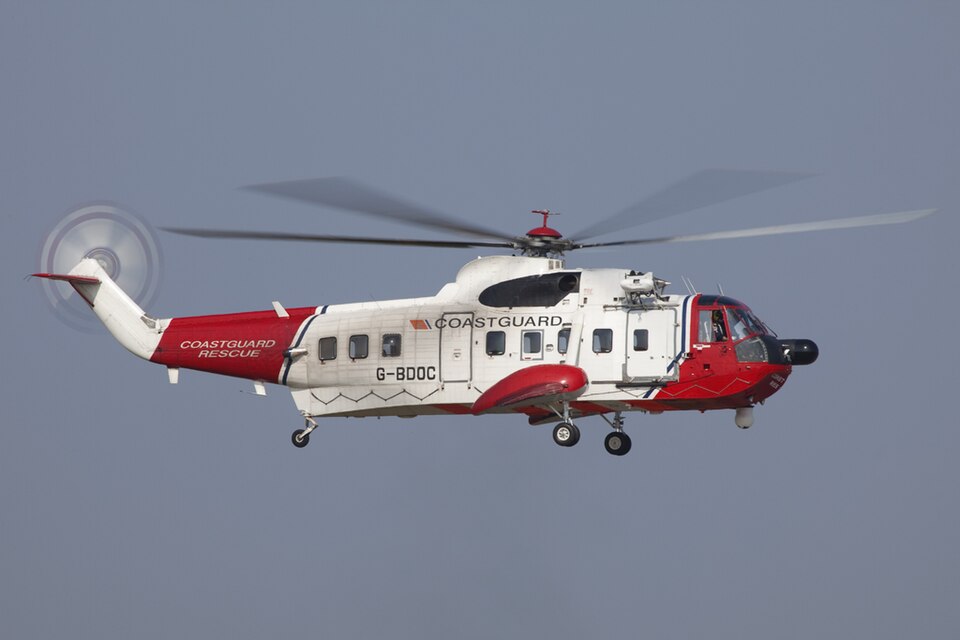
History of the Flight
On 15 September 2004 at approximately 0800 hrs, a Sikorsky S-61N helicopter, registration G-BDOC, was conducting a winching operation near Sullom Voe, Shetland. The crew comprised a commander, first officer, winch operator, and winchman. The helicopter had departed Sumburgh Airport at 0715 hrs to collect a marine pilot from Scatsta Aerodrome, then proceeded to a designated ship about 15 nm north of Scatsta.
The crew visually acquired the ship and identified the winching area, marked by a solid yellow circle surrounded by a broken yellow circle. After completing pre-winching checks, the helicopter positioned on the port side of the ship. The crew noted a possible obstruction (a mast) to the rear of the helicopter and decided to move the winching position forward about 40 feet to an area marked by a green walkway. They were aware of a yellow-topped mast riser located on the deck to the right of the helicopter, which would be at the commander's four o'clock position.
The commander established a hover about 40 feet above the deck, then descended to about 20 feet. The winchman was lowered to the deck. The crew maintained the hover while the winch operator prepared the marine pilot. The commander felt a slight drift forward and right, corrected it, and then the winch operator began lowering the marine pilot. Shortly after, the commander heard a short repetitive noise, similar to a birdstrike he had experienced before, and moved the helicopter higher and left. The first officer felt a vibration, and the winchman on the deck called out a possible blade strike.
The crew reassessed and continued the winching, lowering the marine pilot and retrieving the winchman. After all crew were aboard, the commander manoeuvred clear, performed a control check, and flew to Scatsta Aerodrome, transmitting a 'PAN' call. No abnormal vibrations or system warnings were observed.
Engineering Information
After landing, examination revealed that four of the five main rotor blades had extensive damage on the lower surface, starting about 25 cm from the tip. The yellow mast riser on the ship showed corresponding damage, including loss of a lifting lug. All five blades were replaced, and the helicopter returned to service. The damage included gouging of the main rotor spar and disruption of the bonded blade skin. The blade spars were not fully penetrated, so the Blade Integrity Monitoring system was not activated. Maintenance records showed no indication that aircraft condition was a factor.
Deck Dimensions and Clearances
The ship's manoeuvring zone had a radius of 13.5 metres, with the winching circle diameter 5 metres. The distance from the edge of the manoeuvring zone to the rear obstruction was 11 metres, and to the mast riser was 5.5 metres. The mast riser height was 10 metres. With the main rotor radius of 9.45 metres, if the rotor were centred over the winching circle, the clearance from the mast riser would be about 9.6 metres. However, the crew's new winching position over the green walkway reduced the average clearance to about 2.1 metres. Ship roll, estimated at 3°, brought the top of the mast riser closer to the rotor disc.
Recorded Information
The combined cockpit voice and flight data recorder provided good quality recordings. The CVR confirmed crew recollections and indicated that blades struck with unequal audible effect, with at least one blade striking a second time. FDR data showed radio altitude starting at 55 feet, settling to about 20 feet above the deck for over a minute before the strike. After the strike, altitude increased to about 45 feet, then slowly reduced. The helicopter was over water about 45 seconds after the strike.