Accident
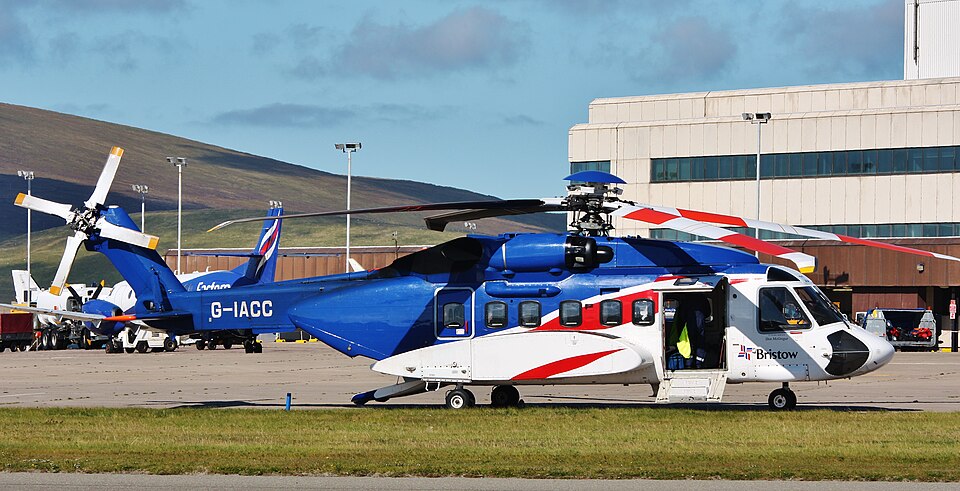
On 30 March 2011, a Sikorsky S-92A helicopter, registration G-IACC, sustained damage during a ground taxi at Scatsta Airport, Shetland Islands. The helicopter was being taxied to parking spot A2 under the direction of a marshaller. After being signalled to stop by the commander, who was the pilot flying, the co-pilot stated "Disc/Brakes/Lights" in accordance with Standard Operating Procedures. The commander levelled the disc, applied toe pressure on the foot brakes, and then intended to raise the parking brake handle.
History of the Flight
The commander inadvertently raised the collective lever instead of the parking brake handle, causing the helicopter to lift approximately six feet into the air with a slight roll to the left. Believing he had raised the parking brake handle, the commander released the collective lever. The collective trim system then lowered the lever to the fully down position, resulting in a hard landing. The crew advised their company by radio and taxied to the North Apron for engineering inspection.
Collective Trim System
The Sikorsky S-92A collective lever is equipped with a trim position mechanism incorporating an electromagnetic brake with a control trigger on the underside of the grip. When the trigger is depressed, the brake releases, allowing free movement of the lever. When released, the lever is held in the selected position. Raising or lowering the lever without depressing the trigger requires overcoming resistance. If released under such circumstances, the lever returns to the previously selected 'trim neutral' position, which in this case was the Minimum Pitch On Ground (MPOG) position.
Safety Action
Following the incident, the operator issued a Flying Staff Instruction (FSI) titled 'Guarding Flight Controls and Control Handover'. The instruction emphasized the importance of using the positive handover technique when the pilot flying passes control to the pilot monitoring, especially during critical phases of flight or when on ground with rotors running. It specifically noted the need to guard flight controls when applying the parking brake to avoid inadvertently raising the collective lever.
Conclusions
The commander concluded that the accident was the consequence of an unintentional and inadvertent application of the collective lever instead of the parking brake. The hard landing resulted in deformation of the airframe structure in two places, a crack in one of the left main landing gear wheel rims, and deflation of the tyre.