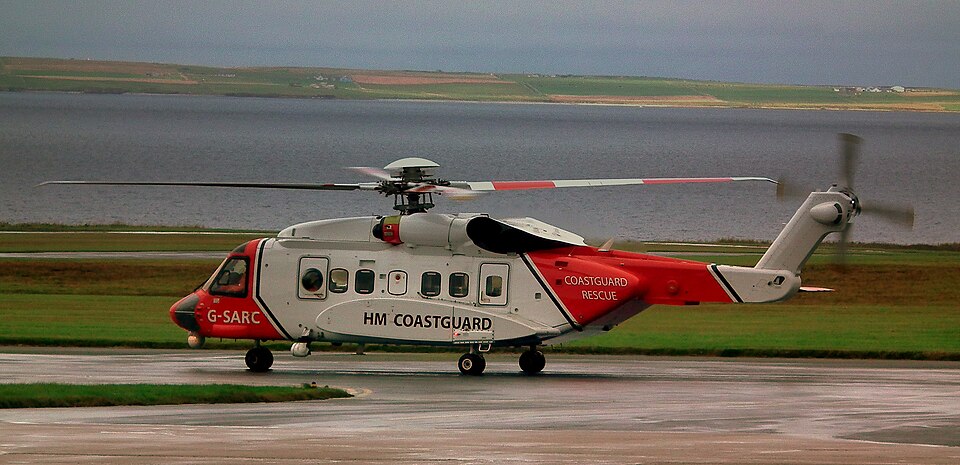
Incident Overview
On 9 July 2010 at 0950 UTC, a Sikorsky S-92A helicopter, registration G-SARC, was conducting a search and rescue (SAR) mission over the Harris Hills on the Isle of Harris, Scotland. The aircraft, powered by two General Electric CT7-8A turboshaft engines, was operated by a crew of four with no passengers on board. The commander, aged 47, held an Airline Transport Pilot's Licence and had accumulated 8,982 total flying hours, including 653 on type. No injuries were reported, and the aircraft sustained no damage.
Flight History
While flying manually in mountainous terrain, the helicopter inadvertently entered instrument meteorological conditions (IMC). The commander, who was the pilot flying, requested engagement of the autopilot heading (hdg) mode to follow a pre-briefed escape heading. The co-pilot selected hdg mode on his mode select panel, but it did not engage. Subsequently, the commander requested barometric altitude hold (alt) mode and that the minimum safe altitude be set in the altitude pre-select window. The co-pilot first briefly selected radio altimeter hold (radalt) mode, then selected alt as requested. He then selected hdg mode and aligned the heading bug with the helicopter's current heading. The commander then asked for altitude preselect (altp1) mode; the co-pilot attempted to select it several times without success.
Suddenly, while still in IMC, the autopilot entered what appeared to be a hover mode. This halted any climb and increase in forward speed as the helicopter attempted to enter a hover. The aircraft adopted a nose-up attitude of approximately 15° with a small bank angle and began to descend. The crew observed 'hov' (automatic hover velocity) mode annunciated at the top of the Primary Flight Display (PFD), and the PFD switched to the hover reference page. At that moment, a gap in the cloud revealed a hill ahead and below the helicopter. The co-pilot called for an immediate climb. The commander, flying solely by reference to instruments, promptly disengaged the autopilot and initiated a climb. He then requested hdg mode, which the co-pilot selected, and altp mode, which again could not be engaged.
The helicopter subsequently exited IMC and entered visual meteorological conditions (VMC) over lower terrain. The SAR mission was completed, and the aircraft returned to base without further use of the automatic flight control system modes.
Operator Response
In response to the incident, the helicopter manufacturer assisted the operator in analyzing the event. It was noted that the initial heading mode selection may not have engaged because airspeed was below the lower capture limit of 50 kt. Additionally, the cockpit design for the newer S-92A SAR variant was reviewed with regard to switch positioning and nomenclature to reduce the likelihood of incorrect switch selection during high-workload periods.
The operator implemented several safety actions: autopilot engagement procedures were standardized to include clear commands and execution instructions; a "Locate, Mark, Select" principle was adopted for both helicopter and simulator operations, requiring positive identification of any switch before activation; and flight tests were conducted in VMC to better understand the AFCS modes that might have been engaged during the event. These procedures were incorporated into the revised Operations Manual and enforced during training.