Introduction
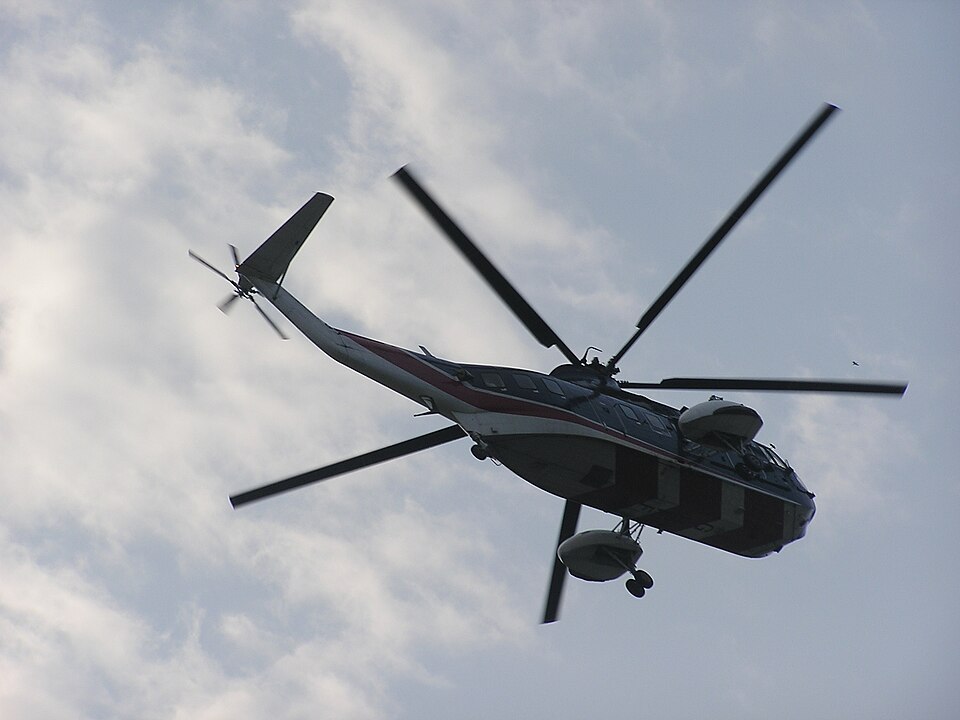
On 20 April 2004 at 0820 UTC, a Sikorsky S-61N Sea King helicopter, registration G-BFFJ, was involved in an incident while airborne over Cornwall. The aircraft, powered by two General Electric CT58-140-2 turboshaft engines and manufactured in 1978, was conducting a scheduled public transport passenger flight. The crew consisted of three members, and there were 19 passengers on board. No injuries were reported, and the aircraft sustained no damage. The commander, aged 59, held an Airline Transport Pilot's Licence and had accumulated 12,250 flying hours, of which 8,000 were on type.
History of Flight
The crew reported for duty at Penzance (PZE) at 0630 hrs. The actual meteorological observations at PZE indicated a visibility of 10 km with clear skies. Similar conditions were reported at the Scilly Isles (ISC). The only forecast weather valid for the return flight was for St Mawgan, which included a 30% probability of 500 metres visibility in fog patches with scattered cloud at ground level. The crew also consulted the UK Low Level Forecast Form 215, which noted the possibility of isolated areas of fog and stratus cloud.
After consulting fuel tables, the crew departed PZE at 0728 hrs with 1,400 lbs of fuel, 50 lbs above the minimum VFR fuel required for the return flight. They landed at ISC 22 minutes later after a cloudbreak procedure. During the turnaround, they were advised that PZE weather had deteriorated to a visibility of 4,500 metres and broken cloud at 500 feet. Despite this, they decided not to uplift additional fuel and departed ISC at 0759 hrs with 1,000 lbs of fuel, sufficient for the return flight but without a diversion allowance.
En route, they were informed of further deterioration at PZE, but continued as the conditions were still above approach minima. They prepared for the approach but did not brief a go-around procedure, believing the weather would not require one. At the missed approach point, they lacked the required visual references and executed a go-around. They elected to divert to St Mawgan, where the cloudbase was broken at 200 feet (their minimum for landing). While en route to St Mawgan, they observed a break in the cloud cover over RAF Portreath and decided to land there. The helicopter landed at RAF Portreath at 0834 hrs with 425 lbs of fuel remaining.
Fuel Management Discussion
Under company policy based on JAR-OPS 3 Subpart D, VFR fuel could be used when PZE visibility and cloudbase were not less than 4,000 metres and 600 feet respectively, without a diversion fuel allowance. At the time of the incident, no meteorological forecast was available for PZE, leaving the crew to interpret other weather information. Although forecasts included a small probability of fog, actual conditions were excellent, influencing the crew's decision to carry VFR fuel. Even after receiving reports of deteriorating weather, the crew considered it unlikely that conditions would fall below approach minima given the short flight duration. At ISC, they had the opportunity to refuel but chose not to due to the time required and the impact on the schedule, as well as the fact that reported conditions remained above approach minima.
Follow-up Action
Following the incident, the operator implemented several measures: 1. Crews are to be informed whenever PZE weather falls below VFR limits and of any fog warnings. 2. Official meteorological observations must be received by PZE no later than 30 minutes before scheduled departures. 3. On the first flight of the day, crews are not to embark passengers at PZE until an official ISC actual weather report is received and appropriate fuel is determined. In marginal weather, operations should advise crews on extra fuel relative to payload. 4. The company PZE weather decision flowchart was withdrawn to encourage crews to study the operations manual. Additionally, the company requested a Terminal Aerodrome Forecast service for PZE from the Meteorological Office.