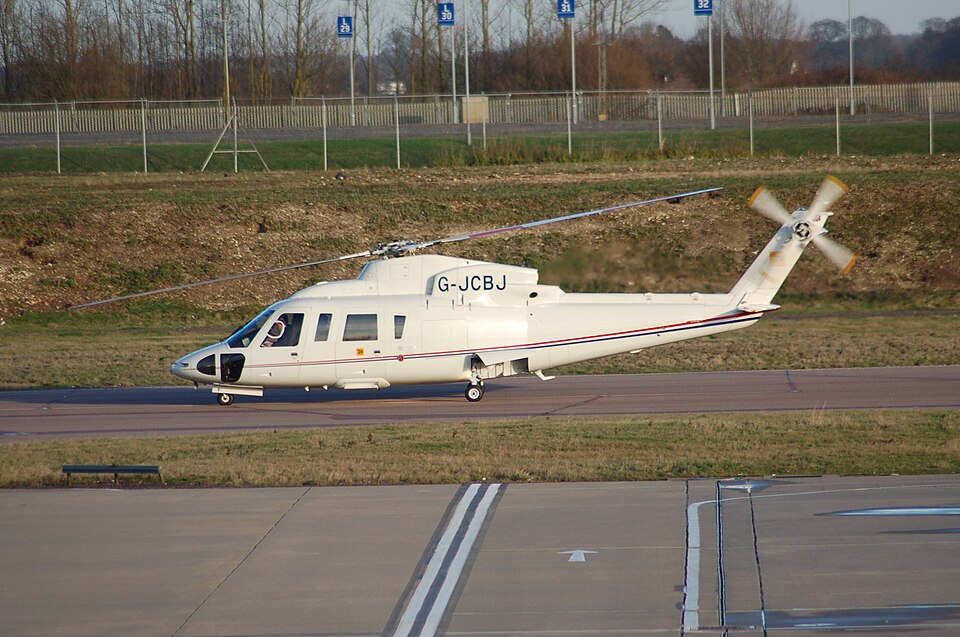
Synopsis
On 11 October 2003, a Sikorsky S76C Spirit helicopter (registration G-JCBJ) sustained structural damage to its tail cone after a heavy landing at Cranfield Airfield, Bedfordshire. The helicopter was conducting a training flight with two crew members, neither of whom were injured. The incident occurred during a practice rejected takeoff following a simulated engine failure as part of a short field takeoff profile.
History of the Flight
The flight was a check flight for the handling pilot, involving a Licence Proficiency Check, Operator Proficiency Check, and Instrument Rating Renewal. The helicopter was equipped with a 30-minute closed loop Cockpit Voice Recorder (CVR) but no Flight Data Recorder. The crew briefed the flight at East Midlands Airport and then flew to Cranfield for the manoeuvres.
The short field takeoff profile required a full power climb with slight forward speed to 40 feet above ground level, followed by a vertical climb to a takeoff decision point (TDP). The examiner simulated a right engine failure using the OEI Training Switch before the TDP. The handling pilot lowered the nose to 10° nose down and adjusted collective to control rotor RPM. However, neither pilot recalled achieving translational lift, and both noted an abnormally high rate of descent. The helicopter touched down hard on the left main landing gear, then the right main gear and nose gear.
Spectral analysis of the CVR showed rotor RPM (Nr) in the climb was 107%, then reduced to 103%, recovered to 107%, and dropped to 88% during landing. The total elapsed time from climb start to landing was about 16 seconds, with the descent lasting about five seconds. An eyewitness reported seeing the helicopter descend rapidly and almost vertically.
Meteorological Conditions
An aftercast by the Met Office indicated a surface wind between 240° and 280° true at five knots. ATC messages recorded winds varying from 230° to 320° magnetic, with maximum speed seven knots. The last wind given to the helicopter before the accident was 250° magnetic at 4 knots. The helicopter's position during the manoeuvre was in the lee of airfield hangars.
Examination of Engines and Systems
Both Turbomeca Arriel 2S1 engines were removed and inspected, showing no damage. The digital engine control units had no failure messages. A power assurance check five days prior indicated adequate power margins. There was no indication that an engine defect or malfunction contributed.
Flight Procedure Details
The OEI Training Switch allows realistic simulated engine failures without using emergency power ratings. For the rejected takeoff, the procedure required achieving translational lift, indicated by a rumble or flickering standby airspeed indicator. The investigation concluded that the high rate of descent, due to the absence of translational lift, was the most probable cause of the heavy landing, possibly because the manoeuvre was flown in a slight tailwind.