Flight Sequence
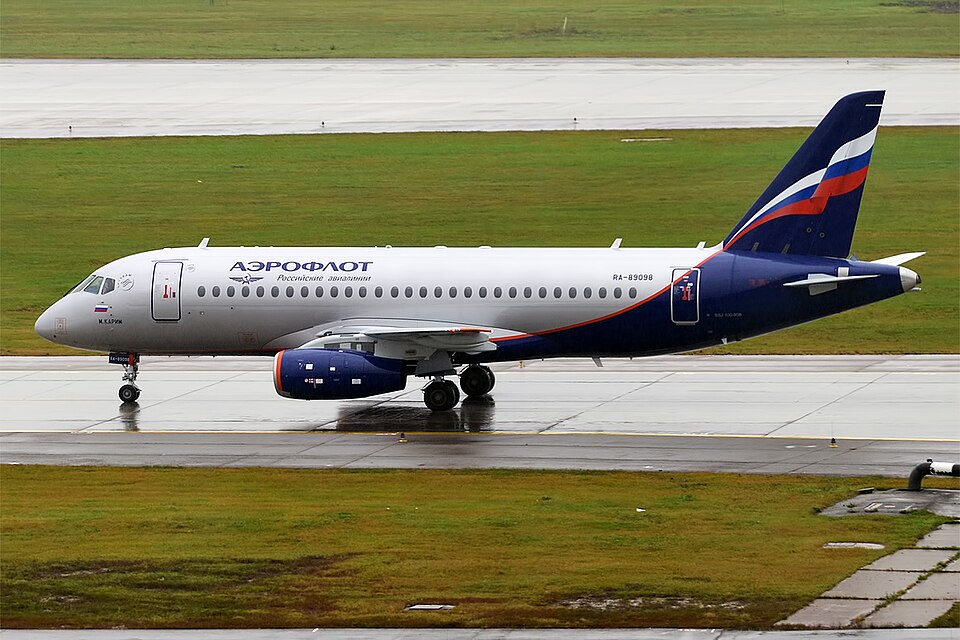
On May 5, 2019, Aeroflot flight SU-1492, operated with an RRJ-95B aircraft registered RA-89098, was scheduled from Sheremetyevo Airport (UUEE) to Murmansk Airport (ULMM). The crew comprised a captain, first officer, and three cabin crew members. Preflight procedures were completed, and passenger boarding closed at 14:40. Engine start was approved at 14:45:30, taxi began at 14:50:15, and the aircraft lined up on runway 24C at 14:57:20, holding for approximately five minutes. Takeoff clearance was issued at 15:02:23. After takeoff, at 15:03:36, at a QNH altitude of 1,250 feet (380 m), radio altitude of 690 feet (210 m), and indicated airspeed of 160 knots (296 km/h), the autopilot was engaged. The aircraft climbed under air traffic control instructions, receiving clearances to FL60, FL70, FL90, FL100, and FL110.
Emergency and Return
Between 15:07:30 and 15:07:33, the captain remarked, "It is going to bump now," and the first officer responded, "Crap." At 15:08:09.7, the cockpit voice recorder captured a noise effect lasting 1.5 seconds, most probably indicating the aircraft encountered an atmospheric electricity strike. At 15:08:11.9, the autopilot disconnected, accompanied by a warning and reversion of the fly-by-wire control system (FBWCS) to DIRECT MODE. The autothrottle initially remained engaged but was disconnected at 15:08:47. The aircraft was in a right roll of about 20 degrees while passing FL89 (2,700 m) in climb, and manual control from the left seat began. The aircraft continued a right turn per the standard instrument departure. After a brief discussion, the captain decided to return to the departure airport and instructed the first officer to declare PAN-PAN. After unsuccessful attempts to contact ATC on the primary frequency, the crew set the transponder to squawk 7600. Radio communication was restored at 15:09:35 on the emergency frequency (121.5 MHz). The first officer reported, "Moscow Approach, and we request return ... radio contact lost and aircraft in DIRECT MODE." The aircraft was vectored for the approach. At 15:26:30, the crew set squawk 7700 without reporting the reason. An ILS approach to runway 24L was planned.
Landing and Aftermath
At 15:27:20, glideslope descent began. The crew was cleared to land, with weather indicating surface wind from 160 degrees at 7 meters per second, gusting to 10 m/s. At 15:30:00, approximately 900 meters from the runway threshold, the first touchdown occurred at an indicated airspeed of 158 knots (293 km/h). The aircraft touched down on three points with a vertical acceleration of at least 2.55 G, then bounced. A second touchdown occurred 2.2 seconds later at 155 knots (287 km/h), with the nose landing gear contacting first, resulting in a vertical acceleration of at least 5.85 G, and another bounce. A third touchdown at 15:30:06 at 140 knots (258 km/h) produced a vertical acceleration of at least 5 G. As a consequence of the hard touchdowns, the main landing gear legs and airframe structural elements were destroyed, leading to fuel spillage and the subsequent onset of fire. The aircraft veered left off the runway and came to a stop on the soil between taxiways TWY2 and TWY3 at approximately 55°58′06.20″ N, 37°24′07.20″ E, 185 meters from the runway centerline, with a true heading of about 128 degrees. The aircraft stopped at about 15:30:38.
Probable Cause and Contributing Factors
The official investigation determined that the accident was caused by uncoordinated control inputs by the pilot-in-command during flare, landing, and multiple bounces (porpoising), characterized by disproportionate alternating sidestick inputs in pitch with the sidestick held against stops. These inputs resulted in three hard touchdowns; the second and third touchdowns absorbed energy exceeding the design limits for structural integrity, causing destruction of airframe elements and fuel tanks, leading to fuel spillage and fire. Contributing factors included: ineffective crew training programs for the FBWCS reversion to DIRECT MODE, which did not address the specific emergency; ineffective airline safety management system monitoring of piloting skills, failing to identify the captain's systematic errors in pitch control during landing; failure to identify hazards from previous DIRECT MODE events; unclear aircraft documentation on flare and landing correction; and the crew's noncompliance with regulations regarding thunderstorm avoidance, which led to the atmospheric electricity strike.