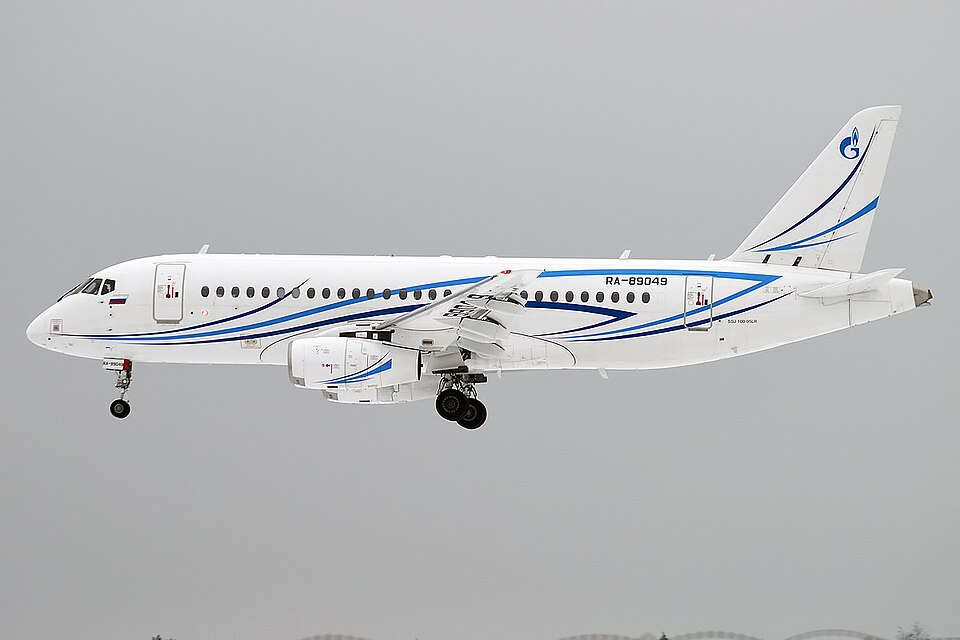
Incident Sequence
On the day of the accident, the RRJ-95 departed Lukhovitsy-Tretyakovo Airport Runway 10 at 1452 local time on a short ferry flight to Moscow-Vnukovo Airport. The crew of three was returning to base. During initial climb, at an altitude of 950 feet and an indicated airspeed of 140 knots, the autopilot was engaged. The aircraft then initiated a left turn in accordance with departure procedures. With a rate of climb of 1,000 feet per minute, the crew retracted the flaps when an audible alert informed the pilots of an airspeed inconsistency. At that moment, the pilots checked the airspeed parameters and confirmed that the values were identical on the left and right displays, namely 180 knots.
While maintaining a constant altitude of 5,000 feet, the aircraft displayed a pitch angle between 5° and 7° and an angle of attack fluctuating between 9.5° and 13.5°. The oscillations of these values were synchronous and corresponded to the deflection of the elevator. Suddenly, the stabilizer went into a dive and remained deployed for 16 seconds in a position between -3.2° and -0.5°. With the pitch angle decreasing from 5° to -3.5°, the aircraft started to descend. The autopilot was disengaged and the captain took over the controls.
At an altitude of 4,600 feet, with an indicated airspeed of 280 knots, both pilots realized that the airspeed value was unreliable. The aircraft then stabilized at an altitude of 4,500 feet for 20 seconds before beginning a slight climb when the indicated airspeed exceeded the maximum operational speed of 308 knots. Having reached a high angle of attack, the spoilers deployed automatically, but due to the increased engine power, the aircraft's speed did not decrease. With a lift coefficient decreasing after the spoilers were deployed, the aircraft began its descent. With the throttles at takeoff speed and the spoilers deployed, the aircraft continued its descent before rolling to the right. The crew reduced the throttles to idle, but all their efforts were without effect. At a speed of 365 knots, in a 25° nose-down attitude and a 25° right bank, the airplane crashed in a dense wooded area located 1,500 metres west of the village of Apraksino, some 25 km northwest of the departure airport. The airplane disintegrated on impact and all three crew members were killed.
Probable Cause
The official investigation found that the accident was the consequence of the activation and simultaneous operation of the protections of the fly-by-wire system for maximum airspeed and angle of attack. The activation of the airspeed protection function became possible after the crew exceeded the indicated airspeed limit due to uncertainty caused by an abnormal in-flight situation. This situation was characterized by the absence of the expected response of the aircraft to crew control inputs, excessively high angles of attack not consistent with the indicated airspeed, and the absence of operational recommendations for flight crews in the event of a fly-by-wire (FBW) system failure (since such a scenario was not included in the RRJ-95 Abnormal Procedures Checklist). The angle-of-attack (AoA) protection function was triggered because the consolidated angle-of-attack value reached the threshold for its activation, as a result of erroneous (excessively high) readings from the angle-of-attack sensors of the two primary air data systems. The erroneous angle-of-attack indications were caused by the mix-up of the covers of the left and right angle-of-attack sensors during their removal/installation, resulting from violations of the RRJ-95 Maintenance Manual requirements during maintenance at the aircraft repair facility.