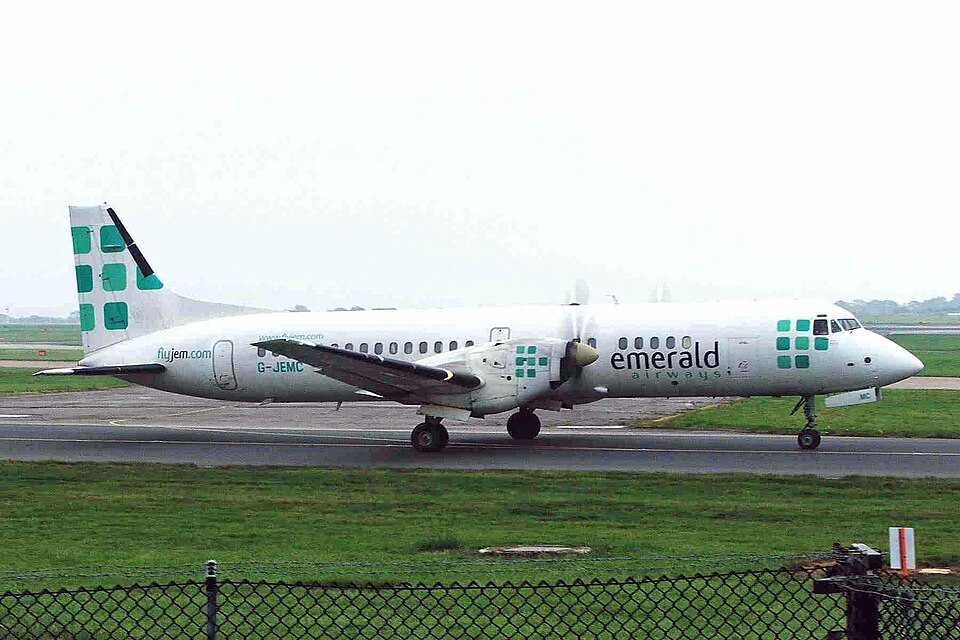
Incident Overview
On 23 May 2005, a British Aerospace ATP aircraft, registration G-JEMC, operated by Emerald Airways, experienced a serious incident shortly after takeoff from Isle of Man (Ronaldsway) Airport. The aircraft, configured with 64 seats, was carrying 33 passengers and a crew of four. Approximately 10 nautical miles southeast of the airport, a seal in the retraction line of the hydraulically operated forward left cabin door airstairs failed, causing hydraulic fluid to escape as a fine mist into the passenger cabin.
Sequence of Events
The mist, perceived by the cabin crew as smoke, prompted them to inform the flight crew via interphone. In response, the cabin crew relocated passengers toward the rear of the cabin to minimize exposure to the mist. This movement shifted the aircraft's center of gravity (CG) beyond the operator's specified aft limit.
The commander declared an emergency (PAN and later MAYDAY) to air traffic control and decided to return to Ronaldsway. During the approach, the Enhanced Ground Proximity Warning System (EGPWS) alerted the crew to an incorrect flap setting for landing, which was then corrected. After landing, the aircraft taxied clear of the runway, but nosewheel steering difficulties forced the commander to stop short of the terminal buildings. One passenger with asthma was taken to a local hospital but was discharged without requiring treatment.
Causal Factors
The investigation identified two primary causal factors: 1. A combination of a stuck door safety microswitch plunger and a jammed-on airstairs UP switch allowed hydraulic pressure to remain applied to the airstairs retraction actuators during flight. This led to the failure of a hydraulic seal, resulting in fluid discharge as a fine mist. 2. The flight crew's non-adherence to Standard Operating Procedures (SOPs) and associated checklists increased risk by failing to properly manage the situation, including not following smoke-related checklists, not associating the hydraulic low-level warning with the smoke report, and not addressing the implications of passenger movement on CG.
Findings and Recommendations
The investigation noted several findings, including that the crew was properly licensed and rested, the aircraft documentation was in order, and there were no prior maintenance checks required on the airstairs operating system. The cabin crew did not seek the commander's approval before moving passengers, and the commander did not request clarification or take corrective action regarding the CG shift.
A safety recommendation (2006-069) was issued to the UK Civil Aviation Authority, advising that cabin crew training include awareness of handling problems from CG shifts due to passenger redistribution and the need to inform and seek flight crew approval before such moves.
Aftermath
Following the incident, the operator's Air Operator's Certificate was suspended by the CAA on 4 May 2006, and the company effectively ceased trading. No further safety recommendations were made.