Background
On 15 June 2006, a Boeing 737-300, registration OO-TND, operated by TNT Airways Limited, was on a scheduled cargo flight from Liège Airport to London Stansted Airport. Due to unexpectedly poor weather conditions at Stansted, the crew diverted to Nottingham East Midlands Airport (EMA). The weather at EMA required a CAT IIIA approach and landing.
Events
During the approach to Runway 27, at approximately 500 ft above ground level, air traffic control (ATC) transmitted a company message indicating that the aircraft was not to land at EMA and that, at the crew's discretion, they were approved to go-around. The commander, who was the pilot flying, attempted to reply to and clarify this message. In doing so, he inadvertently disconnected both autopilots.
At around 400 ft above aerodrome level, the commander attempted to re-engage the autopilots but only succeeded in engaging one autopilot in control wheel steering (CWS) modes. The aircraft diverged to the left of the runway centreline and developed a high rate of descent. The co-pilot called for a go-around only after the aircraft had contacted the ground. The commander initiated a go-around after hearing the Enhanced Ground Proximity Warning System (EGPWS) 'SINK RATE PULL UP' warning at a radio altimeter height between 87 ft and 59 ft, and after seeing the green grass ahead. The go-around was initiated too late to prevent the aircraft striking the ground.
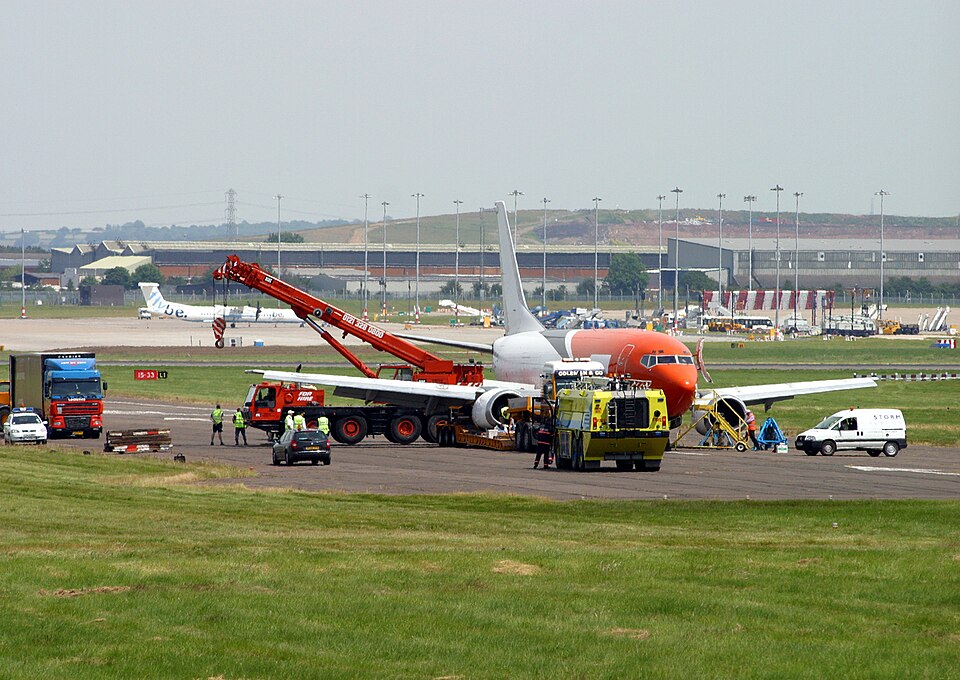
The aircraft made contact with the sterile grassed area to the left of Runway 27, abeam the threshold. During this ground contact, the right main landing gear detached from the wing, causing damage to the right flaps and loss of hydraulic System A. The aircraft became airborne again, and the crew experienced a short period of confusion before the commander resumed control. The aircraft was flown to Birmingham Airport (BHX) with the nose and left landing gear down, and with the trailing edge flaps stuck at 32° on the left and 40° on the right, producing a tendency to roll left.
At Birmingham, the Runway 15 ILS glideslope transmitter was switched off following maintenance, so the commander decided to accept a longer route to carry out an ILS approach for Runway 33. This allowed a police helicopter to inspect the damaged aircraft. A successful partial gear-up emergency landing was made.
Findings
The investigation determined that the following causal factors contributed to the accident:
- ATC inappropriately transmitted a company R/T message at a late stage of the CAT III automatic approach.
- The commander inadvertently disconnected the autopilots in attempting to respond to the ATC message.
- The commander lost situational awareness in the latter stages of the approach.
- The performance of both pilots may have been adversely affected by tiredness due to overnight duty periods and the low point in their circadian rhythm.
- The crew did not make a decision to go-around when required.
Contributory factors included: the commander re-engaging one autopilot during a CAT III approach after inadvertent disconnection; the co-pilot not calling 'go-around' until after ground contact; and the ineffective training of the co-pilot regarding his authority to call for a go-around. The flight crew were properly licensed and medically fit, and the aircraft was serviceable up to the moment of ground impact.
Safety Recommendations
One safety recommendation was made: that the Kingdom of Belgium Civil Aviation Authority require TNT Airlines to review their standard operating procedures to ensure that it is clear to all pilots when a go-around is required. Additionally, the report noted that the timing and content of the ATC message was inappropriate, and that the revision of MATS Part 1 (effective 31 July 2006) addressed this issue. The meteorological reporting system at EMA was upgraded in April 2007 to include automatic reporting of RVR data.