Introduction
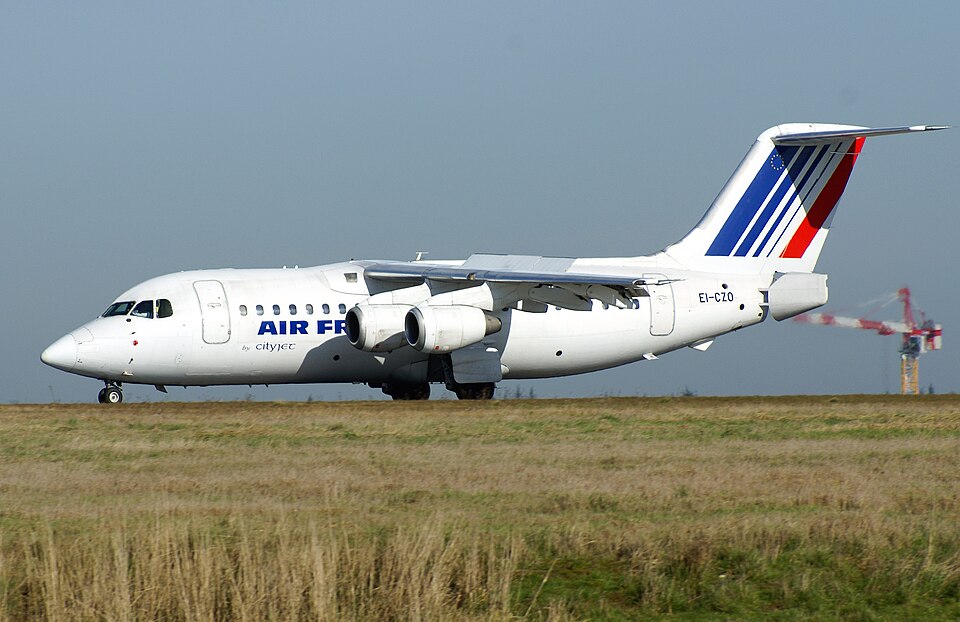
On 20 February 2007 at 0833 hrs UTC, a serious incident occurred at London City Airport involving a BAe 146-200 aircraft, registration EI-CZO, operated by CityJet. The aircraft burst all four main landing gear tyres during landing and overran the landing distance available (LDA), though it remained on the paved surface. The Air Accidents Investigation Branch (AAIB) conducted an investigation.
Synopsis
The flight crew reported a total failure of the aircraft's brakes. Enquiries revealed that the aircraft overran the LDA but stayed on paved ground. In light of previous overrun events involving the BAe 146 and Avro RJ series, the Chief Inspector of Air Accidents ordered a full investigation.
Causal Factors
The following causal factors were identified: 1. The incorrect determination of the approach reference speed (VREF) as 119 kt resulted in the aircraft landing faster than necessary. The correct VREF for the actual landing weight was 110 kt. 2. Data suggested the control columns may have been positioned forward of their customary position after touchdown, which could have reduced the aircraft's weight on the main wheels during the early landing roll. 3. Despite the commander's recollection of moving the airbrake/lift spoiler lever to the 'lift spoiler' position, the lift spoilers did not deploy, although the system was serviceable. 4. The non-deployment of lift spoilers prevented timely transfer of weight to the main wheels, reducing wheel brake effectiveness. 5. The commander's perception of brake system failure led him to select the emergency braking system, which removed anti-skid protection. 6. The lack of any positive force required to hold the lift spoiler lever at activation probably resulted in the lever moving away before deployment logic could be satisfied.
Findings
The flight crew was properly licensed and medically fit, and operated within duty time limits. The aircraft's documentation was in order. The operator required landings at London City Airport to be carried out only by aircraft captains; the commander was pilot flying. The approach was flown at 124 kt (VREF 119 kt plus 5 kt). The aircraft touched down at the far end of the touchdown zone with a pitch attitude of zero degrees and an indicated airspeed of 119 kt; correct touchdown speed was 103 kt. After touchdown, the commander selected thrust levers to ground idle, moved the airbrake/lift spoiler lever to 'lift spoilers', and applied rudder pedal brakes. As the co-pilot was about to check for lift spoiler deployment and brake pressure, the commander called "NO BRAKES". He then selected the wheel brake hydraulic system from Green to Yellow, and subsequently the emergency braking system. Skid marks indicated all four main wheels locked over the last 473 m of ground roll, causing all tyres to deflate. The aircraft halted on paved surface beyond the LDA, approximately 160 m from the dock edge, after a ground roll of 1,027 m. The flight crew was unaware of the tyre failures. Examination found no defects in lift spoiler or braking systems. The force required to move the lift spoiler lever from lift spoiler to airbrake was close to zero, within maintenance limits, but a non-mandatory modification to increase that force to 12 lb had not been embodied on EI-CZO.
Conclusions
The combination of touching down at a speed higher than appropriate for the aircraft's weight, the failure of lift spoilers to deploy, the commander's mistaken belief that wheel braking systems had failed, and an incorrect braking technique caused the aircraft to overrun the LDA. Use of the emergency braking system, not fitted with anti-skid, caused all four main tyres to burst.
Safety Recommendations
Three safety recommendations were made: (1) EASA should mandate BAe Systems Service Bulletin 27-73-00889 for the BAe 146 series to increase operating force of the lift spoiler lever; (2) Cityjet should incorporate allowable deviation criteria for steep path ILS approaches into their Operations Manual; (3) Cityjet should remind flight crews to preserve recorded data on flight data and cockpit voice recorders after incidents.