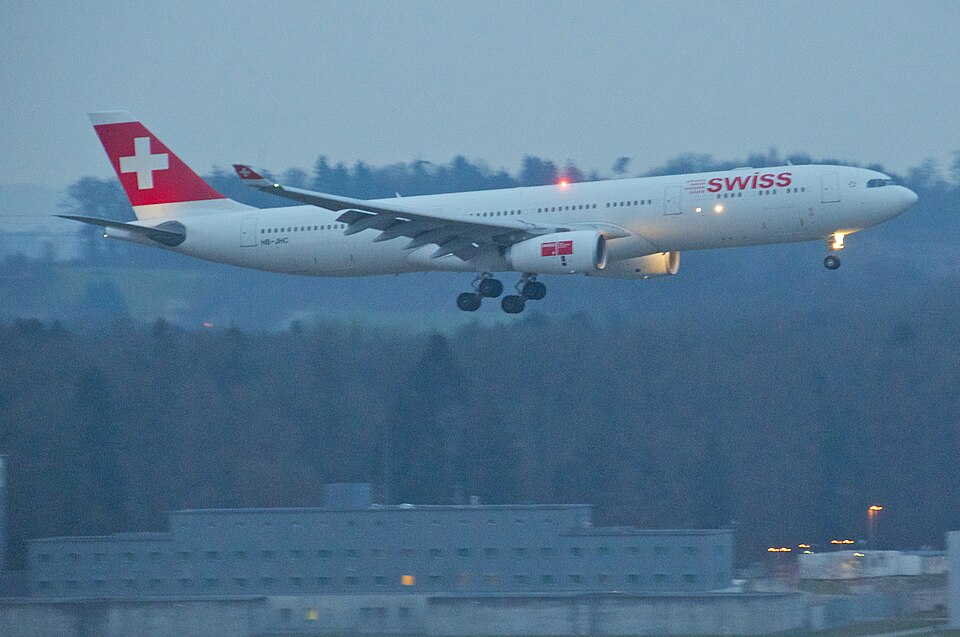
On November 26, 2015, an AIRBUS S.A.S. A330-343 (registration HB-JHC) was involved in an aviation accident near Zürich Flughafen (LSZH), ZH, CH. This summary draws on records from the Swiss Transportation Safety Investigation Board (STSB / SUST).
A Swiss A330-343 (HB-JHC) suffered a hydraulic leak during climb-out from Zurich on 26 Nov 2015. The flight returned and landed safely with no injuries.
Overview and Flight Details On 26 November 2015, Swiss International Air Lines flight LX18, operating an Airbus A330-343 with registration HB-JHC, departed Zurich (LSZH) for Newark (KEWR). The aircraft had been on the ground for eleven days following a C-Check. The flight was conducted under instrument flight rules (IFR) with the copilot as pilot flying and the captain as pilot monitoring. ## Incident Progression Approximately five minutes after takeoff, while climbing on the VEBIT 3S standard instrument departure route, the crew received a master caution warning for a green hydraulic system leak (HYD G LEAK), accompanied by a single chime. This occurred after the landing flaps had been retracted one stage. Subsequent warnings indicated low reservoir level and low pressure from the engine-driven pumps. The crew interrupted the climb, maintained a speed of 210 knots, requested a holding pattern over the GIPOL waypoint at flight level 120, and issued a PAN-PAN urgency call. ## Crew Actions and Health Effects The crew determined that the flight could not be continued. They informed the passengers and followed electronic centralized aircraft monitoring (ECAM) procedures, discussing the consequences of system failures, including the loss of nose wheel steering and the requirement for gravity gear extension. A smell of hydraulic fluid was detected in the cockpit and cabin. The copilot experienced headaches and put on an oxygen mask. Some passengers and crew members later reported nausea and headaches. The cabin air source was switched from the engines to the auxiliary power unit (APU). ## Landing Decision and Execution Because the ECAM display did not show a “land as soon as possible” message, the situation was not time-critical. The crew considered the trade-offs of landing below the maximum landing mass of 187 tonnes, which would have required a holding time of at least three and a half hours, given the presence of potentially toxic hydraulic fumes. Maintenance advised that no major inspection would be required if the landing occurred over the maximum landing mass, provided the touchdown sink rate did not exceed 360 feet per minute. The crew decided to reduce fuel mass in the holding pattern for one hour with flaps 2, aiming for an approach mass of approximately 205 tonnes. The aircraft was not equipped with a fuel dumping system. The crew conducted an instrument landing system (ILS) approach to runway 16 under radar vectors. The captain served as pilot flying. The sink rate at touchdown was approximately 300 feet per minute, and the aircraft came to a stop at intersection E7. About ten minutes after landing, the brakes reached a maximum temperature of approximately 425 degrees Celsius. Passengers deplaned via the jet bridge. ## Post-Flight Findings A post-flight debriefing was led by the captain. The following day, cabin crew members were contacted by the duty officer to check their health. One flight attendant reported nausea, dizziness, and disturbances in taste, smell, memory, and concentration. A medical examination approximately 24 hours after the flight and hematological results showed no pathological findings. Following the incident, engine-driven pumps EDP1 and EDP2 were replaced. Metal fragments were found in their case drain filters. A sample of the green hydraulic system fluid analyzed five days later was satisfactory. Further investigation revealed internal damage to both pumps, with EDP1 showing more severe damage and seizure of the rotating group. Existing wear was noted on the piston shoes after approximately 34,000 flight hours. ## Weather Conditions At the time of landing, the Zurich METAR reported visibility of 10 km or more, wind from 360 degrees at 3 knots with a directional variation from 310 to 030 degrees, temperature of 3 degrees Celsius, dew point of 2 degrees Celsius, and QNH of 1019 hPa. Clouds were reported at various altitudes, with showers observed in the vicinity of the airport. No hazards were indicated.