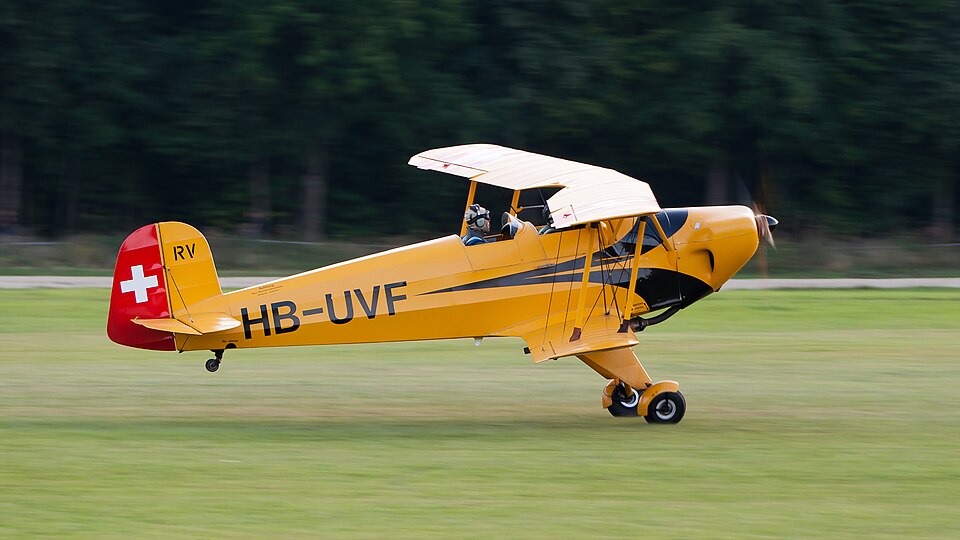
On May 9, 1997, an AG FÜR DORNIER-FLUGZEUGE BÜ 131 APM (registration HB-UVF) was involved in an aviation accident near Alp Grossrisch, LU, CH. Investigators recorded the probable cause as: Late recognition of the deteriorating weather situation followed by a forced landing on unsuitable terrain. This summary draws on records from the Swiss Transportation Safety Investigation Board (STSB / SUST).
On 9 May 1997, a Bücker Bü 131 (HB-UVF) made a forced landing at Alp Grossrisch after rapid weather deterioration. Both occupants were lightly injured and the aircraft was heavily damaged.
Overview and aircraft details On 9 May 1997, a Bücker Bü 131 biplane registered HB-UVF was involved in an accident at Alp Grossrisch in the municipality of Entlebuch, canton Lucerne. The aircraft was owned and operated by Aéro-Club Suisse, based in Prangins. The flight was an aerobatic training flight, and the aircraft was approved for aerobatic operations with no technical defects reported. ## Flight and weather conditions The flight departed from Kägiswil at 1340 local time (UTC+2) for an approximately 20-minute aerobatic training flight west of the Schlierengrat. At departure, weather at Kägiswil was good, with a cloud base above 2,000 m. The flight instructor, a Swiss national born in 1948 with a professional pilot licence, occupied the rear seat, while the student pilot, a Swiss national born in 1964 with a private pilot licence, occupied the front seat. During the flight, the pair trained loops and rolls at a working altitude of 100 m. The instructor observed rapidly approaching clouds and decided to return to Kägiswil before the planned flight time elapsed. As clouds developed, the aircraft had to descend on the north side of the Schlierengrat to about 1,800 m. Approaching the Glaubenbergpass from the north, further descent was required due to weather. The pass crossing was only narrowly clear, and because of a high-voltage line, a change in the direction of the motorway at the pass, and limited space for a turn, the instructor chose to attempt other exits from the area. Within minutes, clouds formed in the operating area, and all exits for safe visual meteorological conditions (VMC) became impassable. A northern exit with descent was also impossible because a cloud front reached the ground in the Schwändili area. The aircraft became trapped between Schimbrig, Risetenstock, the Schlierengrat, the Glaubenbergpass, and Fürstein. After careful consideration, the instructor decided on a forced landing in very difficult terrain. ## Accident outcome and findings The aircraft was heavily damaged during the off-airfield landing. Both pilots were able to leave the aircraft under their own power and were lightly injured. For safety reasons, the student pilot was hospitalised for more than 48 hours over the weekend. The investigation found that both crew members held valid licences. The aircraft was approved for aerobatic flights and had no technical defects. According to the Swiss Meteorological Service, a cold front associated with a low-pressure system over the United Kingdom crossed Switzerland. At the accident location and time, snow and rain showers were developing, the cloud base was rapidly falling from 6,000 ft to below 4,000 ft, visibility was dropping from 15 km to below 1 km, wind was from 260° at 20 kt with gusts to 45 kt, temperature was 0°C, dew point was -7°C, and QNH was 1,006 hPa. ## Assessment The crew was surprised by a rapidly deteriorating weather situation. The investigation concluded that the weather development was assessed too optimistically, leading to a critical situation. The crew realised that attempts to reach the various exits from the valley were always slightly too late, leaving the aircraft in VMC but trapped. The decision to make a controlled landing in unsuitable terrain was judged to be correct. The investigation noted that a controlled landing in unsuitable terrain offers greater safety than entering clouds or attempting a low-speed turn, which often ends tragically. The instructor applied the principle of keeping the aircraft controlled toward the ground, even in unsuitable terrain, and deliberately avoided the more dangerous options of continuing into clouds or attempting a turn.
Probable cause
Late recognition of the deteriorating weather situation followed by a forced landing on unsuitable terrain.