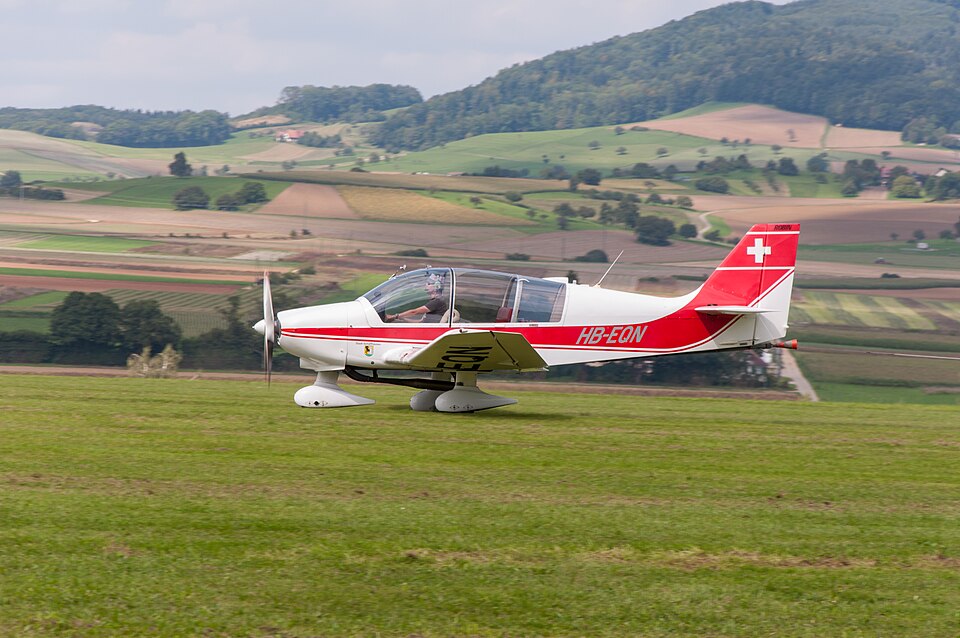
On March 19, 2016, an AVIONS PIERRE ROBIN S.A. ROBIN DR 400/180 R (registration HB-EQN) was involved in an aviation accident near Schaffhausen Flugplatz (LSPF), SH, CH. This summary draws on records from the Swiss Transportation Safety Investigation Board (STSB / SUST).
A Robin DR 400/180 R, registration HB-EQN, overran the runway at Schaffhausen (LSPF) on 19 March 2016 during a training flight. The aircraft was lightly damaged; no injuries were reported.
Incident Overview On 19 March 2016 at 15:20 local time, a Robin DR 400/180 R with registration HB-EQN overran the end of runway 07 at Schaffhausen (LSPF) during a training flight. The aircraft was lightly damaged, and the two occupants were not injured. ## Aircraft and Personnel The aircraft was owned and operated by Segelfluggruppe Schaffhausen. The pilot was a Swiss national born in 1938, holding an EASA private pilot licence for aeroplanes issued by the Federal Office of Civil Aviation (BAZL). The pilot had a total of 892 flight hours, including 626 hours on the accident type. The accompanying instructor was a Swiss national born in 1960, holding an EASA airline transport pilot licence for aeroplanes and a class rating instructor qualification for aeroplanes, with a total of 13,062 flight hours, including 283 hours on the accident type. ## Flight Details The flight was a visual flight rules (VFR) training exercise conducted as part of an annual internal check flight. The programme included two touch-and-go landings and a full-stop landing, all on runway 07, which had an available length of 540 m and a width of 30 m. A strip of plastic ground plates about 5 m wide ran along the runway to prevent gear sinking in soft conditions. The designated touchdown point for the landing exercises was near the fuel station, approximately 220 m from the runway threshold. ## Sequence of Events The first touch-and-go landing was uneventful. During the second approach, the aircraft was somewhat high and fast, prompting the instructor to command a go-around. On the third approach, intended for a touch-and-go, the aircraft touched down slightly beyond the defined point. The pilot then climbed to 3,500 ft above mean sea level, where the instructor reduced engine power to begin an emergency landing exercise. On final approach, the pilot set the landing flaps. The aircraft was again somewhat high and fast and touched down about 70 m beyond the defined point, roughly 250 m from the runway end. The pilot applied the wheel brakes, but braking effect was limited on the relatively smooth surface. The instructor judged that the remaining runway length might be insufficient and steered the aircraft slightly to the right to gain additional roll-out distance. The aircraft continued rolling about 30 m on grass, crossed a field road running perpendicular to the runway, and came to rest after about 5 m in soft farmland. The nose gear sank into the ground, the propeller contacted the ground, and the engine shut down automatically. The crew then switched off the ignition and electronic switches and left the aircraft uninjured. ## Damage and Investigation The aircraft sustained light damage to the nose gear and propeller. No third-party damage was reported. The investigation found no indications of pre-existing technical defects that could have caused or contributed to the accident. The summary investigation was conducted under Article 46 of the Swiss Ordinance on the Safety Investigation of Incidents in Transport (VSZV).