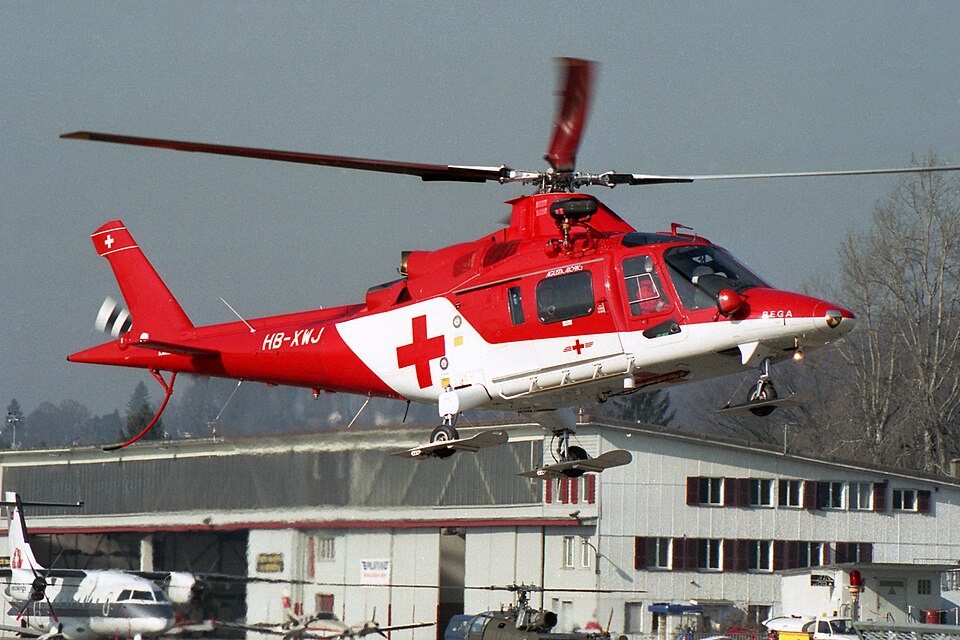
Structural Design Flaw in Hospital Helipad Triggers Ground Resonance

Casualties unknown • Samedan, GR, CH

An Agusta A109K2 helicopter sustained significant damage during a landing at Samedan Hospital due to ground resonance caused by an improperly designed rooftop helipad.

What happened

On the evening of 23 June 2008, an Agusta A109K2 helicopter, registration HB-XWJ, was performing a landing at the rooftop helipad of Samedan Hospital. The flight, which included a pilot, a paramedic, and a doctor, began from Samedan Airport.

Upon touchdown, the pilot noticed a slight ground resonance. In an attempt to stabilize the aircraft, the pilot fully lowered the collective lever, but the lateral oscillations intensified rapidly. The pilot responded by pulling back the power levers and shutting down the engines. The resulting vibration caused severe damage to the aircraft, including a destroyed rotor blade and damaged landing gear. The helicopter ended up positioned at the edge of the platform, partially overhanging the hospital building. The helipad itself sustained damage, with platform gratings becoming detached and shifted.

The investigation

Investigators examined the structural integrity of the Samedan Hospital helipad and the technical condition of the aircraft. The investigation revealed that the helipad's design did not comply with ICAO Annex 14 Vol. II or the ICAO Heliport Manual. While the platform was rated for static loads of up to 4500 kg, the design failed to account for dynamic loads.

Technical analysis showed that the excitation frequency of the Agusta A109K2 (between 1 and 8 Hz) coincided with the natural frequency of the helipad (between 4.45 and 11.7 Hz) depending on the landing position. This overlap triggered the resonance. Additionally, the investigation looked into the aircraft's autopilot system, finding that a defective technical condition in the autopilot may have contributed to the event.

Findings

  • The primary cause of the accident was ground resonance resulting from the incorrect structural design of the helipad.
  • The helipad failed to incorporate necessary considerations for dynamic loads during its design phase.
  • A technical deficiency in the aircraft's autopilot system may have acted as a contributing factor.
  • At the time of the accident, the aircraft's mass and center of gravity were within permitted operational limits.
  • The investigation noted that a similar ground resonance incident had occurred on the same platform in October 2009.

Probable cause

The accident was caused by ground resonance during landing, stemming from a helipad design that failed to account for dynamic loads, potentially exacerbated by a malfunction in the aircraft's autopilot system.

Frequently asked questions

What happened in the 2008-06-23 COSTRUZIONI AERONAUTICHE GIOVANNI AGUSTA S.P.A. A109K2 accident near Samedan, GR, CH?

An Agusta A109K2 helicopter sustained significant damage during a landing at Samedan Hospital due to ground resonance caused by an improperly designed rooftop helipad.

What aircraft was involved and where did it happen?

The accident on 2008-06-23 involved a COSTRUZIONI AERONAUTICHE GIOVANNI AGUSTA S.P.A. A109K2, registration HB-XWJ, at Samedan, GR, CH.

What was the probable cause of the accident?

The accident was caused by ground resonance during landing, stemming from a helipad design that failed to account for dynamic loads, potentially exacerbated by a malfunction in the aircraft's autopilot system.

Investigation report by the Swiss Transportation Safety Investigation Board (STSB / SUST). Original record: https://www.sust.admin.ch/inhalte/AV-berichte/2122_e.pdf. This page is a structured re-presentation; facts and quotes are in the Swiss Transportation Safety Investigation Board (STSB), Switzerland.

Loading the flight search…