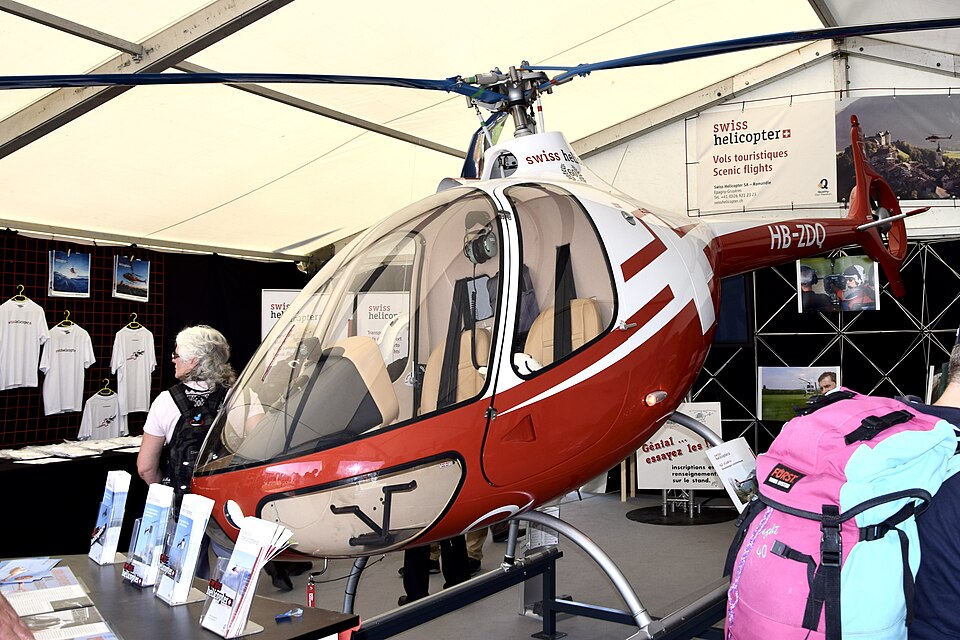
Accident Overview
On 15 June 2022, at approximately 14:00 LT, a Cabri G2 helicopter registered as HB-ZDQ departed from Gruyère Aerodrome (LSGT) for a private visual flight rules (VFR) flight with a pilot and one passenger. The helicopter was owned and operated by Swiss Helicopter AG. The intended route included Jaunpass, Lenk, Col du Pillon, Aigle, Lausanne, and return to Gruyère.
Flight Sequence
According to the pilot's statement and video recordings, after engine start and pre-takeoff checks, the pilot performed a hover and a 180° right turn to proceed toward runway 35. At approximately 50 meters height, while turning left to overfly the grass runway, the pilot could not stop the left yaw rotation. The pilot estimated indicated airspeed between 40 and 50 kt during the turn. The yaw rotation continued, with the helicopter turning multiple times to the left before stopping with a nose-down attitude. The pilot then pushed the collective lever halfway, and the rotation ceased. The helicopter transitioned to low-level straight flight, crossed the runway, then entered another left turn followed by a hard landing on skids in a field. The skids broke. The helicopter briefly became airborne again and settled heavily. The pilot shut down the engine and rotor and exited uninjured. The passenger reported back pain and was hospitalized for more than 48 hours. The emergency locator transmitter activated; no fire occurred.
Helicopter Information
The Cabri G2 is a two-seat helicopter with a skid landing gear, a three-blade main rotor (clockwise rotation), and a fenestron anti-torque system. At takeoff, the calculated mass was 627 kg, within the maximum takeoff mass of 700 kg. The center of gravity was within limits. The helicopter had undergone a 100-hour inspection on 23 May 2022, during which the engine and main transmission were replaced due to life limits. A 25-hour inspection was performed on 5 June 2022.
Damage and Examination
The on-site visual examination revealed: landing gear dislocated; fuselage resting on the cell; cabin intact; main rotor free to turn; fenestron lying flat on the ground with its attachment broken at the stabilizer; all flight controls connected except the rear transmission shaft, which was broken; dual controls at the left seat were removed. The wreckage was transported to the STSB hangar for further examination. The manufacturer confirmed the findings. Continuity of the rear rotor control chain was confirmed; control stop positions were correct; engine power control and cockpit indications were correct; the transmission shaft rupture was a consequence of fenestron impact with the ground.
Manufacturer Service Letters
The manufacturer had issued three service letters concerning the risk of loss of yaw control on the Cabri G2:
- SL 12-001 (2012): addressed yaw control during approach, noting that a right quartering tailwind is an aggravating factor and that an inadvertent left yaw requires immediate and significant right pedal input due to the fenestron's size and shape.
- SL 19-001 (2019): concerned throttle management in simulated engine failure.
- SL 19-002 (2019): addressed yaw control at low rotor rpm.
Injuries and Damage
One passenger suffered serious injuries (back pain, hospitalized >48h). The pilot was uninjured. The helicopter was strongly damaged. No other damage occurred.