Incident
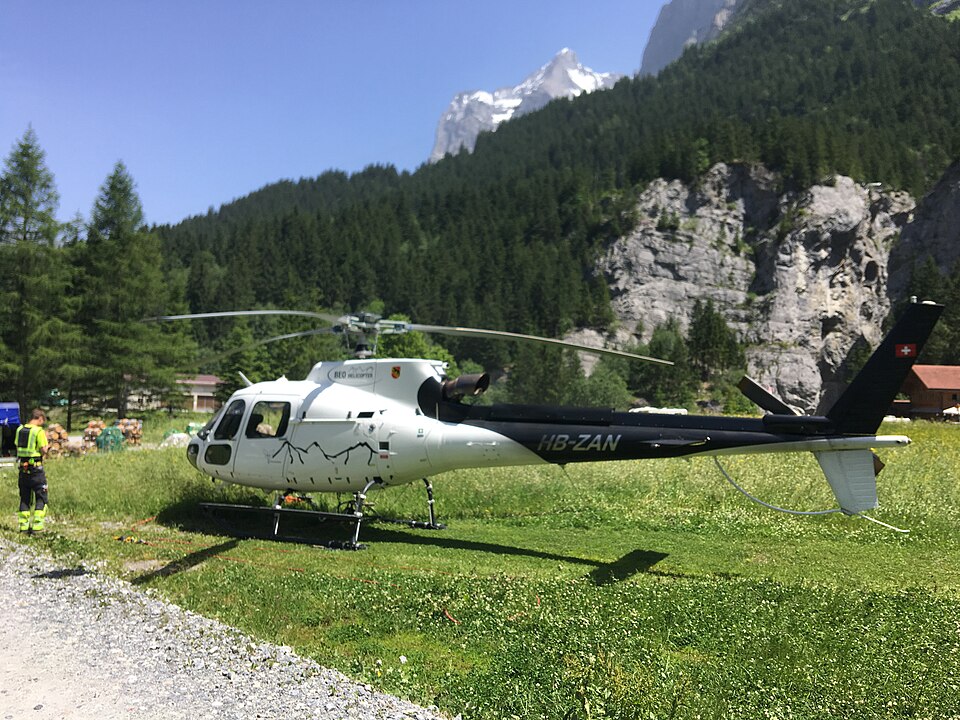
On 20 February 2018 at 14:20 local time, a serious airprox (ICAO category B) occurred over Insel Ufenau, Lake Zurich, Switzerland. The involved aircraft were an Airbus Helicopters AS350 B3 (registration HB-ZAN) operated by Fuchs Helikopter and two Swiss Air Force Boeing F/A-18C fighters (registrations J-5015 and J-5018). The closest distance between the helicopter and the fighters was less than 500 m horizontally and less than 100 m vertically.
Aircraft and Personnel
The helicopter pilot held a Swiss Commercial Helicopter Pilot Licence with 6734 total flight hours, including 5300 on type. The two fighter pilots each held military pilot licences; one had 2443 total hours (1816 on type) and the other 2423 total hours (1248 on type). The helicopter was equipped with a transponder and a Flarm collision avoidance system. The fighters had transponders and onboard radar but no collision warning devices.
Sequence of Events
The two F/A-18C fighters, with call signs "Hammer 21" and "Hammer 22", departed Payerne Air Base to identify a foreign state aircraft flying along airway G5. After identification, they flew a planned navigation route at about 1000 ft AGL over Thun, Bern, Burgdorf, Emmen, Zug, Lake Zurich, and onward. Their ground speed was approximately 355 kt at 2400 ft AMSL.
Meanwhile, the helicopter pilot was conducting external load operations using a 50 m cable between Pfäffikon SZ harbor and Insel Ufenau. After dropping a load on the island, he accelerated back toward Pfäffikon. His ground helper warned him by radio about two F/A-18s approaching from the west. The helicopter pilot saw the fighters crossing his path from west to east at an estimated distance of 250 to 500 m and about 100 m above. The helicopter's Flarm did not issue a warning. The helicopter's transponder and radio were on, and the frequency of Wangen-Lachen airfield was selected.
The military FLORAKO radar system recorded the fighters' tracks at 14:11, but the helicopter was not visible on radar, likely due to its low altitude. The tactical control unit did not issue traffic warnings to the fighters because no traffic was seen on radar. The fighter pilots had no radar or visual contact with the helicopter. All aircraft continued their flights without further incident.
Analysis
The analysis noted that the helicopter's low altitude prevented radar detection. Why the fighters' onboard radar did not detect the helicopter could not be determined. The fighters' radar display is located in the lower instrument panel, requiring head-down attention to see targets; it does not automatically show on the head-up display. The high speed of the fighters (355 kt at low altitude) reduced reaction time for evasive maneuvers. The diffuse visibility conditions made visual detection of the helicopter difficult. No collision warning system was installed in the fighters. The flight paths crossed at nearly right angles, so even if visually detected, the fighters would not have needed to maneuver to avoid a collision. The analysis concluded that a compatible collision warning system on the fighters could have prevented the dangerous proximity.
Conclusions
The serious incident occurred with a close proximity of less than 500 m horizontal and less than 100 m vertical. No causal factors were explicitly stated in the report.