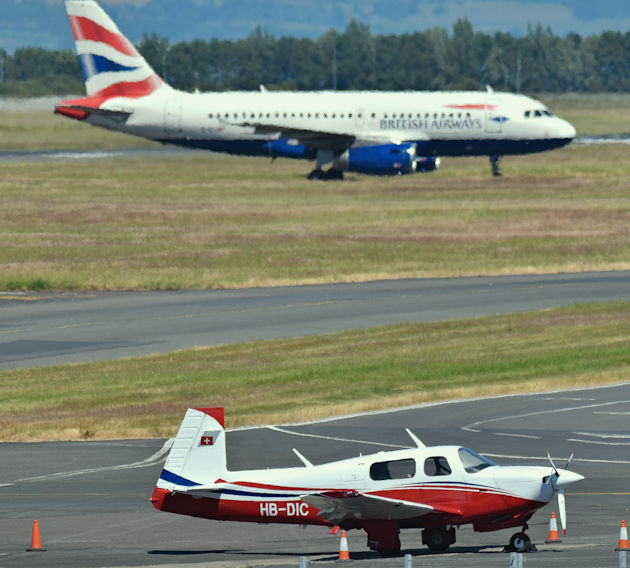
Flight and Incident
On Saturday, 5 December 1998, a privately owned Mooney M20J, registration HB-DIC, departed from Birrfeld airfield at 1550 local time with a pilot and one passenger. The pilot had refueled to approximately 40 US gallons. The intended flight was a round trip of less than one hour. The flight initially proceeded eastward, climbing to 3500 ft over Mellingen and then to 4000 ft near Beinwil and Reinach. Due to deteriorating visibility, the pilot turned back but found poor conditions near Mellingen, so he diverted toward the Hallwilersee area where conditions were better. He considered landing at Triengen but rejected it due to the short runway, then proceeded to Hausen am Albis. Over that airfield, the snow-covered terrain made it difficult to identify the runway, so he continued toward Wangen-Lachen, where visibility was better.
Landing Gear Failure
Approaching Wangen-Lachen following the published procedure, the pilot reduced speed and activated the landing gear lever. The green indicator light did not illuminate. A second attempt also failed. The pilot set flaps to the mid position and pulled the circuit breaker to manually extend the gear. After two to three pulls, he felt a firm stop. Repeated attempts with both electric and manual systems were unsuccessful. The pilot then decided to land with the gear retracted. He selected runway 08, flew the approach at 80 to 75 knots, and touched down gently near the taxiway, slightly left of centerline. The landing occurred at 1645 local time. The snow on the ground allowed the aircraft to slide a long distance; it came to rest approximately 60 meters east of the runway end. The occupants evacuated the aircraft without injury. Damage included the propeller, landing gear, and underside of the fuselage. There was no third-party damage.
Post-Accident Examination
During recovery, the aircraft was lifted and moved. After removing external snow, the landing gear, which had extended a few centimeters, operated normally and locked. The wheel wells were partially filled with frozen snow. On 11 December 1998, after the aircraft was placed on jacks and the left pushrod (slightly deformed from the landing) was temporarily straightened, functional tests showed that both electric and manual gear extension worked correctly multiple times. Manual extension required about ten pulls before a spring pressure was felt, followed by a positive stop. The locking mechanism was found to be in order. No mechanical or electrical faults were found.
Weather Conditions
At the time of the accident, weather was characterized by a northwesterly flow with a stable situation on the northern Alpine slope. A cold front had passed, and a moist, unstable polar air mass reached the Swiss Plateau. At 1645 local time, a snow band lay along the Greifensee-Hallwilersee axis. Visibility ranged from 4 to 8 km, locally reduced to 2-3 km in snow showers. Wind was around 285 degrees at 6 knots, gusting 12-15 knots. Temperature at Wangen-Lachen was 0.0°C with dew point -5.0°C. At Birrfeld, snow was present on the apron; the taxiway was about 60% cleared, and the runway was clear. The end of civil twilight was at 1717 local time.
Cause
The accident investigation determined the cause to be blocking of the landing gear due to ice formation in the wheel wells, followed by an emergency landing.