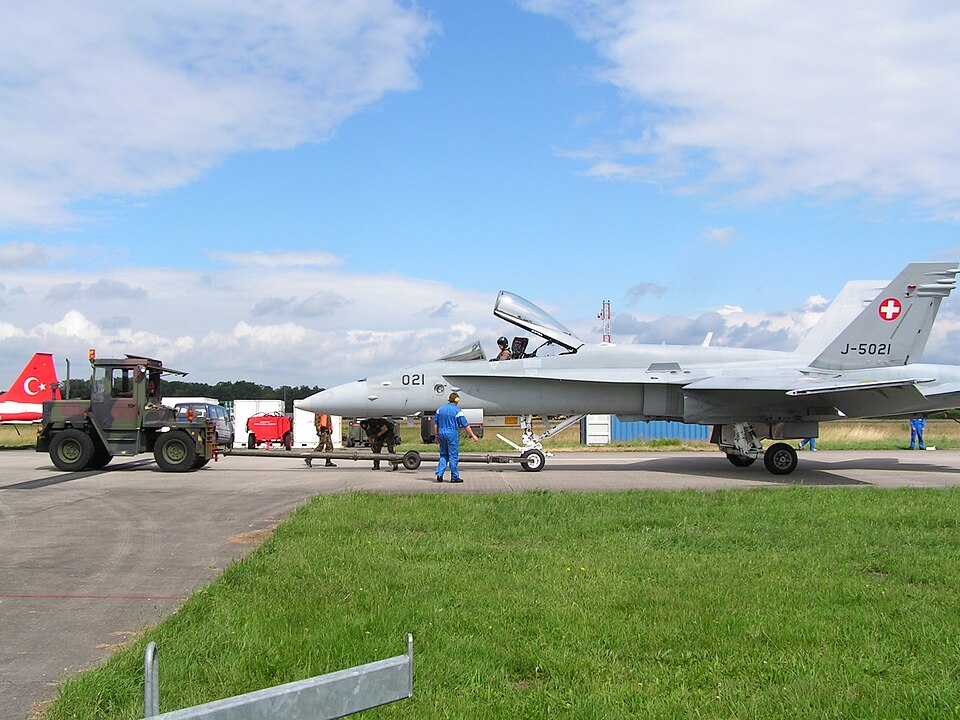
On October 2, 2018, a BOEING F/A-18 (registration J-5021) was involved in an aviation accident near Thunersee, BE, CH. This summary draws on records from the Swiss Transportation Safety Investigation Board (STSB / SUST).
On 2 October 2018, a Swiss Air Ambulance AW109SP helicopter and three F/A-18 Hornets came within about 100 m horizontally and 50 m vertically over Lake Thun. The helicopter pilot evaded after collision alerts.
Incident Overview On 2 October 2018 at approximately 15:36 local time, a dangerous proximity (airprox) occurred over Lake Thun in the canton of Bern, Switzerland. The incident involved a civil helicopter and three military fighter aircraft in Class E airspace. The minimum separation was estimated at about 100 m horizontally and 50 m vertically. ## Aircraft and Operations The civil aircraft was an Agusta Westland AW109SP helicopter registered HB-ZRP, owned and operated by Schweizerische Luft-Ambulanz AG (Swiss Air Ambulance) based in Zürich. It was conducting a training flight under visual flight rules (VFR), departing from the Rega base at Wilderswil (LSXI) near Interlaken and climbing westward toward Lake Thun. The helicopter was equipped with a transponder, a Traffic Advisory System (TAS), and a Floice collision-avoidance device. The three military aircraft were Boeing F/A-18 Hornets owned by the Swiss Confederation. They were operating under VFR in a military formation, departing from Meiringen (LSMM) and climbing toward Interlaken. They were equipped with transponders, radar, and a Combined Interrogator Transmitter (CIT). ## Sequence of Events The helicopter pilot was listening on the Meiringen military airfield frequency and learned shortly after takeoff that three F/A-18s had departed in formation toward Interlaken. In the Interlaken area, the F/A-18 pilots adjusted their flight paths to avoid gliders and two other fighter aircraft. The lead F/A-18 pilot reported over radio that he had identified the two other fighters and that they posed no threat. The helicopter pilot partially heard this transmission and interpreted it as indicating that the F/A-18 crews had his helicopter in sight. His collision-avoidance display showed the approaching fighters from behind, with the advisory changing from a proximity advisory to a traffic alert. At the same time, he initiated a descending evasive maneuver and shortly afterward saw the fighter formation above and to his right. He estimated the vertical separation at 150 to 200 ft. The lead F/A-18 pilot first saw the helicopter shortly before closest approach, below and to the left of his flight path, and then instructed his formation to climb. He estimated the minimum distance to the helicopter at about 100 m. ## Weather and Airspace Weather conditions were good and did not influence the incident. At 4,400 ft AMSL, the wind was 2 kt from 270°, visibility was 10 km or more, and there was local light drizzle. Clouds were 5/8 to 7/8 at 11,000 ft AMSL, the temperature was 3 °C, the dew point was -9 °C, and QNH was 1024 hPa. The incident occurred in Class E airspace, where crews are responsible for maintaining separation under the “see and avoid” principle. ## Analysis and Conclusions The helicopter’s collision-avoidance equipment detected the approaching fighters and displayed them in the cockpit, allowing the pilot to take evasive action. The fighter aircraft were not equipped with a collision-avoidance device, so their pilots saw the helicopter only late in the approach. The Swiss Transportation Safety Investigation Board (STSB) noted that equipping military aircraft with collision-avoidance devices compatible with civil standards would be an effective safety measure. It had already issued Safety Recommendation No. 474 in 2013 on this subject and therefore closed the investigation with this summary report.