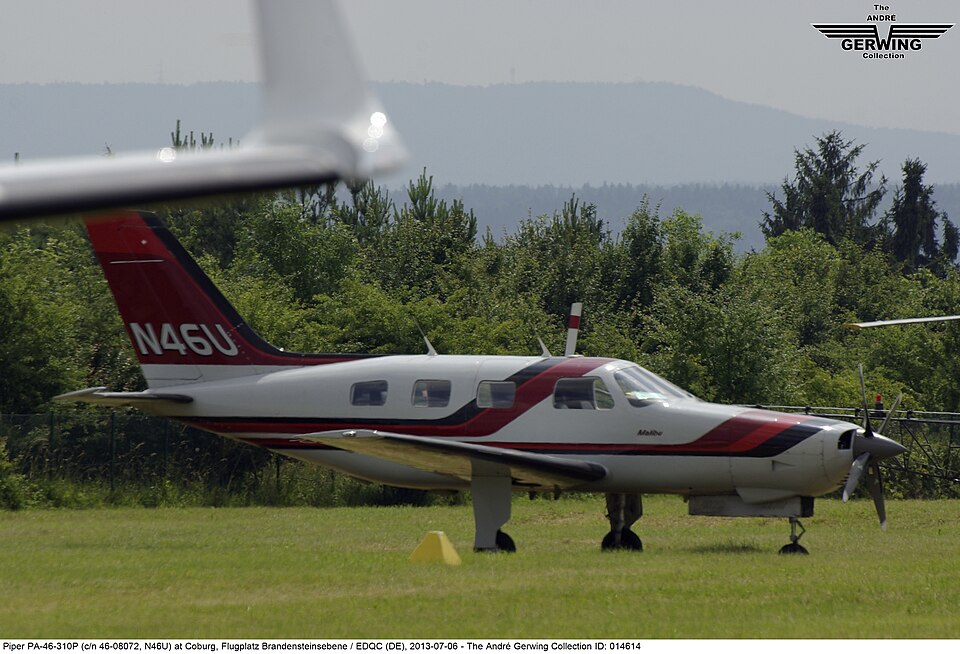
Course of Events
On 9 January 2017, at approximately 11:07 local time, a Piper PA46-310P (Malibu), registered as N46U, was preparing for a private flight from Birrfeld Airport (LSZF) to Straubing Wallmühle (EDMS) for its annual inspection. A safety pilot, familiar with the aircraft, accompanied the pilot-in-command. The temperature was well below freezing, with -1°C at the time of the incident, and the tarmac runway was partially covered in snow.
According to the pilot, the aircraft was refuelled before the flight and 1 part per thousand of methyl glycol was added as a fuel system icing inhibitor. Pre-flight checks, including draining fuel tanks for water, revealed no issues. The engine started and ran smoothly during run-up. The pilot taxied to the holding point for runway 26, checking magnetos, then began the take-off run. When lifting the nose landing gear at an indicated airspeed of approximately 80 knots, a marked loss of power occurred. The pilot immediately aborted the take-off, steering slightly right in a north-westerly direction where more distance was available beyond the runway. The aircraft overshot the end of runway 26 by about 40 meters and came to a stop in adjacent snow-covered meadowland. Both occupants were unhurt. The pilot taxied the aircraft back to the apron; the only damage was a bent nose landing gear fork.
Investigation Findings
Approximately two hours after the incident, a static engine test was performed. The engine started immediately, ran normally across all operating ranges up to take-off power, and performed perfectly after over a minute at maximum power. A visual inspection of the air filter and engine bay connecting pipes revealed nothing unusual. Fuel samples were taken from the outlet valve of both collector tanks and the fuel filter sump for laboratory analysis.
Two weeks later, the nose landing gear was reinstalled with a new fork, followed by an inspection of the engine and fuel system. This inspection found no explanation for the malfunction. A subsequent static engine test again showed perfect operation. That same day, N46U flew uneventfully from Birrfeld to Straubing.
Fuel Analysis
Laboratory analysis of the three fuel samples from the aircraft confirmed they met AVGAS 100LL specifications but revealed abnormal water content:
- Fuel filter sump: 30 mg/kg water, clear, no free water.
- Right collector tank: 110 mg/kg water, clear, no free water.
- Left collector tank: 430 mg/kg water, clear, containing approximately 0.5 ml of free water.
The report notes that at sub-freezing temperatures, water droplets in fuel can freeze into fine ice crystals that remain suspended due to density similar to fuel. These crystals can block fuel filters and cause engine power loss. An additive such as Prist (DEGMME) or isopropyl alcohol can inhibit icing when properly mixed. The pilot's operating handbook permits Prist at 0.1-0.15% by volume.
Analysis and Conclusions
The investigation found no engine abnormalities that could explain the loss of power during take-off. Given the high water content in the fuel samples, it is a fair assumption that the formation of ice crystals temporarily restricted fuel supply, leading to the power loss. The pilot acted logically by aborting the take-off and steering away from obstacles. The Swiss Transportation Safety Investigation Board (STSB) concluded the investigation with this summary report, citing no further investigation required.