Background
On April 25, 2011, a mountain biker sustained injuries after falling on a trail known as "Dättlikoner-Downhill" in the Frohberg area above Dättlikon, Zurich. His companion called the emergency center at 13:06, and paramedics from Winterthur Rescue Service were dispatched. After assessing the steep and slippery terrain, they requested a helicopter evacuation.
Accident Sequence
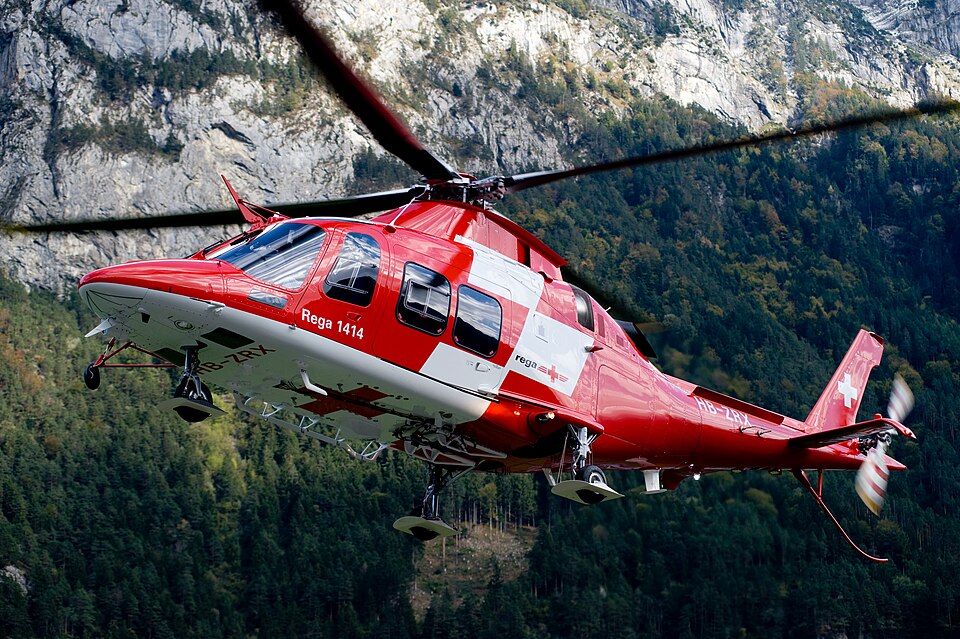
Rega (Swiss Air-Rescue) dispatched an Agusta AW109SP helicopter, registration HB-ZRX, from its St. Gallen base at 13:40. The crew consisted of a pilot, a flight physician, and a helicopter emergency medical service (HEMS) crew member. After a reconnaissance flight, they identified the patient on a clearing in the forest. At 14:07, the pilot landed approximately 200 meters southwest of the site to prepare for winching.
The helicopter then took off to lower the flight physician via the rescue winch. The pilot estimated his altitude at about 15 meters above the treetops, and the winch cable was deployed to around 50 meters. The HCM monitored the area for obstacles but noted nothing unusual. After the physician was set down, the HCM retracted the cable, and the helicopter began to climb slowly and turn right. As the winch hook cleared the treeline, the HCM reported the flight path obstacle-free, and the helicopter transitioned to slow forward flight.
On the ground, the two Winterthur paramedics were attending to the patient. One paramedic was leaning over the patient's head to shield him from debris, and the other was at the patient's feet. Immediately after the physician was winched down, a loud crack was heard. A tree trunk, about seven meters long and 25 centimeters in diameter, broke from a previously damaged tree and fell with the crown first, then the trunk segment, directly onto the patient. The patient experienced severe pain in the pelvic region.
The flight physician and the HCM decided to expedite the transport to Winterthur Cantonal Hospital. The patient was winched up together with the physician in a rescue bag and flown directly to the hospital, landing at 14:25.
Cause
The official investigation determined that the accident occurred because, during the winching down of the doctor, the trunk of a previously damaged tree broke due to turbulence from the helicopter's rotor and fell on the patient, who was in the dangerous zone where he had been prepared for evacuation.