History
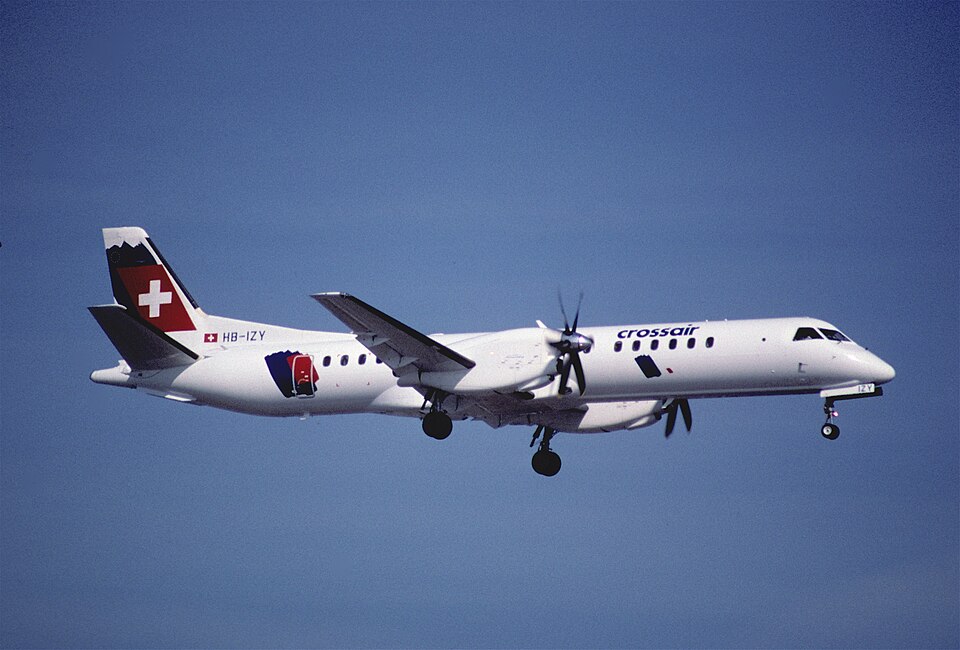
On 23 September 1999, at approximately 16:37 UTC, an air traffic incident occurred between two aircraft in the Zurich area, 18 NM north-east of ROTIS. The first aircraft, CRX518, a Crossair SAAB2000 registered as HB-IZY, was en route from Geneva to Dusseldorf. The second, BZH831, a Britair CL600 registered as F-GRJB, was flying from Munich to Lyon.
CRX518 initially contacted Zurich radar on frequency 133.050 MHz, reporting flight level (FL) 210 climbing to FL240, with a requested cruising altitude of FL310. The controller (RE-Upper1) cleared CRX518 via FRI–TRA–TGO to FL270. Meanwhile, BZH831 was at FL280 on route KPT–TRA–BENEM and was instructed to proceed direct to BENEM.
As CRX518 reached FL270 and requested a higher level, the controller instructed it to maintain FL270, expecting FL280 in about 15 NM, to allow CRX518 to cross with another aircraft (KAC171A) first. Two minutes later, after crossing with KAC171A, the controller cleared CRX518 to climb to FL280. At that moment, CRX518 and BZH831 were approximately 10 NM apart on opposite courses.
Immediately, the controller recognized his error and instructed CRX518 (then at FL276) to descend back to FL270. Simultaneously, he directed BZH831 to turn 15 degrees right. However, based on a Traffic Collision Alert System (TCAS) Resolution Advisory, BZH831 was already climbing. Despite these measures, the aircraft came within 3 NM horizontally and 700 ft vertically.
Findings
- Both aircraft were in radio contact with Zurich radar (Upper 1).
- Both aircraft were in transit through the Zurich region.
- BZH831 was instructed to remain at FL280.
- In the Trasadingen (TRA) region, there were a few cumulonimbus (CB) clouds.
- The Short Term Collision Alert (STCA) at air traffic control signalled very late.
- BZH831 was following a TCAS Resolution Advisory.
Analysis
At the time, traffic was moderate to heavy. Due to CB clouds near TRA, some pilots requested minor course corrections to avoid the hazards.
The controller's plan was for CRX518 and BZH831 to cross approximately 18 NM north-east of ROTIS. He had authorized CRX518 to climb to FL270 because another aircraft (KAC171A) was on a reciprocal course at FL290, about 10 NM ahead of BZH831, and was descending to Geneva.
The controller realized his mistake immediately and was also alerted by the planning controller. He then instructed CRX518 (climbing between FL271 and FL275) to descend back to FL270. Meanwhile, BZH831's pilot received a TCAS alert to climb, which he followed up to FL288. The controller then assigned BZH831 an avoiding heading.
An STCA activated at the controller's workstation at the same time, but by then both controller and pilots had already initiated conflict resolution measures. The controller's initial instruction to CRX518 was imprecise—"maintain FL280" instead of FL270—due to his shock at the situation. He corrected it on the second attempt.
The conflict was resolved through rapid reactions and cooperation.
Cause
The incident arose as a result of a brief lack of attention on the part of the Radar controller, resulting in the fact that BZH831 was for a short time no longer part of his control concept.