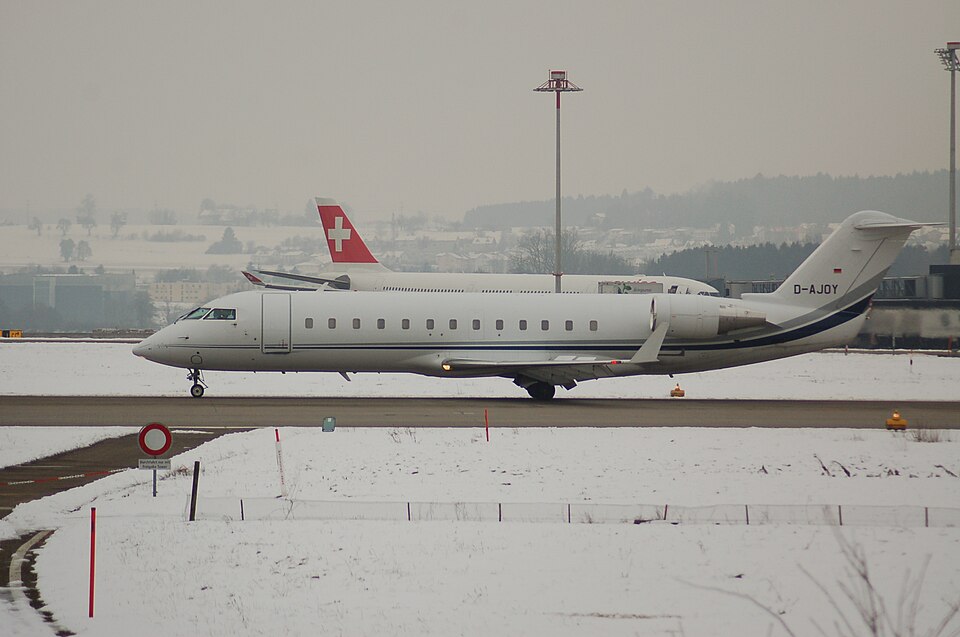
Incident Overview
On 12 March 2016, a Bombardier CL-600-2B19 aircraft, registered D-AJOY and operated by Elytra Charter GmbH & Co. KG, was conducting a commercial charter flight from Tromsø Airport (ENTC), Norway, to Geneva Airport (LSGG), Switzerland. The aircraft carried two flight crew members, one cabin crew member, and ten passengers. The flight was operated under Instrument Flight Rules (IFR) and proceeded without incident until the descent phase.
Sequence of Events
At 13:53 UTC, the crew initiated the descent in clear skies with good visibility. Three minutes later, the indicated airspeeds on the two primary flight instruments began to diverge, along with discrepancies in pitch and roll attitudes. The crew detected the airspeed inconsistency and disengaged the autopilot at 13:58 UTC, but did not notice the attitude discrepancies. For the remainder of the flight, the crew focused on the unreliable left-side airspeed indication. They did not complete the relevant checklist from the Quick Reference Handbook (QRH) and switched the air data source selector multiple times.
At 14:02 UTC, the crew declared an emergency with Geneva ATC, referencing a previous accident of the same aircraft type. The controller's inquiry about weather conditions went unanswered. Control of the aircraft was exchanged between captain and first officer several times without resolving the left-side airspeed issue. At 14:10 UTC, all cockpit indications became congruent again, and the crew informed ATC. The aircraft landed without further incident at 14:20 UTC. Geneva Airport temporarily closed due to the emergency, causing three airliners to divert and 18 flights to hold.
Investigation Findings
The Swiss Transportation Safety Investigation Board (STSB) secured and analyzed the flight data recorder, cockpit voice recorder, and cockpit audio recorder. Flight data were provided to the manufacturer for simulation. The air data systems underwent technical examination.
Data showed that from 13:56 UTC, the left primary instrument's airspeed gradually declined and then failed for about nine minutes. Bombardier's simulation confirmed that the right-side airspeed indications were correct throughout. No water or moisture was found in the air ducts. The cause of the divergent airspeed was identified as a faulty Air Data Computer 1 (ADC1). After the incident, ADC1, both pitot tubes (right side and standby) were replaced, and subsequent system tests revealed no issues.
The attitude discrepancies (up to six degrees pitch and two degrees roll) were within the manufacturer's tolerance. The QRH's abnormal procedures checklist for unreliable airspeed spans over 13 pages, but the air data source selector switch change is only mentioned on page five; the report noted that the QRH did not provide adequate support. The crew's repeated switching of the air data source selector without maintaining the correct position for an ADC1 failure indicated an inadequate procedure. Non-standard ICAO phraseology partially impaired communication with ATC.
Based on these findings, the STSB concluded the investigation with this summary report.