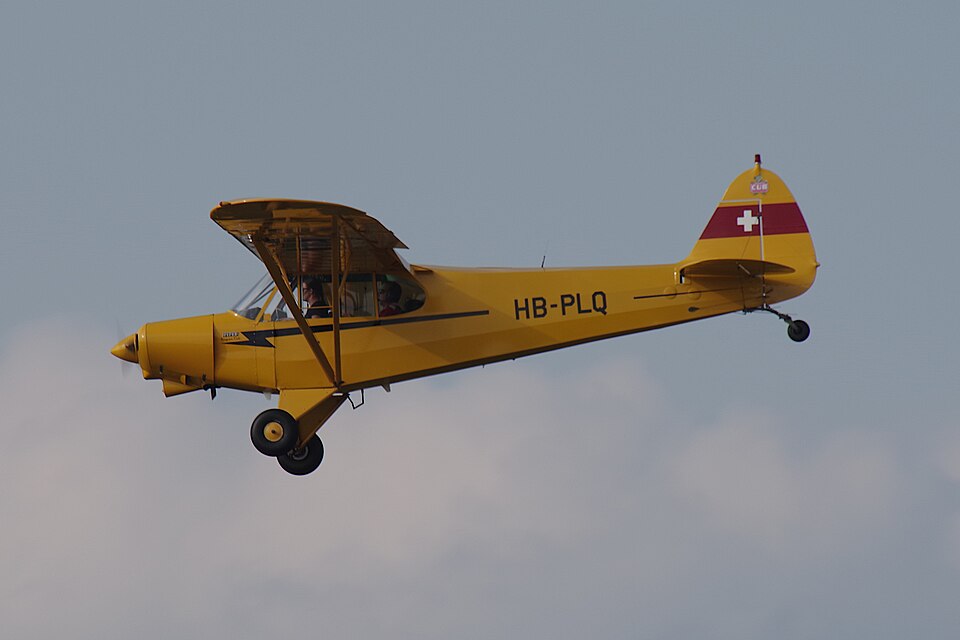
Incident Overview
On September 11, 2017, at approximately 10:14 local time, a Piper PA-18 “150” (Super Cub), registered as HB-PLQ, sustained substantial damage following a runway excursion at Birrfeld Airport (LSZF). The aircraft was operated by Motorfluggruppe Fricktal, based at Schupfart. The two occupants, a flight instructor and a pilot (who also held a Class Rating Instructor endorsement), were not injured. The aircraft’s left wing and left landing gear were damaged, and the airport’s northern perimeter fence was struck.
Training Flight Details
The flight was a continuation of a training session intended to enhance the pilot’s awareness of yaw tendencies in tailwheel aircraft. Before departure, the flight instructor and pilot discussed a series of exercises to be performed during touch-and-go landings, designed to build systematic experience:
- Landings 1–3: Normal landings on the grass runway.
- Landings 4–6: Grass runway landings followed by tailwheel slalom along the full length of the runway to sense yaw tendencies. Each subsequent touch-and-go aimed for a lower roll speed to increase the feel.
- Landings 7–9: Grass runway landings where the instructor deliberately disturbed the aircraft’s longitudinal alignment using rudder inputs, deviating a few degrees left or right. After the pilot took control, he had to realign the aircraft with the runway axis.
- Landings 10–13: Hard surface runway landings with slalom on the main wheels to perceive the difference in behavior between grass and asphalt.
- Landings 14–15: Similar to landings 7–9 but on the hard surface runway.
Loss of Control and Collision
During the 15th landing on hard surface runway 26, despite the previously practiced corrective techniques, the aircraft could not be realigned with the runway axis. It overran the right edge of the runway after taxiway Echo, crossed the northern taxiway, and collided with the airport’s northern boundary fence.
Environmental Conditions
Wind measurements taken at Birrfeld during the touch-and-go sequence indicated a mean surface wind speed of 8 to 15 km/h, with gusts between 18 and 22 km/h. Wind direction varied between 230° and 270°. The investigation noted that it is conceivable that the variation in wind strength played a role during the loss of control on the final landing.
Investigation Findings
The Swiss Transportation Safety Investigation Board (STSB) questioned whether exercises designed to sense yaw tendencies are meaningful.
Probable Cause
Not determined; no probable cause was explicitly stated in the report.