Near-collision with drone during approach to Zurich

Casualties unknown • 20 km SE des Flughafens Zürich, ZH, CH

An Airbus A330 flying from Dar es Salaam narrowly avoided a multi-rotor drone at 5,000 feet during its approach to Zurich.

What happened

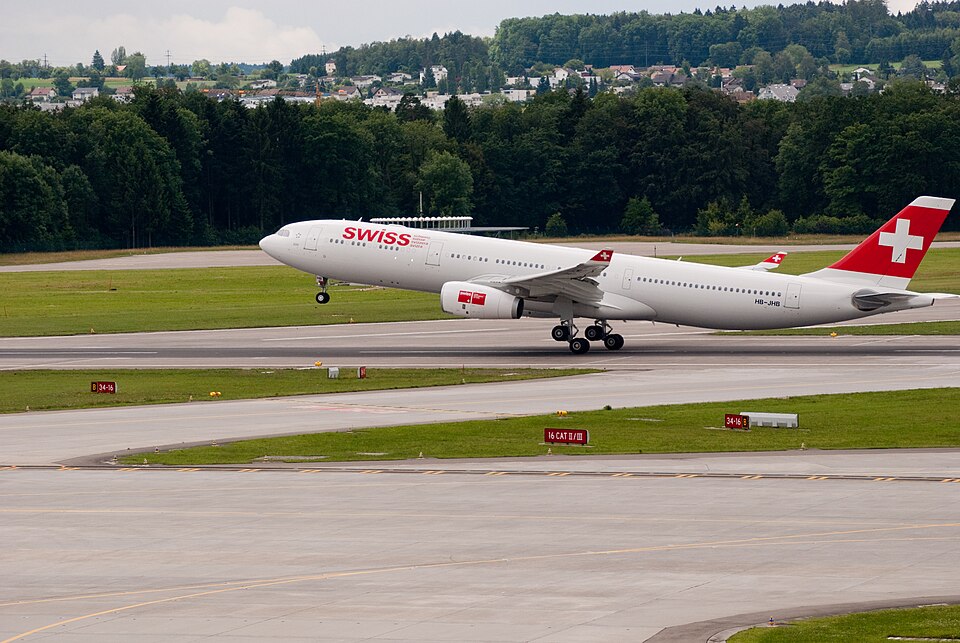
On May 6, 2017, an Airbus A330-343, registration HB-JHB, operated by Swiss International Air Lines, was performing a stabilized ILS approach to runway 34 at Zurich Airport (LSZH). The flight, LX0294, was arriving from Dar es Salaam with 185 passengers and 12 crew members on board.

While on approach, the crew of a preceding aircraft notified Zurich Final approach control that a drone-like object had been spotted approximately 5,000 feet AMSL to the left of the approach path. Shortly after receiving this information, the crew of HB-JHB spotted a multi-rotor drone, approximately one meter in diameter, directly in the approach path at the same altitude. The drone was visible for only about two seconds before the aircraft passed approximately 10 meters beneath it. Due to the extreme proximity and the short duration of visibility, the flight crew had no time to execute an evasive maneuver.

Following the encounter, the crew notified Zurich Final approach control in Swiss German. The aircraft continued the approach and landed safely on runway 3 and proceeded to the stand without further incident.

The investigation

The investigation examined the flight path, weather conditions, and the sequence of events leading to the near-miss. Investigators noted that while visibility was good (40 km) and the weather was clear at the altitude of the encounter, the drone was positioned precisely at the expected approach height of 5,000 feet AMSL near the MILNI waypoint. The investigation also reviewed the communication between the flight crews and the approach controller.

Findings

  • The crew of the preceding aircraft provided a timely warning, yet the high speed of the approach and the drone's position made early visual detection impossible for the crew of HB-JHB.
  • The drone was positioned at a height and location that suggested it may have been deliberately placed to capture close-up footage of approaching commercial aircraft.
  • The use of Swiss German for the report to the controller meant the warning was not accessible to all flight crews in the vicinity.
  • The investigation highlighted that visual detection of unmanned aircraft systems (RPAS) often occurs too late to allow for effective avoidance maneuvers.
  • The presence of a multi-rotor drone of this size poses a significant risk, as an engine ingestion could cause substantial damage or even an engine fire.

Probable cause

The near-collision was caused by the presence of an unauthorized multi-rotor drone positioned directly in the aircraft's flight path at 5,000 feet, which was detected too late to allow for an evasive maneuver.

Frequently asked questions

What happened in the 2017-05-06 AIRBUS S.A.S. A330-343 accident near 20 km SE des Flughafens Zürich, ZH, CH?

An Airbus A330 flying from Dar es Salaam narrowly avoided a multi-rotor drone at 5,000 feet during its approach to Zurich.

What aircraft was involved and where did it happen?

The accident on 2017-05-06 involved a AIRBUS S.A.S. A330-343, registration HB-JHB, at 20 km SE des Flughafens Zürich, ZH, CH.

What was the probable cause of the accident?

The near-collision was caused by the presence of an unauthorized multi-rotor drone positioned directly in the aircraft's flight path at 5,000 feet, which was detected too late to allow for an evasive maneuver.

Investigation report by the Swiss Transportation Safety Investigation Board (STSB / SUST). Original record: https://www.sust.admin.ch/inhalte/AV-berichte/HB-JHB_1.pdf. This page is a structured re-presentation; facts and quotes are in the Swiss Transportation Safety Investigation Board (STSB), Switzerland.
Loading the flight search…