Accident Overview
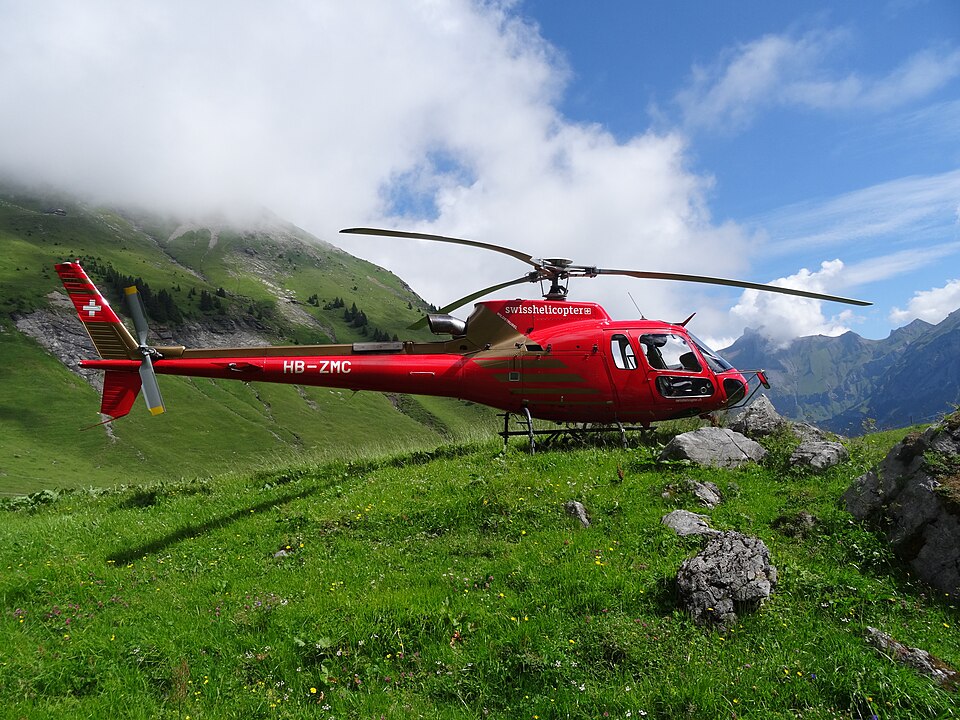
On 25 June 2022, at approximately 11:10 local time, a Eurocopter AS 350 B3 helicopter, registered as HB-ZMC, was involved in an accident at "Underi Heitere" in Diemtigen, Canton of Bern, Switzerland. The helicopter, owned and operated by Swiss Helicopter AG, was destroyed upon impact and subsequent fire. The pilot sustained serious injuries, flight helper 1 was slightly injured, and flight helper 2 was uninjured. No third-party injuries occurred. Ground contamination resulted from fuel spillage.
Flight Operations
At the time of the accident, the operator's base in Gsteigwiler (LSXG) was hosting an open house event, while regular operations continued concurrently. At 10:10, a Contadino flight order was received to recover a dead cow from the "Bodeflue" alp in Diemtigen and transport it to "Underi Heitere" for further handling. The pilot, who was already engaged in sightseeing flights, was assigned the mission along with two flight helpers. The flight helpers received a map excerpt showing cables as obstacles relevant to the mission.
Sequence of Events
The pilot departed Gsteigwiler at 10:58 with both flight helpers on board, heading towards Diemtigen under visual flight rules (VFR) in sunny weather at 16 °C. Shortly before reaching the operational area, the pilot detoured around paragliders after a warning from the Floice obstacle warning system. The Moving Terrain display, which shows obstacles as red lines, depicted the cables at "Underi Heitere".
Upon arrival, the pilot first flew to the pickup location, where flight helper 2 disembarked to prepare the cow for transport. Flight helper 1 moved to the left rear seat. The pilot then headed to the drop-off area near the "Underi Heitere" alpine hut, where flight helper 2 was to attach a 30-metre long line to the helicopter's primary hook. During the approach, flight helper 1 alerted the pilot to the position of a trailer. The farmer's wife, standing near the trailer, pointed to a meadow north of the access road, where transport helicopters had previously landed. However, the pilot chose a landing spot south of the alpine hut, above the road.
Collision and Impact
The helicopter flew a final approach from the northeast towards the selected landing site. Flight helper 1 opened the sliding door to assist during landing. He perceived everything as normal and did not see any cables. Suddenly, he heard a high-frequency noise from the rear of the helicopter and felt it begin to sink. The tail rotor had collided with cables. The helicopter impacted the ground from several metres while rotating clockwise, immediately catching fire.
Flight helper 1 sustained only slight injuries, managed to exit the helicopter on the right side, and pulled the unconscious, seriously injured pilot from the burning wreck. The pilot was wearing a helmet during the flight but was not wearing it when rescued. The Emergency Locator Transmitter (ELT) did not activate upon impact and therefore transmitted no signal.
Aircraft and Obstacle Information
The helicopter HB-ZMC was equipped with a cable cutter system, an obstacle collision warning device, and a Moving Terrain display showing obstacles as red lines according to the aeronautical obstacle map. The obstacle database, maintained by the Federal Office of Civil Aviation (BAZL), includes all reported obstacles 25 metres or more above ground in non-built-up areas. The left obstacle (reference LH 253BE00076), consisting of two cables, was listed as an unmarked obstacle with a maximum height of 35 metres above ground (absolute height 1533.93 m/M). The second, parallel cable was not in the database because its height was less than 25 metres.
The aircraft was not equipped with a crash-resistant fuel system; Airbus Helicopters has offered a retrofit option for the AS 350 B3 since 2020.
Investigation Outcome
The Swiss Safety Investigation Board (SUST) opened an investigation on 29 June 2022. It determined that the accident was not attributable to technical, operational, organisational, or systemic causes. Consequently, the investigation concluded with a fact report aimed at raising safety awareness among affected aviation circles. No probable cause was stated.