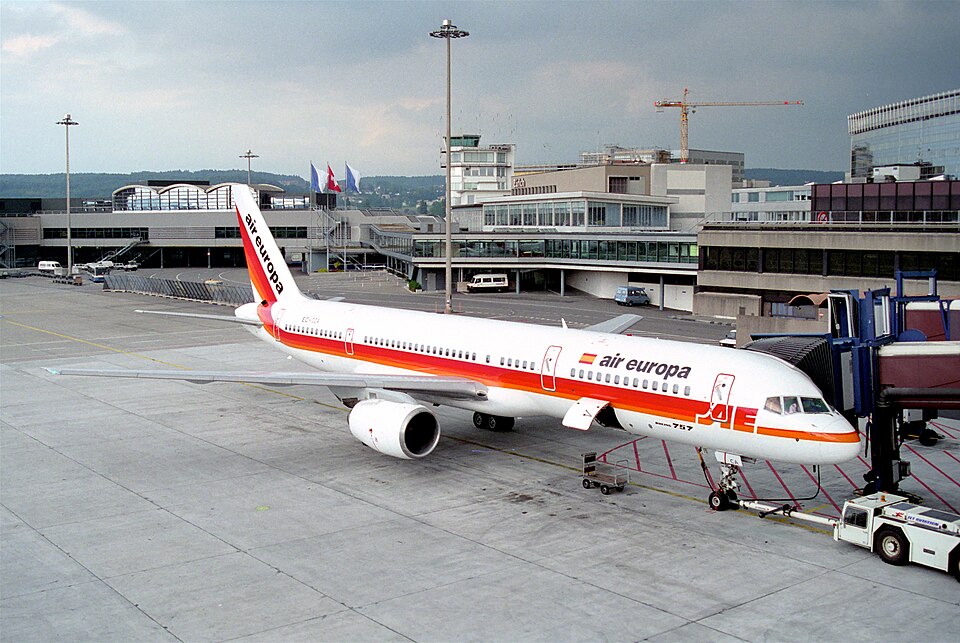
Incident
On 3 October 1999, at 0840 UTC, Air Europa Flight 631, a Boeing 757-200 registered as EC-GCA, was leveling off at flight level 330 during a commercial scheduled flight from Palma de Mallorca when smoke appeared on the left-hand side of the cockpit. The smoke was accompanied by an odor typical of an electrical fire or an overheated electrical motor. The cockpit crew decided to divert to Geneva Airport, where they performed a successful landing. No injuries occurred during disembarkation.
Investigation
The Geneva airport authority notified the Swiss Federal Aircraft Accident Bureau, which opened an investigation the same day under ICAO Annex 13. The crew was interviewed in Geneva, and technical investigation was conducted by SR-Technics with the operator's maintenance staff. On the next day, the Flight Data Recorder (FDR) and Cockpit Voice Recorder (CVR) were sent to Zurich for readout, but the FDR readout was unsuccessful due to tape damage. The French Bureau Enquête Accidents assisted in the investigation, which extended its duration.
Findings
All crew members held valid licences. The aircraft had no prior history of smoke or odor. During the investigation, all electrical fans and equipment were checked. When the windshield heater was switched on, the smoke reappeared, and shortly thereafter the windshield cracked. Electrical resistance measured at terminals J5 to J1 and J4 to J1 of the heater system was approximately 50 ohms, exceeding the maximum of 11.15 ohms. The flex wire conductor from terminal J5 to the bus bar inside the window was fused underneath terminal block J5, with carbonised areas at that location. The control unit's fail-safe provision did not detect the local increase in heating resistance and temperature. The FDR investigation revealed that the tape was damaged, likely due to a direct readout process that caused excessive tape tension, leading to tape flaring and derailment from guide rollers. The time and person responsible for breaking the original seal on the FDR could not be determined.
Cause
The incident was caused by a faulty electrical resistance on a terminal block of the windshield heater system at the left-hand windshield, producing an "electrical smoke."